TL;DR: A flow-builder (ManyChat, Chatfuel, and the classic "constructor" bots) routes customers down branches you draw by hand. It works until someone phrases a question you didn't anticipate — then it dead-ends to the menu. An autonomous agent answers from your knowledge base instead of a script, so the off-script question is the one it's built for. Below: where the tree breaks, what it costs to maintain, what the "20–30% vs 80%" stat actually says, and the cases where a flow-builder is still the right, cheaper choice.
For creators and small teams choosing between a chatbot builder and an AI agent. Updated 2026-07-05.
The takeaways
- A scripted tree matches each message against keywords and conditions you predefine; a paraphrase, a typo, or two questions in one message fall out of the tree.
- The real cost of a flow-builder isn't the monthly fee. It's the branch you build and re-test for every new edge case, on and on.
- "Scripted bots handle 20–30%, AI agents 80%" is repeated everywhere and cited almost nowhere. The defensible version is more interesting.
- Flow-builders genuinely win for bounded, regulated, or must-be-identical answers. Below a threshold, don't switch.
Where a flow-builder breaks
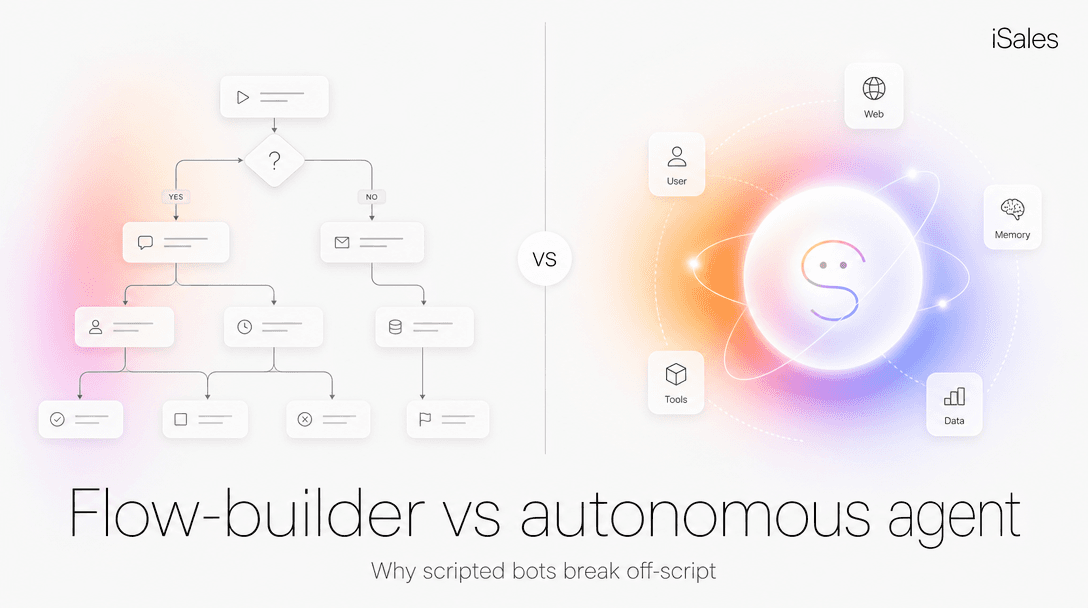
A flow-builder is a decision tree. Each user message is checked against keywords or conditions you set, then matched to the branch you built for it. Inside the branches you drew, it's fast, predictable, and cheap.
The break happens on the first message you didn't draw. A customer types "do you ship to Austin if I order tonight?" and your tree only has a button labelled "Shipping." The bot sees an unrecognized string and does the one thing it can: falls back to the menu, or replies "Sorry, I didn't get that." This isn't a defect in one product. It's how keyword-and-condition routing works — decision-tree bots only understand the inputs they were programmed for (Peripher.AI, 2026). Slang, a two-part question, a follow-up that leans on the previous turn: each is a paraphrase the tree never enumerated.
An autonomous agent handles that same message differently. It retrieves the relevant facts from your knowledge base and composes an answer instead of hunting for a branch. The off-script question is the normal case, not the failure case. That difference is the thing you're actually choosing between — read the pillar guide for the full picture of what a Telegram AI assistant does.
Flow-builder vs autonomous agent, in one table
Copy this and mark the rows that describe your situation. If most of your reality lives in the left column, a builder is fine; if it lives on the right, you're paying the tree tax.
| Criterion | Flow-builder (scripted tree) | Autonomous agent |
|---|---|---|
| Off-script message | dead-ends to the menu / "I didn't get that" | answers from your knowledge base, or hands the thread to you |
| How it grows | you draw every new branch by hand | you add knowledge, not branches |
| Complexity ceiling | hard caps on flows, conditions, sub-flows; the AI is a paid add-on | bounded by your docs, not by the tree |
| Voice | template phrasing, reads robotic | your brand voice |
| Cost basis | monthly fee, often billed by active contacts | pay per action |
| Best for | fixed, bounded, must-be-identical answers | open questions, paraphrases, a growing catalog |
| Where the agent loses | — | predictability, byte-identical answers, deep audit trails / RAG citations |
The last row isn't a formality. An agent trades determinism for flexibility, and there are jobs where that's the wrong trade (more on that below).
The number everyone quotes — and what it actually says
Nearly every "chatbot vs AI agent" post repeats one stat: scripted bots resolve 20–30% of questions, AI agents 80%. It's directionally right and almost never sourced. Here's what holds up, with dates:
- The 80% is a forecast, not today. Gartner projects that agentic AI will autonomously resolve about 80% of common customer-service issues by 2029 — a 2029 prediction, not a measurement of current tools.
- Rule-based bots sit low. Independent benchmark syntheses put rule-based bots without AI below roughly 35% containment, often in a 20–40% band. Treat it as a range, not a precise figure.
- Containment isn't resolution. Up to about one in five "contained" conversations is a customer giving up, not getting helped (Ada, 2026). A tree that "handles 75%" may be closing the window, not closing the loop.
The honest takeaway: the gap between a script and an agent is real, but the headline number is a projection stacked on a metric that flatters bots. If a vendor quotes you a clean "80% resolution," ask what they count as resolution.
What a scripted tree actually costs to maintain
The monthly fee is the small number. The real cost is upkeep. Every question a customer asks that isn't in the tree becomes a task: build a new branch, wire its conditions, and re-test that you didn't break a neighboring path. Decision-tree systems are brittle and costly to maintain as the environment changes (arXiv, 2026) — the tree only stays useful while a human keeps growing it.
The tree also has ceilings. Builders cap how complex a single flow can get: you split logic into sub-flows, you can't always chain steps after certain blocks, and one connection maps to one handle. The AI that would field the off-script question is usually a separate paid tier on top. So the "cheap" builder becomes a base fee, plus an AI add-on, plus your own hours maintaining branches.
The pricing you don't see on the sticker
Flow-builders price by how much your audience engages, not by what you sell. ManyChat cut its free tier to 25 contacts in March 2026 (down from around 1,000); Pro is $29/mo, and the AI features that would handle an unscripted message sit in a separate add-on of roughly $29/mo — a floor near $58 before your list even grows (pricing research-dated 2026-07-05). Chatfuel and similar tools also bill by active contacts, so the invoice climbs as more people message you, whether or not any of them buys.
Per-action pricing inverts that. You pay for the work done, not the size of your contact list. iSales runs on a prepaid balance: a text reply is a few cents of model usage, and new accounts get a free start to test it on a real conversation before paying anything.
When a flow-builder is the right call
Don't switch if your situation is genuinely bounded. If customers ask a fixed set of questions, if the answer must be byte-identical every time (a legal disclosure, a KYC step, a regulated quote), or if your whole process is a short booking or menu flow with a handful of branches — a scripted tree is the correct tool, and usually the cheaper one. Determinism is a feature there: a rule-based flow gives the same auditable answer every time, and an agent swaps that guarantee for flexibility you don't need.
A rough line to test yourself against: if you can list every question a customer asks on one screen and the answers never change, stay on the builder. When the questions are open-ended, arrive in the customer's own words, or grow with your catalog, the branch-drawing never ends — and that's when an agent starts paying for itself.
FAQ
What happens when the agent gets something wrong? It will confidently miss an edge case, especially in its first days on your knowledge base, so plan to skim its early conversations and fix the source docs. This is the real trade for flexibility: a tree is predictable because it only says what you scripted; an agent generalizes, and generalizing sometimes misses.
Does it get more expensive as my audience grows? Billing scales with work done, not contact count, so a growing but quiet list doesn't inflate the bill the way active-contact pricing does. A list that messages constantly will cost more, because it's doing more work.
Can it hand a conversation to a human? Yes, for the moments that need one. The point isn't to remove you; it's to stop the tree from dead-ending the 11pm question before you wake up.
Is my knowledge base private? Your own docs ground the answers. You control what goes in, and you can clear or export it.
Next step
See a demo dialog answer a real question from your niche — the first 30 messages are free, no card. Start in Telegram: launch your AI assistant free.
Sources & last updated
- Gartner — agentic AI customer-service projection (2025). Analyst forecast; 80% figure is a 2029 prediction.
- Ada — containment vs resolution (2026).
- Peripher.AI — decision-tree chatbot mechanics (2026).
- Diagnostic-QA maintenance-cost framing (arXiv, 2026).
- Competitor pricing (ManyChat, Chatfuel) research-dated 2026-07-05 — verify on the live pricing page before relying on exact figures.
Competitor prices checked July 2026 — list prices, subject to change.