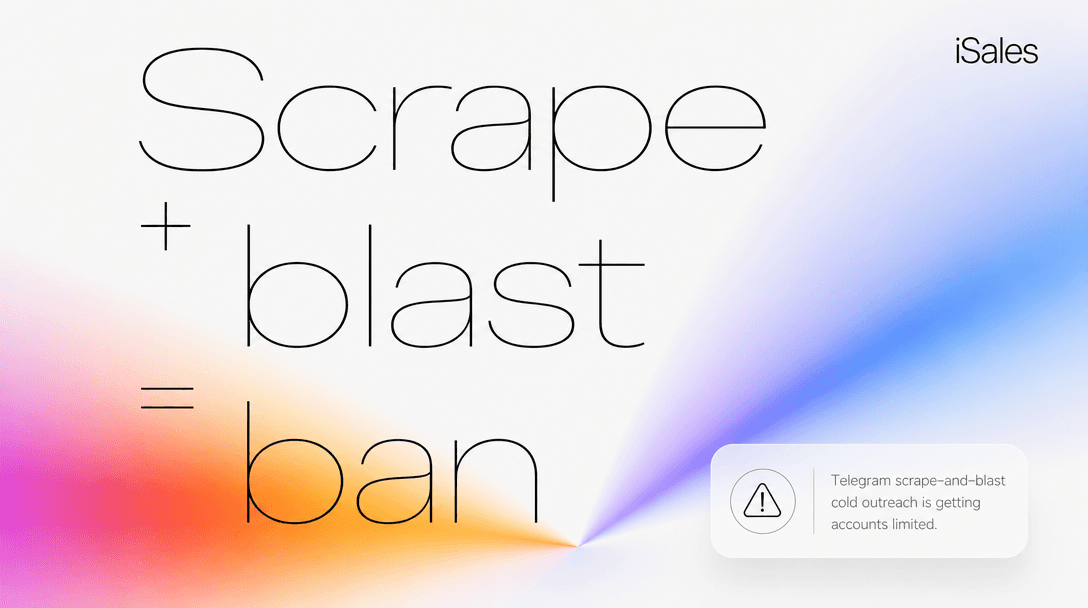
Short version: scraping a public group's member list rarely gets you banned. Firing cold DMs at everyone on that list does. Telegram's spam system runs largely on human reports — recipients tapping "report" on a message they didn't ask for — so the fix everyone sells you (warm the account, add delays, rotate proxies, vary the text) only softens the symptoms. It never removes the one thing that actually triggers a report: you messaged someone who wasn't expecting to hear from you. The durable answer is to change who you contact, not how fast. Wait for a buying signal, then message only the person who sent it.
- Who this is for: anyone doing cold Telegram outreach who keeps losing accounts to "limited" states.
- What's inside: what actually triggers the ban, the three signals moderation reads, why throttling only buys time, the signal-based alternative, and when not to bother.
- Updated: 2026-07-05. Every number below is a figure others report, dated and sourced — not our measurement.
Scraping doesn't get you banned. Blasting does.
The clearest witness here is the industry that sells the blast. TG:ON is a mass-sending tool that markets itself, in as many words, as a way to "automate Telegram without getting banned." Its own journal (June 2026) says the quiet part out loud:
"What gets accounts flagged is the action after scraping: blasting thousands of cold DMs at once. Scrape 5,000 usernames, then fire 5,000 cold DMs in an hour, and you don't have a scraping problem — you have a behavioral problem."
A separate scraping teardown (Clura, June 2026) reaches the same place from the engineering side: Telegram "reads volume and pattern, not the fact that you looked at a public list." Reading a public member list is a low-risk API call. What escalates you from a FloodWaitError (wait a bit) to a PeerFloodError (your account can no longer message strangers) is the pattern of contacting many people who never saved your number.
So the mental model most guides give you, "scraping is risky, buy proxies," points at the wrong thing. The scrape is data collection. The ban is a reaction to a behavior that happens afterwards.
What Telegram's spam system actually reads — the three signals
Telegram doesn't publish its spam rules, but its own Spam FAQ states the governing principle outright: "People usually don't like it when strangers contact them — so they will report you if they find your messages annoying." Moderation is downstream of a human tapping "report." Everything an account does either raises or lowers the chance of generating that report.
Three signals move it in practice, and you can audit all three against your own outreach. This is a working diagnostic, not Telegram's complete model:
| Signal Telegram's system reads | What it is | What warmup / spintax / proxies do to it | Does that remove the trigger? |
|---|---|---|---|
| 1. Recipient reports | Strangers mark your message as spam because they didn't ask for it | Nothing — you're still messaging uninterested people | No |
| 2. Verbatim repetition | The identical text sent to many accounts | Spintax / text variation genuinely lowers it | Partly |
| 3. Cold-contact velocity | Many DMs to non-contacts in a short window | Delays, daily caps and account rotation genuinely lower it | Partly |
Two of those three rows are rows the grey tools genuinely win: varied text and throttled sending do reduce signals 2 and 3. That's why a carefully warmed blaster survives longer than a reckless one.
But signal 1 is the one throttling can't reach, and no amount of warming, spinning, or proxy rotation touches it. If the person on the other end didn't want the message, the report risk is still there. You delayed the arrival of the reports; you didn't prevent them. That one row is the part warmup can't fix.
Why "warm up and blast slower" only buys time
Every ranking guide, including the vendors selling the tools, lands on the same advice: warm the account for a couple of weeks, keep daily volume low, split across accounts and proxies, vary your copy. It's not wrong. It's incomplete, because it's optimizing signals 2 and 3 while leaving signal 1 untouched.
Here are the limits practitioners and vendors report in 2026. Treat them as others' figures, not guarantees — Telegram changes them and never confirms them:
| What others report | Figure (research-dated ⚠️) | Source |
|---|---|---|
Cold DMs to strangers before a fresh account hits PEER_FLOOD (in a burst) | ~50 | Telethon issue #397; StackOverflow #67585847 |
| Spam reports within 24h that can trigger a temporary block | ~5–7 | CRMChat, Jul 2026 |
| New contacts per day a fresh account can add | ~40–50 | CRMChat, Jul 2026 |
| Account warm-up ramp before higher volume | ~10–14 days | CRMChat, Jul 2026 |
| Bot-API send ceiling (a different regime from userbot DMs) | 30 msg/sec overall, ≤20/min to one group | Telethon / grammY error docs |
Notice the reports column: as few as five annoyed strangers in a day can limit an account, per CRMChat's 2026 write-up. One StackOverflow report describes hitting PeerFloodError after roughly fifty messages even with a two-minute gap between each. Spacing bought nothing, because the problem was who was being messaged, not how quickly. Throttling changes the slope. It doesn't change the destination.
The replacement: message a signal, not a list
If reports are the trigger and relevance is the only thing that removes them, the design follows: don't message a list at all. Wait until someone signals they want what you have, then message that person, in context.
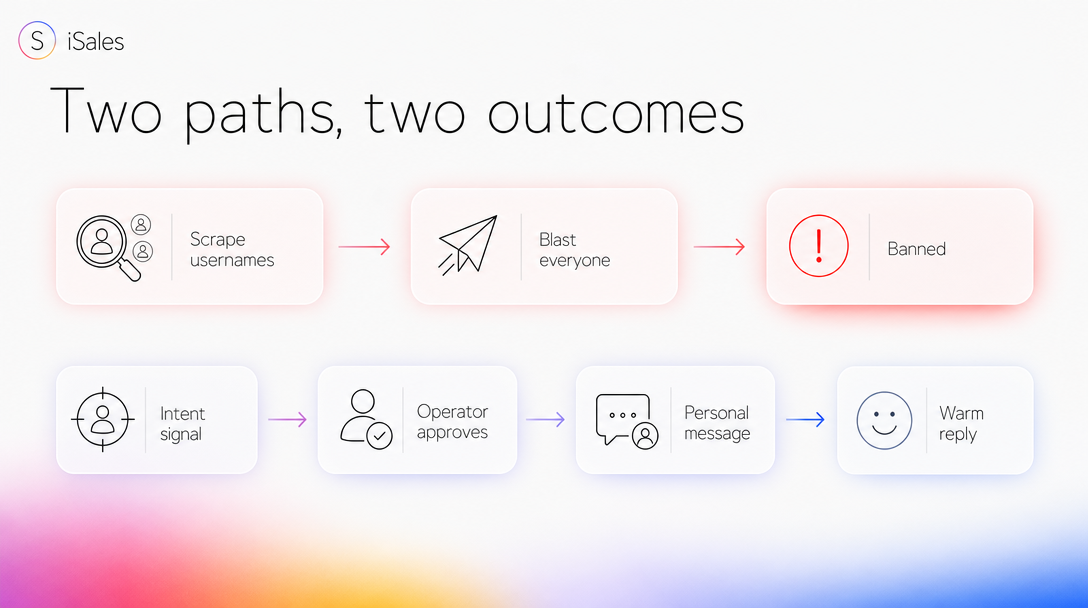 Two paths from the same scraped group: blasting the list maxes out report risk; messaging only a demand signal keeps it low.
Concretely, and as an illustration rather than a case study: picture a marketing group where someone posts, "does anyone here set up Telegram broadcasts?" That message is a demand signal. The safest move is a public reply in the thread, no DM at all. If it does move to a DM, it's because that person raised the topic and expects a follow-up, so your message answers their own question instead of arriving cold. Telegram's guidance is to "only contact people if you're sure they are expecting messages from you," and a signal is how you get to that "sure." It doesn't make report risk vanish, but it sits well below a cold DM to someone who said nothing. Compare the blast path from TG:ON's own example: five thousand identical DMs to five thousand people who said nothing, signal 1 at its maximum, and a limited account by lunchtime.
This is the lane the whole search results page misses. Every page tells you to blast better. None tells you to blast less and wait for intent. That's the model a signal-based Telegram agent is built around: it waits for the intent signal before contacting anyone (signal 1), and only then warms each account gradually and caps its daily volume on a dedicated per-account proxy (signals 2 and 3), with every message held for your approval first. The point isn't more sending. It's sending only where a report was unlikely in the first place. That is what "ban-safe by design" means: it lowers risk, and no tool can promise more than that.
When you don't need any of this
A signal-based agent is slower and lower-volume by design, and it costs money to run. Three situations where it's the wrong tool:
- You already have warm inbound. If people are messaging you first — from ads, a channel, referrals — your job is to answer well, not to hunt. Outbound may be solving a problem you don't have.
- You send a handful of DMs to people who already know you. Under roughly five to ten messages a day, from an aged account, to warm contacts, you don't need warm-up schedules or an agent. Send them by hand.
- You genuinely want raw blast volume and accept the cost. If your model is disposable accounts and pure throughput, a free Chrome-extension blaster is cheaper than a per-account proxy and a paid balance. It will burn accounts faster — that's the trade you're choosing, and it's a legitimate one for some operations. It just isn't this.
If none of those fit — you sell something considered, your buyers live in Telegram groups, and torched accounts are a real cost — the signal model is the one we'd expect to compound instead of degrade.
FAQ
Does scraping a public group violate Telegram's rules? Reading a public group's participant list is a standard API call and is low-risk on its own (Clura, 2026). What draws enforcement is what you do next — mass-contacting or mass-inviting those people. Separate the two in your head; the platform does.
How many cold DMs a day is "safe"?
There's no safe number, only reported ones: fresh accounts are described hitting PEER_FLOOD around fifty messages in a burst (Telethon #397), and ~5–7 spam reports in a day can limit you (CRMChat, 2026). All research-dated and unofficial. Volume is the wrong dial anyway; relevance is the one that moves the trigger.
Does Telegram Premium remove the limits?
Premium can lift some rate limits (FLOOD_PREMIUM_WAIT), but it does not stop report-based moderation. A Premium account blasting strangers still collects reports.
My account is already limited — now what? Limited accounts can still message people who have your number saved and can always reply to anyone who wrote to you first; you can appeal through @SpamBot (Telegram Spam FAQ). Then change the model, or you'll be back.
Is "no-ban" software real? No vendor can guarantee it, and some admit as much. TG:ON's own article notes "no tool guarantees 100% protection from bans" while its homepage advertises exactly that. Read the disclaimer, not the headline.
Sources (research-dated 2026-07-05): Telegram Spam FAQ (telegram.org/faq_spam); Telegram API errors (core.telegram.org/api/errors); Telethon & grammY error docs; TG:ON journal, 2026-06-13; Clura, 2026-06-22; CRMChat, 2026-07-03; Telethon issue #397; StackOverflow #67585847. Competitor and community figures are others' reported numbers, not our own measurements.
Want the signal-based model instead of a faster blast? Launch the agent (pay-as-you-go) — it watches groups for intent, warms up, and DMs only on your approval.