TL;DR: You can sell a photo, video or file for Telegram Stars inside a chat in three steps, and buyers pay in one tap without a card. Cashing out is where money leaks. Stars only convert to real money through Fragment, Telegram's official route, which needs a 1,000-Star minimum and a 21-day hold, then pays out in TON that you swap to USDT. Two separate fees decide your take: the ~30% app-store fee on Stars bought in the mobile app, and a ~6–8% withdrawal stack. Above a certain ticket size, invoicing on your own card or crypto rail keeps far more, and the smartest setup runs both in the same chat.
- Who this is for: creators and experts who already have a Telegram audience and want to sell digital content or paid access without pushing people to a separate store.
- What you'll get: the real sell-and-withdraw steps, the two fee stacks most guides blur, a fill-in net-take calculator, and the line where your own payment rail beats Stars.
- Last updated: 2026-07-05.
The two fee stacks most guides blur together
Most "how to withdraw Stars" guides quote one number. There are two, and they hit at opposite ends of the sale.
Stack one is the buy side. When a customer buys Stars inside the iOS or Android app, Apple and Google take their standard ~30% cut on that purchase. That markup sits on the buyer's side: it inflates what they pay, and none of it reaches you. It applies only to Stars bought in the mobile app. On Telegram Desktop or web there is no app-store cut, so the same 1,000⭐ costs the buyer roughly a third less to fund.
Stack two is the cash-out side. Getting Stars back to money runs through Fragment, and that path has its own costs: a Fragment conversion fee around 5%, a small TON market spread, and an exchange fee when you sell TON for USDT. Call it ~6–8% all-in on a normal day. This stack is unavoidable and it applies to every creator on every tool, including this one. Nobody has a secret rate on Fragment.
Put the two together: of what a mobile buyer pays, only about 60% reaches your USDT wallet, while a desktop-funded sale lands closer to 90%. Rates drift, so treat every percentage here as a 2026 market range, not a guarantee.
Sell content for Stars: the actual steps
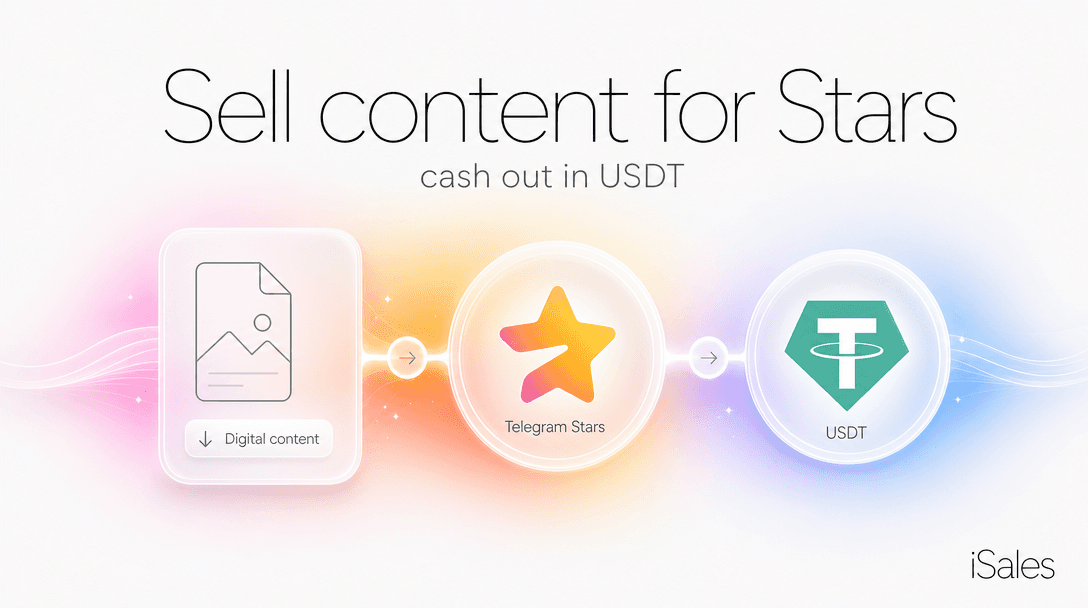
Selling for Stars is three steps, and only the last one touches crypto.
- Add the item you're selling: a photo set, a video, a file, a gated guide, or a paid answer.
- Set the price in Stars. As a rough peg, a buyer spends about $20 to send you 1,000⭐ when buying in the mobile app, and less on desktop.
- Connect a payout wallet once (a TON/USDT address).
After that the buyer taps pay, gets the file in the same chat, and your Stars balance goes up. There is no separate storefront and no redirect to someone else's site. The conversation is the checkout.
Stars work best on cheap, impulse content: a preset pack, a single video, a short guide someone grabs in one tap. For anything expensive, keep reading. Stars stop being the cheap option fast.
Cashing out: the Fragment reality (1,000-Star minimum, 21-day hold)
Stars don't withdraw to a bank. They convert to TON through Fragment, and you swap TON for USDT. Two rules catch first-time creators:
- 1,000-Star minimum. You can't withdraw a smaller balance, so your first few sales sit until they clear the floor (1,000⭐ is about $13 of payout value at recent ~$0.013/Star rates, before the Fragment fee).
- 21-day hold. Each Star is locked for 21 days from the moment you received it. Newly earned Stars are not immediately withdrawable.
The route is Settings → My Stars → Withdraw → Fragment → TON → exchange → USDT. Two practical notes from creators doing this in 2026: TON is the cheapest hop out, and if you want USDT specifically, withdraw on the TRC-20 (Tron) network rather than ERC-20 (Ethereum), where gas can cost several dollars for the same transfer.
The net-take calculator
Copy this and put in your own numbers. The percentages are 2026 market ranges (your numbers, not ours), so check the live rates the day you set a price.
| Line | Your number | Example: a 1,000⭐ item |
|---|---|---|
| What the buyer pays to fund it | ___ | ~$20 on mobile · ~$13 on desktop/web |
| Telegram credits you (payout ~$0.013/⭐) | ___ | ≈ $13 |
| − Fragment withdrawal (~5% + spread + exchange, ~6–8%) | ___ | ≈ −$1 |
| = Lands in your USDT wallet | ___ | ≈ $12 |
| The same item priced at $20 on your own card/crypto rail (~3–4%) | ___ | ≈ $19.20 |
Two things jump out. Your payout is about $12 whether the buyer funded on mobile or desktop; the extra ~$7 a mobile buyer pays is the app-store fee, and none of it reaches you. And a 1,000⭐ item you think of as a "$20" product actually nets ~$12, while the same $20 on your own rail nets ~$19. The gap scales with the ticket: a ~10,000⭐ item (about $200 to a mobile buyer) nets you roughly $120 after fees, versus about $192 on your own rail.
The table leaves one thing out on purpose: Stars can lift conversion. One-tap payment with no card entry closes more impulse buys than a redirect to a checkout, and on cheap content that lift can outweigh the fee. Don't fold a conversion guess into the fee math. Keep the certain cost (fees) separate from the uncertain upside (more buyers).
Stars vs your own rails: the decision line
The line: below roughly a $15–20 ticket, and for impulse content, Stars usually win on convenience even after fees. Above it, and for services or high-value files, your own payment rail keeps meaningfully more.
Here is where the tools actually differ, and where this one loses a row.
| Capability | Native Stars / Telestars | Custodial payment bot | Direct-USDT tool (GramBase-style) | This assistant |
|---|---|---|---|---|
| Sells content for Stars, delivered in chat | ✅ | partial | ❌ | ✅ |
| Invoices on YOUR own card/crypto rail | ❌ | ❌ (holds funds) | ❌ | ✅ |
| Consults and converses in the same chat | partial | ❌ | ❌ | ✅ |
| Direct USDT capture, skipping Fragment + 21-day hold | ❌ | ❌ | ✅ (~2.5%/txn, 2026) | ❌ (Stars mode still uses Fragment) |
| Simplest setup for one cheap item | ✅ | partial | partial | ❌ |
The fourth row is the one this assistant loses. If all you want is to capture USDT directly at the lowest flat fee with no hold, a non-custodial direct-USDT tool at ~2.5% per transaction (2026 range) beats an assistant, because Stars mode still rides Fragment's fee and 21-day hold like everyone else. What an assistant adds is the combination the other three don't offer together: it sells your content for Stars and invoices on your own payment systems, in one chat, so you route each sale to the cheaper rail without running two tools.
When NOT to use an assistant for this
If you sell one cheap file once in a while and never invoice for services, don't add an assistant yet. Telegram's native Stars payment, or a focused Stars shop like Telestars, already does that job. An assistant earns its place when you're doing two things at once, selling impulse content and charging real money for consults or high-ticket access, and you're tired of Fragment eating a third of the big ones.
Common mistakes
- Withdrawing USDT on ERC-20. Ethereum gas can cost several dollars; TRC-20 is a fraction of that for the same stablecoin.
- Running a big ticket through Stars. A multi-hundred-dollar consult sold for Stars pays the store fee and the withdrawal stack on the whole amount. That is a candidate for an invoice, not Stars.
- Pricing before you count both stacks. Many creators budget only the ~6–8% withdrawal and miss the ~30% mobile store fee. Count both before you set the price.
- Forgetting the 21-day hold. If you're counting on that money this week, it may not have cleared yet.
FAQ
Does the buyer need crypto or a wallet to pay in Stars? No. The buyer taps to pay with Stars inside Telegram. Crypto and a wallet are only your side, and only at withdrawal.
What's the minimum to withdraw Stars? 1,000 Stars (about $13 at recent payout rates), and each Star is held for 21 days from when you received it.
Stars to USDT or TON, which is cheaper? TON is the cheapest hop, and Fragment pays out in TON. If you need USDT, convert on TRC-20 rather than ERC-20.
Does buying Stars on desktop really avoid the 30%? The app-store cut applies to in-app mobile purchases. Desktop and web top-ups aren't subject to Apple/Google's fee, so the same sale is cheaper to fund there.
Can I avoid Stars entirely? For services and high-ticket items, yes: invoice on your own card or crypto rail and skip the Stars stack. For cheap impulse content, Stars' one-tap checkout is usually worth the fee.
Next step
If you want one setup that sells content for Stars and invoices on your own payment rails from the same chat, you can try it on your first 30 messages free: open the assistant in Telegram. The pricing page shows the rails and per-action costs.
Sources & last updated
- Telegram Stars withdrawal mechanics, Fragment route, 1,000-Star minimum, 21-day hold, ~$0.013/Star payout rate — creator guides and price calculators, research-dated 2026-07-05 (StarsEarn, GramBase, Telestars, InviteMember). ⚠️ Rates and rules drift; re-verify before pricing.
- App-store ~30% fee on in-app Stars purchases and the desktop exemption — Telegram Stars documentation and Apple/Google in-app purchase policy, 2026.
- USDT network costs (TRC-20 vs ERC-20) — network fee explainers, 2026.
- Product mechanics (sell for Stars, connect a payout wallet, invoice on your own rails).