Short answer: "publish everywhere" is a solved problem. A dozen tools connect your accounts and fan one post out to all of them, and most now show per-platform analytics and let you reply to comments in an inbox. So the scheduler choice is the easy part in 2026. The harder question is whether a single tool makes the post, publishes it, and answers the people it earns, or whether you're paying three subscriptions to hand one post between them. Need a deep calendar, a best-time engine, and approval workflows? Buy a specialist scheduler. Would you rather not stitch a generator, a scheduler, and a reply inbox into three logins? That's a different purchase, and this guide is about that seam.
This is the hub for our publishing coverage. It maps the whole topic and links down to the deep-dives. Skip to the section that matches your question.
What "publish everywhere" actually means in 2026
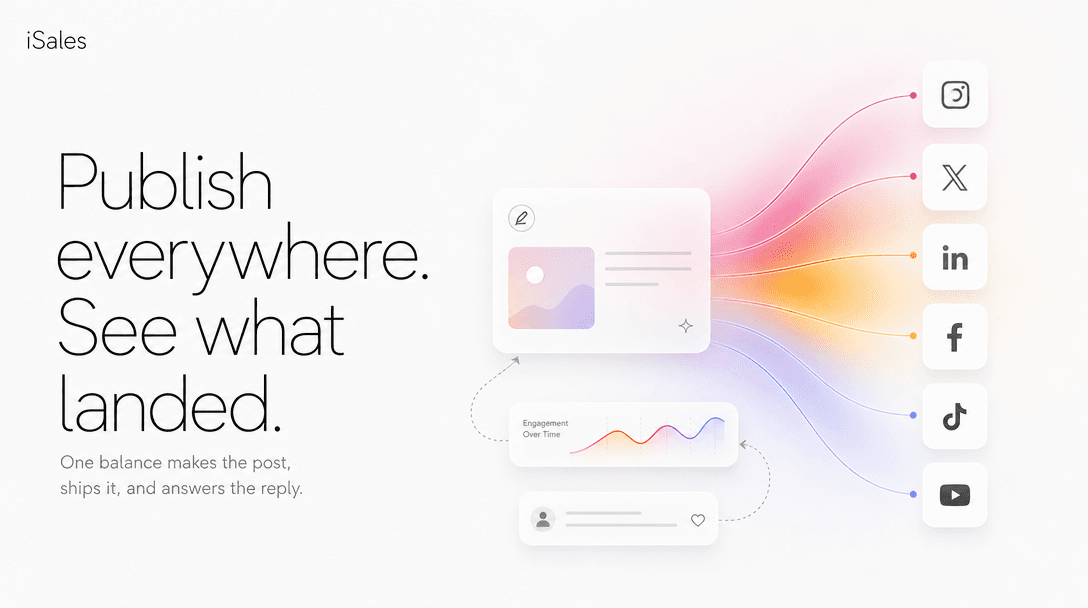
The job has four steps, and any serious tool covers the first three:
- Connect your accounts once (OAuth): Instagram, Facebook, LinkedIn, X, TikTok, YouTube, a Telegram channel.
- Publish one post to all of them from a single window, instead of copy-pasting into eight apps.
- See what landed: per-platform reach, engagement, which post worked.
- Answer the people who reply, comment, and DM.
Tool round-ups stop at step 4, and they mislead by implying step 4 is missing from schedulers. It isn't. The popular "no scheduler answers your audience" line is simply false in 2026.
The seam the round-ups miss
Modern schedulers reply to comments. Agorapulse markets "reply to every comment" and puts a unified inbox on every plan. Hootsuite's Nest inbox handles public and private messages across networks. Buffer bundles a Community inbox, Metricool includes an Inbox on its entry tier, and on the Russian side SMMplanner and Postmypost ship comment inboxes too. So if a page tells you "publish here, but nobody answers the engagement," close the tab.
The real gap is quieter and structural. The tool answering the comment didn't make the post. It's a separate product, separate login, and separate bill from whatever generated the content. Your caption came out of one AI writer, your image out of another, a scheduler pushed it live, and an inbox (maybe the same scheduler, maybe a fourth tool) handles the replies. Four tools, and the seam between "made it" and "answers for it" is held together by you, at 11pm, tabbing between dashboards. That tabbing is the tax worth removing. The reply button was never the missing piece.
Two questions cut through the marketing:
- Provenance: did the tool publishing this actually make it, or is it a relay for content produced somewhere else, in a voice it never learned?
- The loop: does one balance carry the whole path (make, publish, see what landed, answer), or does each handoff cross a subscription boundary?
The map: scheduler depth vs closing the loop
Plot any tool on two axes. Horizontal: scheduler depth (calendar, best-time, approval workflows, competitive reporting). Vertical: loop closure (does one balance make the post, publish it, and answer the engagement?). Most tools cluster in one quadrant, and it isn't the one their homepages imply.
| Open loop — make → publish → answer span separate products/logins; a bolted-on AI caption isn't the whole post | Closed loop — one balance makes the post and answers who engages | |
|---|---|---|
| Deep scheduler (calendar, best-time, approvals, reporting) | Buffer, Metricool, Hootsuite, Agorapulse, SMMplanner: win on depth; some add AI captions, but the finished post (image + brand-voice text) is assembled elsewhere and the reply is a separate login | Sparse: deep scheduling and whole-post generation on one balance are usually built by different companies |
| Light scheduler (connect, publish everywhere, per-platform "what landed") | basic free auto-posters | iSales: concedes calendar depth; the same balance generated the post in your voice and answers the comments |
The concession comes first. We sit in the bottom-left of the depth axis on purpose. If your work is a content calendar three weeks deep with an approval chain and best-time scheduling, the top-left quadrant beats us outright. That is not our fight. The claim is narrow: we hold the vertical axis, so the same place that wrote and made the post publishes it and answers the reply, on one balance, and the seam never becomes your 11pm job. Screenshot the grid and drop your own stack onto it. Wherever your tools straddle two quadrants is the seam you're currently paying for twice.
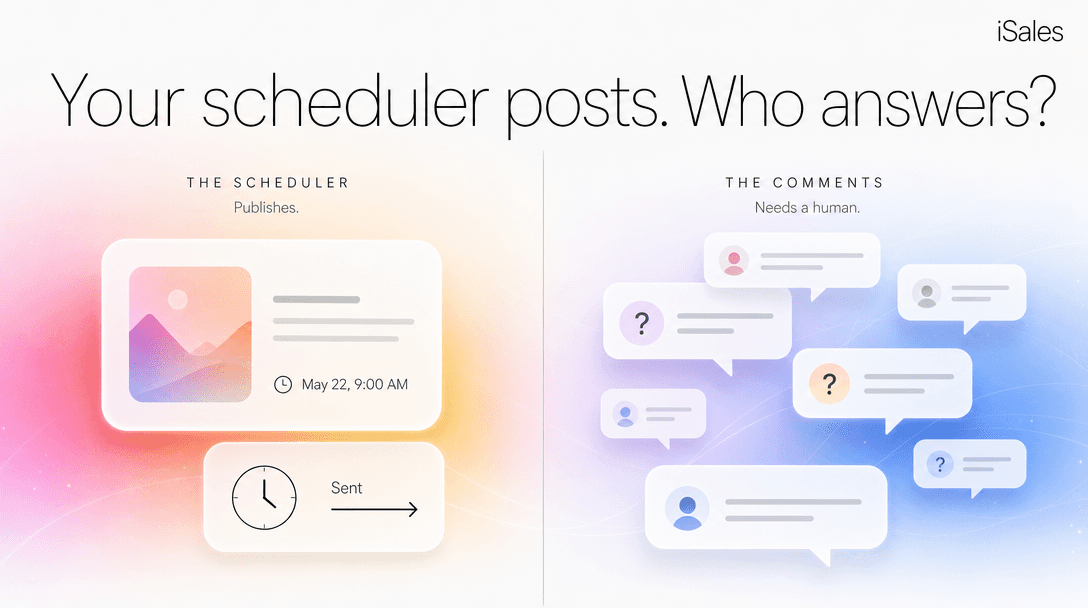
That is the through-line of everything below. For the argument in full, the companion piece your scheduler posts — who answers the people who engage? takes just the reply half apart.
Five logins or one balance
Depth costs money per specialist, and the bills stack sideways. Research-dated mid-2026, entry tiers look like this:
| Tool | Entry price (2026) | What it does | Reply inbox? |
|---|---|---|---|
| Buffer | from $6/channel/mo ✅ | publish + AI captions | Community inbox (bundled) |
| Metricool | Starter ~$25/mo ✅ | publish + analytics | Inbox (X = add-on) |
| Hootsuite | Standard $99/user/mo (annual) ⚠️ | publish + deep reporting, 10 accounts | Nest inbox |
| Agorapulse | $79/user/mo ✅ | publish + listening | unified inbox (all plans) |
Prices read 2026-07-05: ✅ from the vendor's own pricing page, ⚠️ from a secondary source (Hootsuite's month-to-month runs higher). List prices drift — verify before acting.
Now add the tool that actually wrote the post and made the image, a separate generation subscription, and the seam becomes a fourth line item. Run five channels through Buffer (~$30/mo), pay for a generator, and add a standalone analytics view: that's three logins before anyone answers a comment. The certain cost is the stack of subscriptions and logins, and it grows sideways with every channel and every capability you bolt on. Tally your own:
| Line item | Your monthly cost |
|---|---|
| Content generator | |
| Scheduler (× channels) | |
| Analytics / reporting | |
| Reply inbox (if a separate tool) | |
| Total — tools and logins |
The bundle runs the other way. Publishing across every connected network is a $20/mo add-on (≈1,000 Telegram Stars, or roughly $200/year), and publications aren't metered, so it's one price whether you post five times a week or fifty. It sits on the same prepaid balance that generates your content and runs your assistant, priced per action, with the first 30 messages free to try. In stack terms, that's one fewer subscription and one fewer login. For the itemized math, the stacked-tools cost breakdown fills the table above with worked numbers.
Provenance: the reason this stops being optional
There's a timing reason the "who made this" question is moving from nice-to-have to operational, and it's worth one section.
From 2 August 2026, the EU AI Act's Article 50 makes AI-content transparency a legal duty, and it splits the duty in a telling way. Article 50(2) binds providers, the tool that generates the content, to ensure outputs are "marked in a machine-readable format and detectable as artificially generated or manipulated." Article 50(4) binds deployers, whoever publishes, with a narrower duty: disclose AI-generated deepfake images, audio, or video, and disclose AI-written text published to inform the public on matters of public interest, unless a human reviewed it. The pattern is the point: the machine-readable mark is attached at generation, by the tool that made it; the human-facing disclosure sits with the publisher, and only in defined cases.
The plumbing already exists. C2PA "Content Credentials," cryptographically signed provenance metadata, are emitted by the major generators (Adobe Firefly, OpenAI's image models, Google's Gemini/Imagen) and read by platforms. TikTok and LinkedIn adopted them in 2025, and YouTube's auto-labeller began reading them in 2026 (adoption figures reported by the standards body and trade press, not settled fact). Other jurisdictions are drafting the same idea. Russia's Минцифры published a marking draft in March 2026, though it's contested and not yet law.
The structural point: because the mark must be embedded at generation and survive downstream, the tool that made the content is the one best placed to carry its provenance, which is exactly how the EU's provider-side obligation is written. A relay that publishes content it didn't make starts a step behind on a duty that's now dated.
When a standalone scheduler is the right call
Buy the specialist, not the loop, if:
- You run 8+ brand accounts with an approval chain. Publishing needs roles, drafts, and sign-off you shouldn't route through a light tool.
- Best-time scheduling, link-in-bio, and competitive reporting are core to your week. That depth is a real product, and we don't match it.
- Your content is made elsewhere and won't move. If generation lives in a design team or an agency, the provenance argument doesn't apply to you, and a good scheduler is a good scheduler.
Under those conditions the depth wins and the seam doesn't cost you much. The loop pays off when you're one person (or a small team) making the content and answering for it, and the tabbing is the tax.
The map of sub-topics
This pillar links down to the deep-dives. Start here, then go where your question is:
- Who answers the engagement: your scheduler posts; who answers the comments?
- Running it solo, week by week: the weekly publish-and-reply workflow for one person
- What it costs, itemized: stacked social tools vs one balance
- What makes the post: the content engine that generates and publishes
- Who answers the DMs it earns: the AI assistant behind the replies
(A few sub-topic guides, covering post-to-lead, in-window analytics, a Buffer/Metricool/Hootsuite face-off, and the provenance deep-dive, are publishing shortly. This map updates as they land.)
FAQ
Does this replace my scheduler? Not on depth. If you live in a deep calendar with best-time and approvals, keep it. It replaces the stack, the generator plus scheduler plus reply-inbox seam, for people making and answering their own content.
Which networks can I publish to? The major networks via official OAuth (Instagram, Facebook, LinkedIn, X, TikTok, YouTube) plus your Telegram channels. Connection is a couple of taps, with no per-post fee.
Is the analytics as deep as Metricool or Hootsuite? No. Specialist reporting goes deeper. Ours answers the one question that drives the next post, "what landed, per platform," in the same window where you made and published it. The value is zero context switches while you work.
Does it help with AI-content disclosure? Because the content is generated in the same tool that publishes it, the provenance sits at the source rather than in a relay, the structurally right place under Article 50's provider-side marking duty. Disclosure to your audience is still your call as the publisher; no tool removes that.
What does it cost at volume? Publishing is flat and unmetered, so volume doesn't change it — the $20/mo add-on covered above. Content generation and replies draw on the prepaid balance next to it, priced per action.
The next step
If your posts are already made in one place, publish them from there too, and let the same tool answer the people they earn. Connect your socials and publish to every network from one window.
Sources: EU AI Act, Article 50 (transparency obligations, applies 2 Aug 2026); EU Commission — Code of Practice on AI-generated content (2026-06-10); C2PA / Content Authenticity Initiative; vendor pricing pages for Buffer, Metricool, Hootsuite, and Agorapulse, all read 2026-07-05. Competitor prices are mid-2026 list prices and drift; verify before acting. Our own $20/mo publishing add-on and free-tier terms are on the pricing page and may change. Last updated: 2026-07-05.