TL;DR: An AI sales agent has two popular failure modes. "Full autopilot" gives it no oversight, and a probabilistic model left alone will eventually send a confident, wrong message to a real prospect. "Approve everything, forever" gives it total oversight, and you quietly stop reading the queue and rubber-stamp. The third path is managed autonomy: the agent starts on probation, you approve its moves, and it climbs an autonomy dial (1→2→3) only for the actions it has proven it can be trusted with. Below is how the dial works and a portable test for deciding what to promote.
- Who this is for: B2B sellers and operators weighing an AI SDR for Telegram who don't want a black box.
- What you'll get: the two-failure-mode frame, the three real autonomy levels, and a reusable promote-or-gate checklist.
- Last updated: 5 July 2026.
Two failure modes, one third path
Most "AI SDR" pitches ask you to pick a side, and both sides lose you something.
Full autopilot hands the model the keys on day one. The problem isn't marketing hype; it's arithmetic. Language models are probabilistic; they guess, and on niche or recent facts they guess wrong a meaningful share of the time. In outreach that surfaces as an agent fabricating a prospect's job title or referencing a company event that never happened, the kind of error that, as one 2026 SDR review put it, "destroys credibility when caught." Reviews of the autonomous-SDR category through 2025–2026 have been rough enough that most fully-hands-off deployments reportedly don't stick. You can't correct what you can't see, and a black box shows you nothing until the reply-rate graph is already falling.
Approve everything, forever looks like the safe opposite, and for a week it is. Then the human cost arrives. HITL practitioners have a name for what happens next. Strata's 2026 oversight guide calls it automation complacency: "humans over-trust systems, rationalize anomalies, and stop questioning outputs," and "the more reliable a system appears, the less vigilant its human overseers become." Twenty green approvals in a row and the twenty-first gets a reflexive tap. Total oversight decays into no oversight, just with worse ergonomics.
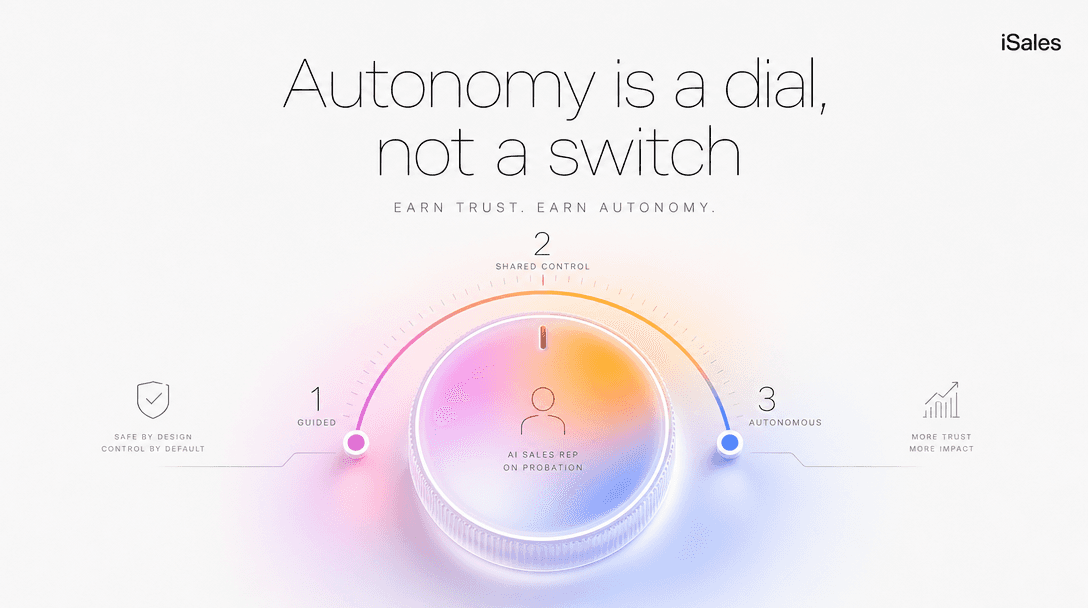
The fix isn't a smarter switch. It's turning autonomy into something you grant in degrees rather than flip on. The revenue-ops teams that make this work start assisted and earn their way to automated: the agent suggests, a human approves the low-risk classes, and scope expands only as reliability is proven. Autonomy is a dial you turn as trust is earned, not a setting you flip on install.
What "managed autonomy" actually means
Managed autonomy means the agent runs, but the amount it's allowed to do without asking is a level you raise deliberately. In practice that's three real settings:
| Level | Name | What it means |
|---|---|---|
| 1 | One-prompt | You describe the goal; the agent plans and proposes. Nothing goes out without you. |
| 2 | Supervised | The agent works continuously, and every outbound action routes through an approvals queue: you see the drafted message, the signal it fired on, and its reasoning, then approve, edit, or skip. |
| 3 | Expert | The agent acts on the classes you've promoted, and surfaces only the exceptions: the edge cases and low-confidence calls. |
Picture the supervised level in practice. Someone in a niche group posts "has anyone actually used [tool] for onboarding?" The agent flags it as a buying signal, drafts a reply that answers the question and mentions what you do, and drops the whole thing in your queue: the message, the signal it fired on, and its reasoning. You read it in ten seconds and approve, edit a line, or skip. Nothing reached the stranger until you said so.
So the queue isn't a permanent tax; it's the probation period. Level 2 is where you watch the agent work and build the evidence to promote it. The point of managed autonomy is to move classes of action from "ask me first" to "just do it" one at a time, on proof, so oversight shrinks where it's earned and stays exactly where it's needed. That is the opposite of both a black box and an endless queue.
The Promotion Test: when to gate, when to promote
This part travels. Whatever tool you use, deciding which actions an agent should ask about is the same four questions, a compressed version of how HITL designers reason about interruption. Score each action type your agent performs; the more boxes it fails, the longer it stays gated.
| Action the agent takes | Reversible? | Scope | Cost if wrong | Confidence | → Gate or promote? |
|---|---|---|---|---|---|
| Classify a group message as a buying signal | Yes (internal) | Internal only | Low | High after ~a week | Promote early |
| Draft a first DM to a stranger | No (it's sent) | External, your account | High (spam flag, ban) | Builds slowly | Gate longest |
| Reply inside an ongoing, warm thread | Partly | External, one person | Medium | Rises with context | Promote mid |
| [your action] |
Read the columns as a policy: irreversible + external + high-cost + not-yet-confident stays gated; reversible + internal + low-cost + proven gets promoted. A first cold DM fails three of four for weeks, so it's the last thing you hand over. Signal classification is reversible, internal, and cheap to get wrong, so it's the first. Copy the table, drop in your own agent's actions, and you have a promotion schedule instead of a vibe.
Why outreach raises the stakes
For an office copilot, a wrong autonomous move means a bad draft you delete. For an outreach agent, every gated action is a message to a stranger in a group you don't own, and the platform is watching. Grab usernames and blast everyone and accounts get flagged; that's the entire reason the queue is stricter here than in a general assistant.
So the guardrails matter as much as the dial. A signal-based agent contacts people on a demand signal rather than a bought cold list, warms up over roughly a week before it sends anything, holds a daily cap (on the order of a few dozen DMs), and runs each account behind its own proxy. Together those reduce ban risk; they don't abolish it. Anyone promising ban-proof accounts is selling immunity nobody can grant. What's real is control and account longevity instead of send volume, and managed autonomy is how you keep that control while still delegating the work.
Managed autonomy vs full autopilot vs approve-everything
| Full autopilot | Approve everything | Managed autonomy (the dial) | |
|---|---|---|---|
| Oversight | None after launch | Total, permanently | Earned down, class by class |
| Week-one operator time | Lowest (hands-off) | Highest | Medium (you triage the queue) |
| Ramp speed | Fastest | Slow | Medial, proof-gated |
| Failure mode | Silent wrong sends | Approval fatigue → rubber-stamping | Slower start; needs a daily habit |
| Visibility into why | Black box | Full but exhausting | Full, and it decays only where proven |
That top-right row is the real trade: if your only metric is "least of my time in week one," full autopilot wins it, and the dial does not. Managed autonomy trades a faster, blinder start for a slower one you can see. Whether that trade is worth it depends on you, which is the next section.
When NOT to put an agent on probation
Three cases where this is the wrong tool:
- You won't open the queue daily in week one. Probation only works if someone actually reviews the early approvals. Skip it for three days and you either fall behind or start rubber-stamping — the exact fatigue failure above. If your week is too full to give the queue ten minutes a day at the start, don't launch yet.
- Your outreach volume is tiny. Below roughly a handful of new outreach conversations a week, the setup and triage overhead costs more than the work it saves. Stay manual until the volume is real.
- You genuinely want zero human touch and accept the risk. If a fully hands-off blaster is what you're after and you're comfortable with the black-box downside, tools exist for that — and this deliberately isn't one. The dial exists precisely for people who aren't comfortable with it.
What it costs to run
The bill, briefly: the Telegram agent is pay-as-you-go, not a seat licence. You set a goal budget (presets of $10, $20, or $50, default $20), pay for a per-account proxy as you use it, and the agent's own reasoning draws from your prepaid balance as it classifies signals and drafts messages. There's no Basic/Pro tier to outgrow. The full breakdown (proxy math, per-action costs, and what a warm lead actually works out to) is its own article; start with the goal budget and read the cost-per-warm-lead breakdown before you scale.
FAQ
Can I run more than one account on the same goal? Yes — the agent supports multiple connected accounts sharing one chatbot budget, each behind its own proxy. The approvals queue stays unified, so you're still reviewing one stream, not one per account.
What happens to my goal budget if I pause the agent? The budget is prepaid, so it just sits there; nothing is lost while paused. There's a small resume threshold on your balance before the agent starts reasoning again, which stops a near-empty balance from launching a run it can't finish.
How is this different from a flow-builder bot I could assemble myself? A weekend n8n build ships a script that follows branches. Managed autonomy adds the parts a script doesn't have: a warm-up schedule, a per-account proxy, signal-before-contact, and an approvals queue with the agent's reasoning attached. The governance is the product, not the message-sending.
Do I ever reach full autonomy? For some action classes, yes (signal classification, warm-thread replies); for the riskiest ones, first cold DMs, many operators keep a light gate indefinitely, and that's a legitimate choice, not a failure.
Next step
If you want an SDR you can watch before you trust, put one on probation: set a goal, start at supervised, and promote it as it earns each level. Launch the Telegram agent (pay-as-you-go) and open the approvals queue yourself. For the strategy around warm Telegram lead-gen this sits inside, see the warm Telegram lead-gen guide.
Sources & last updated
- Outreach.io — AI agents for revenue operations: Copilot vs. autopilot (progressive autonomy).
- Strata — Human-in-the-Loop: A 2026 Guide to AI Oversight (updated 11 May 2026; "automation complacency").
- Programming Central (dev.to) — HITL AI Agents: Why Fully Autonomous Isn't Always Smart (10 Mar 2026).
- Salesmotion — AI SDRs vs Human SDRs: The Real ROI Comparison for 2026 (SDR-credibility context; figures directional, not verified).