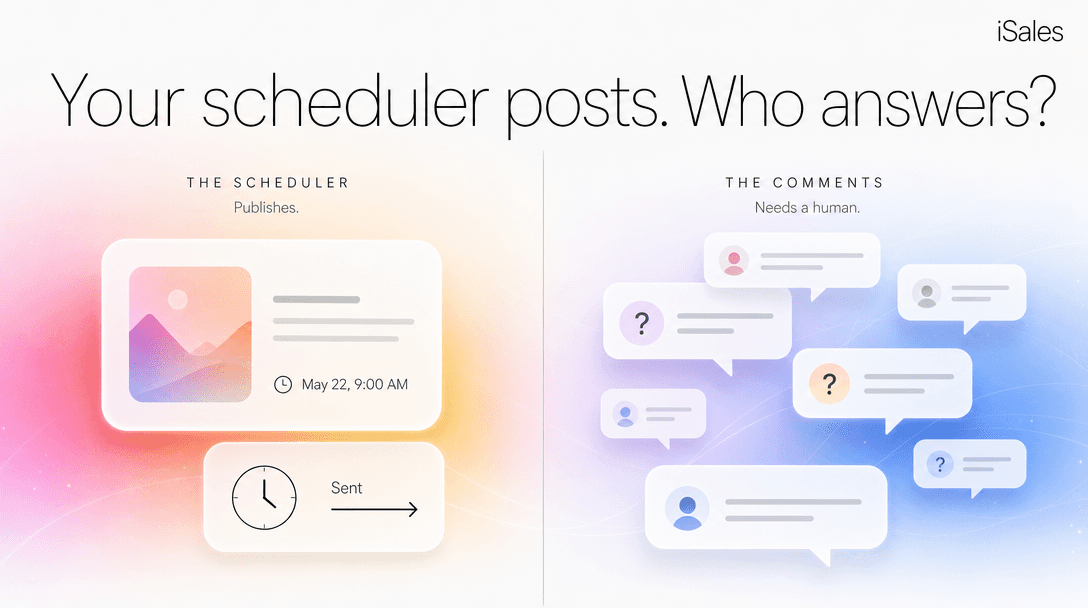
TL;DR: Yes, your scheduler probably answers comments now. Buffer ships a Community inbox (free tier included), SMMplanner has a Social Inbox, and Agorapulse and NapoleonCat are built for it. So "who answers?" is the wrong question in 2026. The one still worth asking: is the tool that answers the same tool that made the post — and can it carry that replier into a booked lead without a handoff? That seam is what no single scheduler owns. Below: a who-owns-each-step table, a 3-question Provenance Test, the real stack cost, and a straight note on when a standalone scheduler is still the right call.
- Who this is for: creators, coaches, and small agencies deciding whether to add or swap a publishing tool.
- What you'll get: a clear test for your own stack, real 2026 prices, and a straight answer on when not to switch.
- Last updated: 2026-07-05. All competitor prices are mid-2026 list values — re-check before you buy.
Do schedulers answer comments now? Yes, that gap already closed
A year or two ago "your scheduler posts and then goes quiet" was a reasonable jab. It isn't anymore, and this article won't pretend it is.
- Buffer has a Community inbox: it flags posts with unanswered comments across every connected channel and lets you reply from one place, with AI reply suggestions and saved replies. It's on the free plan, not locked behind an upsell.
- SMMplanner runs a Social Inbox — comments, DMs and mentions from all profiles in one queue, plus Direct automation and a ChatGPT-based assistant.
- Agorapulse and NapoleonCat exist specifically to answer at scale — NapoleonCat even drafts replies in your brand voice from your FAQs, with approval before anything sends.
If your only need is "reply to comments so my engagement rate goes up," these tools are mature and, in Buffer's case, free. So this article is not going to tell you nobody answers. It's going to ask a sharper question.
Answering to lift a metric vs answering to book a customer
Here is the distinction the ownership question actually turns on: two jobs that look identical for the first message and diverge completely after it.
Picture a comment under a post you scheduled: "How much is it and how do I order?"
- A scheduler's inbox does its job perfectly: it surfaces the comment, suggests a reply, you send it, the thread looks alive. Buffer's own data frames replying as an engagement lift (directionally large on some networks), and that is the product's goal. The reply is the finish line for an inbox, and some tools bolt a funnel or automation on after it. What none of them own is the continuation: turning that specific replier into a qualified, paying customer in the same place the post was made.
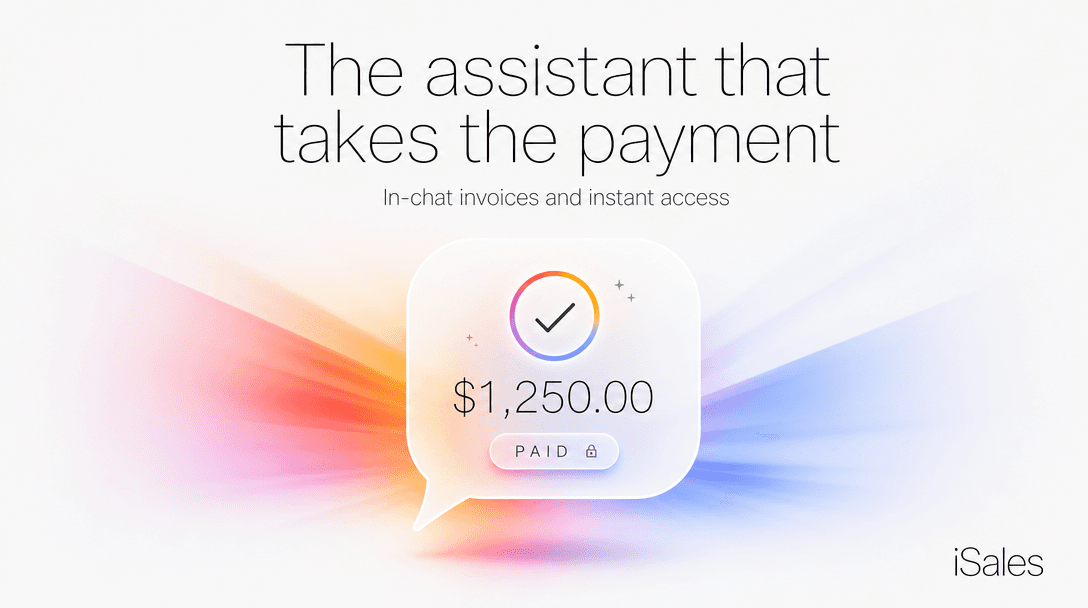
- A closed loop treats the same reply as the starting line: the answer goes out in your brand voice, the person moves into a DM, the assistant qualifies them ("delivery Sunday? which city?"), files the lead, and — where you've connected a payment method — drops the invoice, all in the same chat, on the same balance.
Neither is "better software." They're different jobs. A scheduler optimizes the comment; a loop optimizes the customer. If you're a media brand chasing reach, the first job is the one you want. If every reply is a potential sale you're currently copy-pasting toward a checkout somewhere else, the second is.
The reason most stacks can't do the second job isn't a missing feature. It's a seam. The tool that made the post (a generator), the tool that published it (a scheduler), the tool that replies (an inbox), and the tool that takes the money (a bot or a storefront) are four different logins that don't share context. Nobody holds the handoff.
Who owns each step
Print this and check your own stack. Competitor cells are mid-2026 capabilities, research-dated 2026-07-05 (✅ verified, ⚠️ partial).
| Step | Buffer | SMMplanner | Dedicated inbox / chat-bot (Agorapulse, Salebot) | iSales |
|---|---|---|---|---|
| Make the post in your voice/offer | ✅ AI caption drafts only | ⚠️ AI assistant, bolt-on | ❌ not a creator | ✅ generates the post |
| Publish to your connected networks | ✅ | ✅ | ⚠️ partial | ✅ |
| Reply to comments | ✅ Community (free) | ✅ Social Inbox | ✅ their specialty | ✅ |
| Carry the replier into a qualified lead | ❌ | ⚠️ funnels/automation | ⚠️ Salebot funnels | ✅ assistant qualifies |
| Take the payment in the same chat | ❌ | ❌ | ⚠️ Salebot does | ✅ |
| Scheduler depth (calendar, best-time, link-in-bio, reporting) | ✅✅ deep | ✅✅ deep | ✅ | ❌ shallow |
| One balance / one login for all of the above | — | — | — | ✅ |
Read the table straight and two things are true at once. iSales loses the scheduler-depth row outright. Buffer and SMMplanner have years of calendar, best-time and reporting work iSales does not match, and it doesn't try to. And the reply-to-comments row is checked for the competition too, which was the whole point of the intro. The only column that holds every row above the depth line on one balance is the last one. That's provenance, not a deeper inbox.
One caution so the table doesn't overclaim: "take the payment" isn't a trick only iSales can do. Plenty of chat-bot tools (Salebot, for one) take in-chat payments and support payment integrations. The claim is narrower and it's about the whole row set: among the tools compared here, none made the post, published it, answered the comment, qualified the lead, and invoiced, on one balance, in one place.
The Provenance Test: three questions for your own stack
If you take one thing from this page, take this. Ask it about whatever you're running today, score one point per yes:
- Same brain? Did the tool that answers the comment also make the post, so the reply knows your offer, not just the comment text?
- No handoff? Can that same tool carry the person from the public reply into a DM, qualify them, and take the payment — without exporting to a second tool?
- One balance? Is all of the above on a single subscription and a single login, not four bills that don't talk?
- Score 3 — you own the seam: one tool holds the creator context, the conversation state, and the payment ledger across every step.
- Score 1–2 — you rent it in pieces. It works, but the context (and the margin) leaks at every handoff.
- Score 0 — you have a scheduler and a lot of copy-paste.
This is deliberately not a feature checklist. A tool can beat iSales on every calendar feature and still score 0, because provenance is about who holds the thread, not how deep any one box goes.
What it actually costs: the stack vs one balance
The real cost of "own every step" isn't one bill. It's the stack you assemble to fake a loop. Real 2026 list prices:
- Publish: Buffer Essentials ~$5/channel/mo (annual; ~$6 monthly). Five channels ≈ ~$25/mo, and it scales with every network you add.
- Analytics: Metricool Starter $18/mo (or Advanced $45) — a second subscription for "what landed."
- Answer at scale: a dedicated inbox (Agorapulse / NapoleonCat) — a third paid tool if Buffer's Community isn't enough for your team.
- Make the content: a generator on top of all of it.
- Enterprise route: or Hootsuite at $99/mo (Professional, annual) to bundle some of it — and still no content generation or in-chat sale.
The iSales publishing layer is $20/mo (about 1,000 Telegram Stars; $200/year, ~17% off), flat: no per-channel fee, no per-post fee, and it sits next to the generator and the assistant on one balance. So the comparison isn't "$20 vs Buffer's $5." It's "$20 for the publishing link in a loop you already run" vs "a $25 + $18 + inbox + generator stack that still hands off at every seam." Read it as minus one subscription and minus one login, not plus $20 for posting. (Plug your own channel count and tools into the rows above — the math is yours, not ours.)
When a standalone scheduler is the right call
Do not switch if the loop isn't your job.
- If you post to lift reach and reply to lift engagement, and those replies are not meant to become booked sales, stay on Buffer. It's free for three channels, mature, and does exactly that job well. Paying $20 to close a loop you're not running is waste.
- If you need deep calendar planning, best-time scheduling, link-in-bio, or multi-seat approval workflows, keep your scheduler. iSales is shallow there and says as much; a loop doesn't replace a planner's depth.
- If your team is three people moderating a firehose of comments across ten brands, a dedicated inbox (Agorapulse / NapoleonCat) will out-work any bundled tool on pure inbox breadth.
iSales earns the $20 in one situation only: when the reply under your post is supposed to turn into a customer, and you're tired of the content, the publish, the answer, and the invoice living in four places. If that's not you yet, bookmark this and come back when it is.
FAQ
Does the $20 publishing tier itself answer the comments? No, and that's a real scope limit worth stating. The publishing subscription connects your socials and publishes everywhere; the replying is the assistant line of the platform. They sit on one balance and one login, which is the provenance point, but the $20 is the publishing link, not the whole loop.
I already have Buffer Community. Is that enough? If your replies are about engagement, yes, keep it, it's free. Run the Provenance Test: if you scored 3 on Buffer alone, you don't need this. Most creators score 1, because Buffer replies but didn't make the post and can't take the sale.
What about my calendar and reporting? Keep them. iSales doesn't out-feature a scheduler's depth. Some users publish and answer from iSales while still planning long-form campaigns in their calendar tool — the loop and the planner aren't mutually exclusive.
Telegram Stars — is there a fee? Stars carry a platform fee, so paying $20 in Stars nets less to the vendor than paying by card or crypto, which is the vendor's concern, not a surcharge to you. The price you pay is the price shown; card, crypto and Stars are just rails.
How hard is migrating? You don't migrate a calendar. You connect socials via OAuth (a couple of taps) and publish. If you keep a planner for depth, run both; if you don't, the publishing layer replaces the posting tab, not your whole workflow.
Next step
If you're already generating content and just want the publish-and-answer link in the same place, connect your socials and post your next piece from one window — the assistant handles whoever it earns.
👉 Connect your socials — publish everywhere, on one balance. New accounts get the first 30 messages free.
See the loop in product form on the publishing page and the make-it-here half on the content studio. For the pricing math, the one-balance pricing is the full breakdown.
Sources & last updated
- Buffer — Community engagement features — reply inbox, AI suggestions (vendor doc). nofollow
- Buffer — plans & pricing — Community on free plan; $5/channel Essentials (annual). nofollow, research-dated 2026-07-05
- Buffer — replying boosts engagement — cited as Buffer's own data, directional, not a benchmark. nofollow
- SMMplanner — Social Inbox / autoposting + AI — comments/DMs inbox (vendor). nofollow
- NapoleonCat — social inbox — brand-voice reply drafts with approval. nofollow
- Metricool pricing · Hootsuite pricing — research-dated 2026-07-05. nofollow
- Internal: publishing, content studio, AI assistant guide, flow-builder vs autonomous agent, answering DMs at night, pricing.
Competitor prices checked July 2026 — list prices, subject to change.