TL;DR: For a cold audience, transactional notifications at scale, or a verified business badge, the official WhatsApp Business API is the right pick and this is a short read. A tool that runs on your regular number (an "unofficial" setup) wins in one narrow case: messaging your own opted-in list in a real back-and-forth, without template approvals or a per-message platform stack. The deciding factor is not price. It is who you message and what you send. Below: the cost math, a fill-in table, and a 5-question test you can copy. Last updated 2026-07-05.
For: a small business or solo operator with an existing WhatsApp number and a list of contacts who already know you, weighing whether to migrate to the official API or automate the number you have.
The short verdict
- The official API is the only path Meta treats as sanctioned: no ban risk from the automation method itself, plus a verified business identity. If either matters to you, pick it and skip the rest.
- Since 1 July 2025 the official API bills per delivered template, priced by category (marketing, utility, authentication, service) and country, on top of a provider subscription. That model is fair for high-volume transactional sending and heavy for a few hundred warm conversations.
- A regular-number tool skips template approval and opt-in gating, so it can hold a genuine conversation and write a different message to each contact. It also carries a real ban risk you own, and it caps how fast you can send.
- There is a fill-in cost table and a copyable decision test further down.
What "official" and "unofficial" actually mean
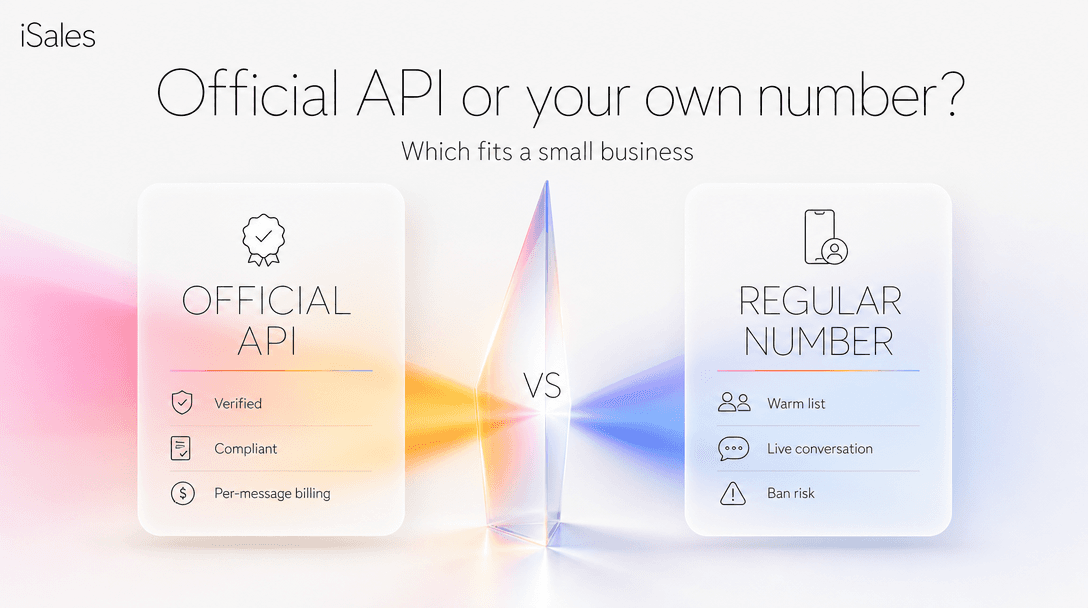
In short: official and unofficial are two different channels, each with its own rules, billing, and risk profile.
The official WhatsApp Business API (the WhatsApp Business Platform) is Meta's sanctioned channel. You go through a Business Solution Provider (BSP), verify your business, register message templates, and collect explicit opt-in from every recipient before you can send a marketing or utility template. Since 1 July 2025 Meta charges per delivered template, priced by category and recipient country.
An "unofficial" setup connects software to your existing WhatsApp through a linked-device or web session: the same mechanism as WhatsApp Web, automated. There is no template approval and no BSP, and you message from the number you already use. The trade sits in WhatsApp's own terms. Automating a regular account this way is against WhatsApp's Terms of Service, and the ban risk is yours to carry.
That one fact decides most of this article. So here is where each rail earns its place.
Where the official API wins
Four rows go to the official API, and for many businesses one of them settles the question.
- Ban and account risk. The sanctioned API is the only automation path Meta does not treat as a violation. (A verified official number can still be restricted for a poor quality rating or a policy breach, so this is "low", not "zero".) A regular-number tool reduces ban risk with warmup and daily limits, but it cannot remove it. If a suspension would end your business, this row alone decides it.
- Verified identity. Only the official channel gives you the verified green badge and a business profile Meta stands behind. Cold recipients trust it more.
- Scale and speed. After the ramp, the official API sends thousands of messages a day. A regular number is capped far lower (a careful tool holds around 50 messages a day, after a warmup period), which rules out same-day blasts by design.
- Transactional reliability. One-time passcodes, order confirmations, shipping alerts: utility and authentication templates are cheap, fast, and built for exactly this. Nothing on the regular-number side matches it.
If your core need is any of those four, the rest of this is a footnote. Pick the official API through a reputable BSP.
Where a regular number wins
The official API's strengths come from the same place as its friction. It is a gated, template-first, per-message channel. For a small business talking to people who already know it, that gating becomes the problem.
- No template approval. You answer "do you deliver Sunday?" in your own words, now, instead of pre-registering a template and waiting on review.
- Real personalization. Free of an approved template, an AI layer can write a genuinely different message to each contact on your list, not one broadcast text with a
{{name}}slot. - Your existing number and list. No WABA migration, no re-collecting opt-ins into Meta's format, no separate business number your customers do not recognize.
- Predictable, low cost at small volume. No per-conversation platform invoice for a few hundred warm messages a month.
The catch stays in view. This holds for a warm, self-collected list and a conversational use. Point it at cold or scraped numbers and you are back to the ban risk you own, now without Meta's sanction to soften it. The mechanics that actually lower that risk are covered in our guide to automating your own WhatsApp number.
The cost math (fill in your own)
Costs move by country and volume, so anchor them yourself. Real 2026 reference points, research-dated 2026-07-05 and subject to change:
- Provider subscriptions sit on top of Meta's message fees. Wati lists a Growth plan around $59/mo; AiSensy lists a Basic plan around $45/mo and Pro around $99/mo. Some providers add roughly a 20% markup on each message.
- Meta's per-message fee varies by category and market: marketing templates run roughly $0.01 to $0.15 each depending on country, utility and authentication far less. Service replies inside the 24-hour customer window are currently free; Meta has said they become chargeable from 1 October 2026.
- A regular-number tool is a flat monthly agent subscription plus a small usage cost per AI message.
One message to 1,000 contacts on your own list, once. Fill the blanks with your market's rate and your list size:
| Line item | Official API (via a BSP) | Your regular number |
|---|---|---|
| Platform subscription / mo | $____ (e.g. ~$45–59) | $____ |
| Per-message × 1,000 | $____ (marketing rate × 1,000) | $____ (usage × 1,000) |
| Setup before first send | verify business, register template, collect opt-ins | connect the number you have |
| Time to reach 1,000 | same day (after ramp) | ~3+ weeks (daily cap + warmup) |
| Message form | approved template | AI-unique per contact |
| Ban / ToS risk | low (method sanctioned; quality/policy rules still apply) | real, yours to manage |
A worked illustration (your numbers, not ours): at a ~$0.03 marketing rate, the official path is roughly $59 + $30 = ~$89 for the month and sends the same day. The regular-number path is roughly $49 + ~$15 in usage, but the daily cap stretches those 1,000 sends across about three weeks. The total is close. The two bottom rows are where they actually differ.
The 5-question test (copy this)
Answer yes or no. A single "yes" in the first three sends you to the official API.
- Am I messaging people who have not explicitly opted in (cold or purchased lists)? → Official API. Opt-in is enforced there; on a regular number, cold sending is the fastest route to a ban.
- Do I need the verified green badge or Meta-backed standing? → Official API.
- Do I send transactional notifications (passcodes, order or shipping updates) at volume? → Official API.
- Is my list warm (people who already messaged or bought from me) and my goal a conversation, not a notification? → Regular number is viable.
- Do I want to run it from my existing number without a WABA migration, personalizing per contact? → Regular number fits.
No to 1–3 and yes to 4–5: a regular-number tool is the better fit. Anything else: the official API.
Where a regular-number tool fits (and where it does not)
iSales is on the regular-number side of that split, on purpose. It connects the WhatsApp number you already use (no WABA), runs an AI agent that replies and writes a different message per contact, and enforces a warmup plus daily limits to reduce ban risk. It does not promise ban immunity, because no tool can. The agent is a flat $49/month, and message generation is billed from a prepaid balance at a small per-message rate, so a warm list of a few hundred stays inexpensive.
That also makes it the wrong tool for the first three questions above. If you need to reach a cold list tomorrow, send thousands of passcodes a day, or show a verified badge to strangers, a BSP-fronted official API will serve you better, and we would point you there. It earns its place only on a warm list and a real conversation, run from the number your customers already recognize.
Common mistakes
- Reading "unofficial" as "no rules." The regular-number path demands more behavioral discipline, not less, because you carry the risk the API would otherwise absorb.
- Comparing on sticker price alone. A $45 subscription plus per-message marketing fees plus a possible 20% message markup is a different number than the list price.
- Migrating to the official API to talk to a warm list conversationally. You pay for templates and approvals you did not need.
- Blasting a cold list from a regular number. The one use that reliably burns the account.
FAQ
Can I use both? Yes, and many do. The official API for transactional and cold outreach, a regular number for warm one-to-one conversation. Different jobs.
Will an unofficial tool get my number banned? It can. Meta treats the connection method as a Terms violation, and enforcement also tracks behavior on top of that. Warmup, daily limits, and per-contact variation lower the odds; nothing removes them. Why a "no-ban" promise is a myth is worth reading before you trust one.
Is the official API always more expensive? No. For high-volume utility and authentication sending it is often cheaper per message. For a few hundred warm marketing conversations, the subscription-plus-per-message stack usually costs more than a flat regular-number tool.
Do I need business verification for the official API? To send at any real volume, yes. As of 2026 Meta requires business verification and a privacy-policy URL to raise your sending limits and unlock the verified badge; a fresh account can send a small template volume first.
What about the 24-hour window? On the official API, once a customer messages you, you can reply free-form for 24 hours. Marketing outside that window needs a paid, approved template.
Next step
If your case is a warm list and a real conversation from your own number, connect it and start the warmup: Connect your WhatsApp agent →. If it is cold outreach or transactional volume, a BSP-fronted official API is the recommendation.
Sources & last updated
- WhatsApp Business Platform pricing, message categories, and the 1 July 2025 per-message change — Meta and industry pricing references.
- Business verification, opt-in, and template-approval requirements — Meta developer documentation.
- Provider subscription references: Wati and AiSensy pricing pages (vendor-listed, subject to change).
- WhatsApp Terms of Service and unofficial-API ban-risk explainers.
Competitor prices checked July 2026 — list prices, subject to change.