In short: If your clients' buyers actually live in Telegram, an agency can add a warm-lead service line built on demand signals instead of bought lists. The real prize is twofold: a channel the big outbound platforms built around email/LinkedIn workflows (Apollo, Clay, 11x) don't cover, and a usage-based cost you can mark up into a predictable per-client line item. It is not a fit for every roster: if your clients are enterprise buyers you reach on LinkedIn and email, skip this and keep your current stack.
Most agency lead-gen still runs on the same fuel: a purchased list, an email sequence, and a monthly retainer that has to look busy. That fuel is getting more expensive to burn. This is a playbook for adding a different service line for the clients whose buyers live in group chats, and for pricing it so it earns margin instead of eating it.
The Tuesday this shows up
Say a five-person agency runs outbound for eight B2B clients. One client sells compliance tooling to crypto exchanges; the buyers spend all day in a dozen Telegram trade and ops groups and rarely open a cold email. The agency bought a 12,000-row list for that client four months ago. On the last send, the bounce rate crossed 6%, the sending domain got throttled, and the client asked the obvious question on the renewal call: "what am I paying the retainer for?"
Nothing in that story is exotic. It is the standard failure mode of a channel that stopped matching where the buyer lives. A better list won't fix that; the clients whose prospects already sit in group chats all day need a different pipeline.
Why the bought-list playbook is quietly expiring
Two forces are grinding against the classic model.
The first is decay. B2B contact data goes stale at roughly 22–35% per year, driven mostly by job changes (15–20% of professionals move annually), according to 2026 data-quality benchmarks from Cleanlist, Instantly and Apollo. A 10,000-row list you buy in January is missing a few thousand valid people by December without a single send. You are renting a puddle that evaporates.
The second is cost and lock-in. In 2026, B2B lead-gen retainers run $2,500–$19,000+ per month, with premium shops often requiring 6–12 months paid upfront (SaaS Hero, Belkins, 2026). Cost per lead runs roughly $420 to $3,080 depending on vertical, with SaaS sitting in the $700–$2,800 band and scaling with contract value. Those are real market rates, and they describe a service the client experiences as a black box: money in, "leads" out, little visibility into what a conversation actually cost to start.
A warm Telegram pipeline attacks both problems. There is no list to decay because contact happens on a fresh signal each time. And because the underlying spend is usage-based, you can show a client exactly what a started conversation costs. That visibility is also what lets you set the price.
What a warm-conversation pipeline actually is
The method matters more than the channel, because "Telegram outreach" already has a bad name earned by scrape-and-blast tools that grab usernames and DM everyone.
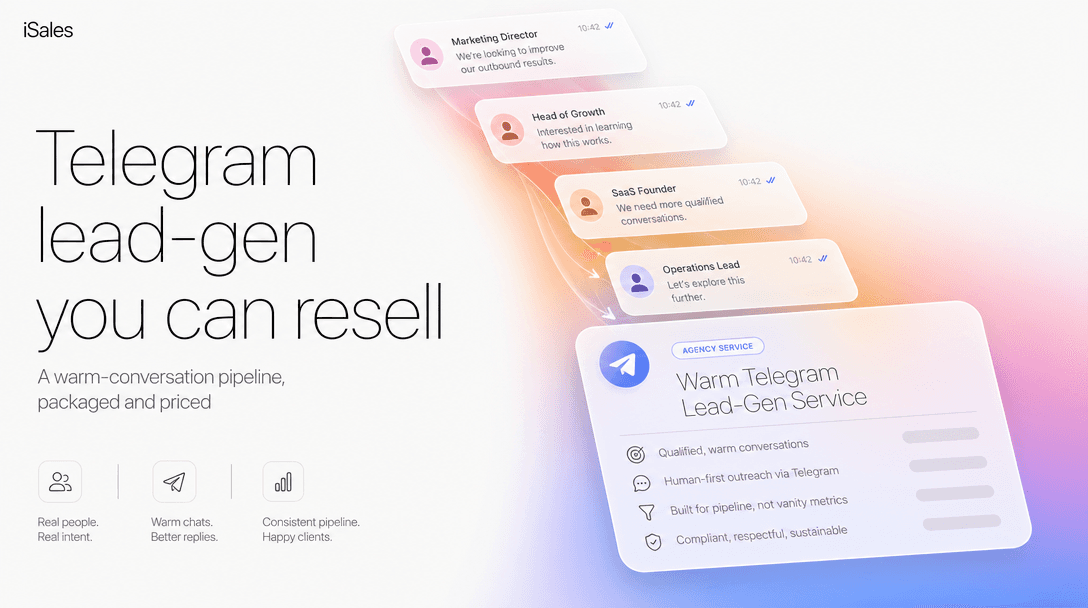
A signal-based agent works the other way around. It joins themed groups where your client's buyers talk, reads for a real intent signal ("anyone know a tool that does X?"), warms the account for seven days on a 10-step schedule, then DMs only the people who showed intent — and at supervised autonomy, each message waits in an approvals queue for a human to release. Each connected account runs on its own dedicated proxy, and daily volume is capped (around 40 DMs/day). Warm-up plus caps plus per-account proxies plus approvals is what reduces ban risk. It is not a no-ban promise, which nobody can truthfully make. It is the set of controls that keeps accounts alive longer than blasting does.
For an agency, three properties matter: contact follows a demand signal rather than a bought list; your operator approves before anything sends, so a client's brand voice never goes rogue; and each client is isolated on their own accounts and proxies.
Package it as a service line: the resale math
The buyer-side cost of a Telegram lead is its own topic; what an agency needs is the resale model: cost-in, price-out, margin, across a roster. Copy this table and fill your own cells.
| Per client, per month | Your cost-in (usage) | Your price-out (what you bill) | Margin |
|---|---|---|---|
| Proxy (one account) | ~$100/mo fallback rate | ____ | ____ |
| Goal budget (agent spend cap) | $10 / $20 / $50 preset | ____ | ____ |
| LLM work (signals, scoring, DM drafting) | from balance, usage-based | ____ | ____ |
| Your operator time (approvals, QA) | ____ hrs × ____ rate | ____ | ____ |
| Client line item | = sum (certain) | = your retainer for this line | price − cost |
Two disciplines keep this grounded. First, keep the certain costs and the speculative ones in separate columns. The proxy, the goal budget and the LLM spend are real, capped, usage-based numbers you can read off the balance. What you can bill and how many conversations convert are estimates you control; never quietly assume every warm reply becomes a paying client. Second, the numbers above are placeholders: your numbers, not ours. Plug in your operator rate and your target retainer, and the table tells you whether the line item clears margin at one client or only at five.
For a price-out anchor, use the market you already sell into: 2026 lead-gen retainers run $2,500–$19,000+/mo (SaaS Hero, Belkins). A single-channel Telegram add-on sits well under a full retainer, so the margin question is whether your cost-in plus operator time fits beneath that ceiling at your current client count.
The strategic point: usage-based cost plus a per-client account model is packageable. You take a variable input cost, wrap it in a fixed monthly retainer for the client, and keep the spread, the same move a hosting reseller makes: pay for the resource as used, sell it as a package.
A signal-based agent vs a Telegram-native CRM vs a classic agency
Each option genuinely wins somewhere.
| Signal-based agent (iSales) | Telegram-native CRM (e.g. CRMChat) | Classic email/LinkedIn agency | |
|---|---|---|---|
| Contact basis | demand signal in groups | often parses/loads group members into pipelines | bought or enriched list |
| Where it's strongest | warm Telegram conversations + approvals | mature Telegram CRM, pipelines, case studies | reach on email + LinkedIn at scale |
| Setup friction | higher: accounts, warm-up, proxies | lower for pure outbound + CRM | lowest: hand over a list |
| Best channel fit | buyers who live in Telegram | Telegram-first outbound teams | LinkedIn/email-native markets |
| Cost shape | usage-based, resellable per client | tool subscription + your service | monthly retainer, often upfront |
The signal-based agent loses real rows here: a dedicated Telegram CRM like CRMChat positions itself around a more mature deal/pipeline surface and publishes agency case studies, and a classic list-and-sequence setup is simply faster to stand up on day one. If your value to the client is a built-out CRM or sheer volume across email and LinkedIn, those tools fit better. The agent wins on one axis, a supervised, signal-based warm channel you can resell with transparent per-client economics, and it asks for more setup to earn that.
When NOT to add this line
Rule this line out if any of the following is true. Your clients sell to enterprise buyers you reach through LinkedIn and email, and Telegram is not where their prospects talk; then it is a channel with no audience. You run one-off blast campaigns rather than ongoing programs, and the seven-day warm-up assumes a durable account, not a burner. Or you have only one or two Telegram-living clients, where the per-account setup overhead is real and the margin table usually only clears once you can amortize your operator's approval time across several campaigns. Under that threshold, keep doing what works.
FAQ
Is contacting people this way compliant? Contact follows a public demand signal rather than a purchased cold list, and a human approves each message at supervised autonomy — but the accounts are yours, so you accept the platform risk knowingly. Treat consent and local rules as your responsibility, and anonymize any lead screenshots you use in reporting or marketing.
How many accounts and clients can one operator handle? That is exactly what the margin table is for. The binding constraint is usually your operator's approval and QA time, not the tooling — model it before you sell the third client, not after.
What do I actually promise the client in the SOW? A cadence of approved conversations and reporting on them, not a lead-count guarantee. You cannot sell a number of deals up front: conversion into payment depends on the client's own offer, not the agent. Promise the process and the cost transparency you control.
What happens when the agent gets a conversation wrong? At supervised autonomy it will occasionally misread a signal or draft an off-tone reply — you will want to skim its output daily in the first week per client. That review time is a line in the cost table, not an afterthought.
Can I white-label it? The client sees conversations from their own Telegram accounts; the tooling sits behind your service. Set expectations on approvals and reporting cadence in the retainer.
Where to start
Stand up one client on one account, run a single goal budget, and watch the approvals queue for a week before you quote a second client. The point is to learn your real cost-in and your operator's real time before you price the line — then the resale table does the rest.
See the approvals queue before you sell it: run a Telegram agent on your own niche, pay-as-you-go.
Sources & notes
- iSales pricing (goal-budget presets $10/$20/$50, proxy fallback ~$100/mo per account, usage-based LLM, ≤40 DMs/day, 10-step warm-up, supervised approvals): product & pricing, 2026-07.
- B2B contact data decay ~22–35%/yr; job changes 15–20%/yr — Cleanlist, Instantly, Apollo (accessed 2026-07).
- B2B lead-gen retainers $2,500–$19,000+/mo, 6–12mo upfront — SaaS Hero; CPL ~$420–$3,080 across verticals, SaaS $700–$2,800 — Belkins (accessed 2026-07).
- CRMChat positions a Telegram-native CRM/outreach product to agencies as a packaged service — CRMChat (accessed 2026-07). Its internal pricing and customer outcomes are the vendor's own claims and are not reproduced here as fact.