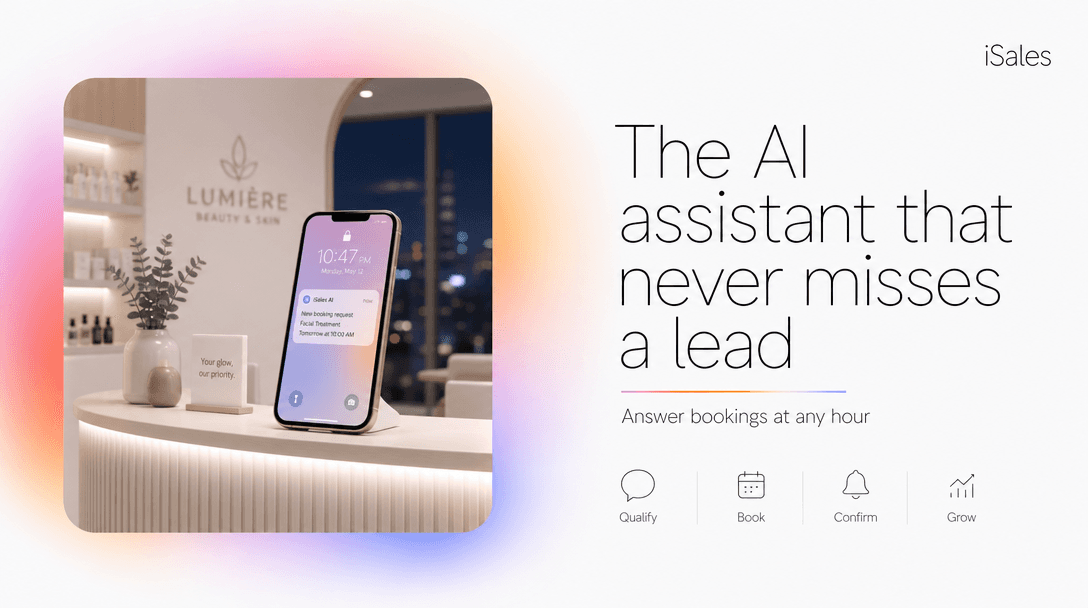
Short answer: for a business that runs on appointments, the lead you lose is almost never the one who says no. It's the one who messaged at 11pm, got silence, and booked the next salon on the list by the time you woke up. An AI assistant closes that gap, but not because it has a longer feature list. It works because of speed: the same assistant answers the question in your voice, from your prices, then books the slot and takes the deposit in the same thread, at any hour. This guide gives you the evidence that speed is the whole game, a copy-paste calculator for what your missed bookings actually cost, a clear-eyed comparison against the booking app you may already run, and the case where you shouldn't automate this at all. It's one use-case inside the broader guide to running an AI assistant for your business.
TL;DR
- Response speed, not answer quality, decides most appointment leads. Research puts the drop-off in minutes, not hours.
- The differentiator isn't "takes a deposit"; good booking apps already do that. It's that one conversation answers, books, and collects, instead of pasting the client into a separate widget mid-chat.
- A dedicated booking system still wins on calendar and staff-scheduling depth. For many salons the right move is to connect an assistant to it, not replace it.
- Under roughly three booking requests a week outside your hours, don't buy anything yet. The threshold is about bookings, not messages.
The booking that's already gone by morning
It's a Friday night. You run a two-chair studio. At 11:12pm a message lands: "Hi! Any openings tomorrow morning? How much for a full set?" You're asleep. She isn't. She sent the same message to three accounts in the same five minutes, and she's booking with whichever one answers.
By 9am one of two things has happened. Either she booked with the account that replied at 11:14pm, or she's still open but cooler, comparing prices instead of ready to commit. Either way the moment that was widest at 11pm has mostly closed by breakfast. Zenoti, a salon-software vendor, found in a September 2025 survey of just over a thousand US consumers that 71% of salon and spa regulars have abandoned a booking because they couldn't reach someone easily, and 81% call to manage appointments outside normal hours at least sometimes. Read it as vendor research, but the direction matches every owner's inbox: demand doesn't keep business hours, and patience is short.
Most guides stop at "be available 24/7." That's the easy half, and it's also where they quietly overpromise. No setup catches every lead. The realistic goal is narrower: stop losing the ones that speed alone would have saved.
Why speed beats features
Here's the part the feature comparisons skip. The single biggest lever on an appointment lead isn't how clever the reply is. It's how fast the reply arrives.
The foundational number comes from a Lead Response Management study run by Dr. James Oldroyd with InsideSales, published through MIT in 2007, across more than 15,000 leads: contacting a new lead within five minutes instead of thirty made you about 100× more likely to reach them and 21× more likely to qualify them. A 2011 Harvard Business Review audit of 2,241 US companies found the average first response took 42 hours, and 23% of companies never responded at all. Those studies cover sales leads, not manicures, yet the mechanism is identical for a booking: attention is perishable, and it decays in minutes.
That reframes the whole purchase: what you're paying for is the answer in the minutes while the client is still holding her phone and deciding, instead of at 9am, when she's already in someone else's chair.
What a missed booking actually costs you
Vendors love a dramatic figure here ("businesses lose $126,000 a year to missed calls"). You can't verify those and neither can they, so ignore them and do your own math on two numbers you actually know. Copy this table and fill the blank cells:
| Your Missed-Booking math | Fill in | Example |
|---|---|---|
| Average ticket (one booking) | ______ | $60 |
| Booking requests that arrive outside your hours, per week | ______ | 8 |
| Of those, share that goes unanswered until it's cold (be conservative) | ______ | 1 in 4 |
| Bookings you likely lose per week = (row 2 × row 3) | ______ | ~2 |
| Monthly leak = row 1 × row 4 × 4.3 weeks | ______ | ~$516 |
Two rules keep the math straight. First, keep the certain cost and the guess apart. The certain cost is the time you spend re-typing the same three answers at 9am; the leak above is a hypothesis about how many cooled leads would have booked, so use a conservative share (one in four, not "all of them") and treat the total as a range, not a fact. These are your numbers, not ours. Second, the leak only has to clear what an assistant costs to run for the math to favour acting, and at cents-per-reply that bar is low. If your filled-in monthly leak is smaller than a night out, you're in the "don't bother yet" zone further down.
The part beyond answering: one thread that books and collects
So an assistant replies fast and in your voice. Answering every after-hours DM without a team is a real problem on its own, and it has its own guide: answering customer DMs at night without a team. But even a fast, on-voice reply still leaves the client to go find your booking link, pick a slot, and pay: three chances to drift off. The thing worth paying for is that the same conversation carries all the way through. It answers "any openings tomorrow?", offers the actual slot, and takes the deposit right there in the same chat, on Telegram or WhatsApp or Instagram, without handing her to a separate widget she has to re-explain herself to.
Be clear about what's novel and what isn't. Taking a deposit to reduce no-shows is not new. Booking systems have offered prepayment and reminders for years, and that's exactly where the differentiation ends. What's different is the unbroken thread: no channel-hop, no "click here to book," no re-typing, grounded the whole way in your own prices and services. For a client deciding at midnight, every extra tap is a place to lose her.
Booking widget, script bot, or an assistant that carries the thread
Three tools get pitched at this problem and they're constantly confused. They sit on a different axis than "how well it chats." The axis that matters for appointments is who carries the booking.
| Dedicated booking app | Marketing / script bot | Assistant that answers + books | |
|---|---|---|---|
| Answers a free-text question at 11pm | No, it's a calendar not a chat | Only the exact paths you scripted | Yes, from your prices/services |
| Books the slot | Yes, its core job, deep calendar | On a rigid flow | Yes, in the same thread |
| Takes a deposit | Yes | Sometimes, via a link | Yes, in-chat |
| Sounds like you | No copy, just a form | Robotic off-script | Trained on your voice/docs |
| Calendar & staff-scheduling depth | Deep, the reason it exists | Shallow | Shallow, leans on yours |
| Cost shape | Flat monthly | Flat, or per-contact | Per action, prepaid balance |
A real booking system (the kind salons already run) wins decisively on calendar, staff rosters, resource rules and loyalty, and an assistant is not trying to out-schedule it. Two more concessions the table shouldn't hide. A flat-rate script bot can be genuinely cheaper at very high volume, so if you field thousands of messages a day, run that math. And an assistant needs a real setup sitting; it will confidently get an odd question wrong in its first few nights, so you'll skim its replies for a week. Where it earns its place is the first three rows working as one motion: answer, book, collect, with no channel-hop.
Should you replace your booking app, or connect to it?
For most salons and clinics: connect, don't replace. If your calendar, staff and loyalty already live in a booking platform, the assistant's job is to be the fast conversational front door. It answers the 11pm question, qualifies, then either writes the booking through to your system or hands a clean, warm lead to it. Rip-and-replace only makes sense if you don't have a scheduling system yet, or the one you have is a spreadsheet.
This is also the answer to the fear owners actually voice: "it won't play nice with my booking system." The right setup is integrate-or-hand-off, never "throw out the tool your front desk already knows." An assistant that forces you to abandon a working calendar is solving its problem, not yours.
When you should not automate this yet
If you get under roughly three booking requests a week outside your hours and you're usually near your phone, don't buy anything. Turn on a free away-message so no one meets silence, keep your booking link in your bio, and answer yourself when you surface. At that volume the setup sitting costs more than the leak, and you'll book them better by hand. The line that flips it isn't a message count. It's when unanswered booking requests (not "hi" and not spam) pile up past your hours often enough that you can feel the lost slots. That's when speed you can't personally provide starts paying for itself.
What it costs, without the pricing trap
The reason a night receptionist never made sense is cost: you can't pay someone to sit up for the handful of after-hours messages that matter. Software changes the unit, but not all pricing is equal, and the model matters more than the sticker. Per-resolution tools bill you a fixed amount every time the AI closes an interaction (Intercom's Fin lists $0.99 per resolution over a 50-outcome monthly minimum, roughly $49 to start; lead-qualification outcomes near $9.99, figures from Intercom checked July 2026). That's predictable until a busy month spikes your bill exactly when you're slammed. Flat per-contact tools (ManyChat's Pro tier around $29/mo, plus about $29 for its AI step) are steadier but cap your contacts. A usage-based assistant instead debits each action from a prepaid balance: a text reply runs a few US cents (roughly $0.02–0.05, depending on the model), with no monthly floor and no per-resolution surprise, so a quiet month costs almost nothing and a busy one scales with actual work. Whichever you pick, price the model, not the headline number.
If what you care about most is that the replies genuinely sound like you and not generic AI, that's the difference between an assistant and copy-pasting from ChatGPT, and it's worth reading before you decide.
Try it free, no card: open it in Telegram. Answer four questions and it replies in a test chat the way you would, in minutes.
FAQ
Does this actually work for my type of business? It fits appointment-and-consultation businesses best — salons, med spas, clinics, coaches, studios, home services — where the money is in bookings and questions repeat (price, availability, "is this for me?"). If you sell mostly complex custom quotes, an assistant handles first-touch and hands the nuanced part to you.
Can it take a deposit and refund it if the client cancels? It can collect a deposit in-chat at booking. Refund and cancellation rules follow your policy and your payment provider's terms — set them the way you already handle no-shows; the assistant applies them, it doesn't invent them.
Will it get my prices or services wrong? It answers from the information you give it, so accuracy tracks your setup. Feed it your real menu, prices and FAQs, keep a hand-off step for unusual questions, and skim its replies for the first week. It will miss an edge case early — that's the argument for the human flag, not for staying up yourself.
What does the customer see on their end? A normal chat, in whichever app they already messaged you on — Telegram, WhatsApp or Instagram. No "press 1 for bookings" menu, no separate app to install, no web form to fill in. On anything unusual it hands the conversation to you instead of guessing, so they rarely hit a dead end. The goal is that it feels like a fast front desk, not a bot maze.
Will automating replies get my account banned? Answering people inside your own chats and your own bot is normal use, not the risky part. Ban risk belongs to outbound mass messaging — a different activity with its own limits — not to answering the customers who message you.
Sources & last updated
- Lead-response speed: Oldroyd/InsideSales, Lead Response Management study via MIT, 2007 (five-minute vs thirty-minute contact odds ~100×/qualify ~21×); Harvard Business Review, "The Short Life of Online Sales Leads," 2011 (avg 42-hour first response; 23% never respond).
- After-hours demand: Zenoti AI Receptionist Survey, 2025-09-12, n=1,011 US consumers, ±3.15% (vendor research — 71% abandoned a booking over hard-to-reach; "81% call to manage appointments outside normal hours at least sometimes").
- Competitor pricing: Intercom Fin (fin.ai/pricing — $0.99/resolution, ~$49 base incl. 50, ~$9.99 lead outcome); ManyChat (manychat.com/pricing — ~$29/mo Pro + ~$29 AI step). Research-dated; may change.
- Our own economics (per-action debits from a prepaid balance, a text reply ≈ a few US cents, first 30 messages free, no card): see the pricing page at /pricing.
- "iSales" and the bot handle are working placeholders pending confirmation.
Competitor prices checked July 2026 — list prices, subject to change.