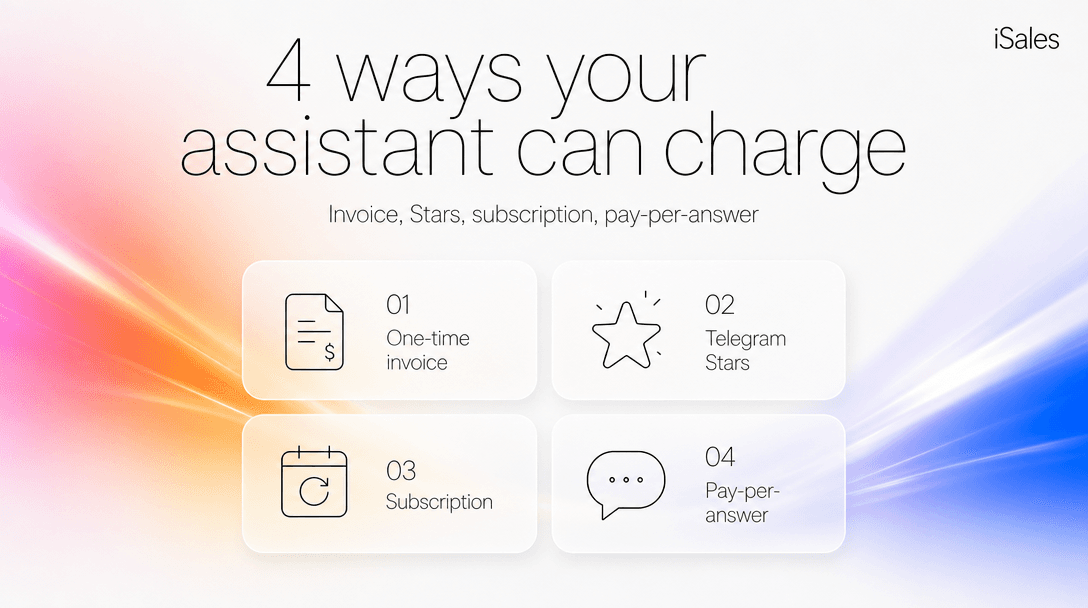
TL;DR: If you've already decided your assistant should take the money itself, not run ads and not hand the sale to a checkout, you still have one choice left. Pick it wrong and a big-ticket sale ends up on Stars-on-mobile, where a ~30% app-store fee rides on the purchase, when it should have been a clean invoice on your own rails. The in-chat model has four shapes: sell files for Stars, invoice a service on your own rails, gate ongoing access, or charge per answer. Which one is yours comes down to two questions about what you sell, not your follower count. This guide is the routing layer; the answer is usually one clear model, and for some readers it's "none of these, go build a storefront."
Who this is for: creators, experts, and small operators who've decided the conversation is where they get paid, and now need to pick how. Last updated: 5 July 2026.
This is the level below "how do I monetize a bot"
There are four broad ways to make money from a bot — ads in it, a subscription around it, affiliate links through it, or the assistant taking the payment itself. That map, and which of those four is right for your reach, is the complete monetization guide's job, and for a lot of people the answer is "run ads" or "use a storefront."
This is what comes next. If your answer was the fourth one, that the assistant should be the seller, that model isn't one thing. It has four distinct shapes, and they route on a different axis than reach does. A person with 800 engaged followers and a person with 80,000 can land on the same in-chat model; a wedding photographer and a tax advisor with identical audiences land on different ones. What decides it is the shape of the thing you sell.
The 2-question rule: which of the four is yours
Answer two questions in order. You land in exactly one place.
Question 1 — Is the thing you sell a file you hand over, or work you do live? A pack of photos, a video, a PDF, a preset. That's a file. A consult, a diagnosis, a review of their specific thing: that's live work.
Question 2 (only if it's live work) — is it one big engagement, ongoing access, or the same small answer over and over?
| Your answer | Your model | The rail |
|---|---|---|
| A file I hand over, bought on impulse | Sell for Stars | Telegram Stars → payout in USDT |
| Live work — one bigger engagement decided in conversation | Invoice on your own rails | Your card / crypto account, in-chat |
| Live work — ongoing access to me or my method | Gate access (subscription) | Recurring, your rails or Stars |
| Live work — the same narrow answer, many times, cheaply | Charge per answer | Metered micro-payments |
Screenshot that table; it's the whole decision. The four sections below are just each leaf with its worked case, its catch, and the tool that already half-serves it.
Model A — Sell files for Stars (the creator)
You're here if what you sell is a thing you hand over and the buyer decides in seconds: a 40-photo set, a preset pack, a locked video, a paid guide. The assistant holds the file, sells it for Telegram Stars, delivers it in the thread, and you cash out in USDT. No storefront, no "add to cart," no leaving the chat.
The catch is the fee. When a buyer taps to pay with Stars inside the iOS or Android app, Apple and Google charge their ~30% store fee on that Stars purchase. That is a buyer-side cost of the mobile rail, and the large majority of Star purchases happen on mobile. Stars bought on desktop skip it. So Stars is the impulse rail: unbeatable for a one-tap $3 unlock, expensive for a $200 sale (that one belongs in Model B). A Stars-only content bot like Telestars (⚠️ 2026) does exactly this and nothing else — perfect if a file is all you'll ever sell, a dead end the day you want to invoice a bigger ticket on your own account.
Model B — Invoice the service on your own rails (the expert)
You're here if the sale is a conversation first: say a website audit you quote at ~$150, a legal review, a done-for-you setup. Nobody one-taps a $150 audit; they ask two questions first. So the assistant qualifies in the thread, then issues an invoice through the payment systems you connected; the buyer pays in-chat and the money lands on your rails, not a platform's.
This is the mode a checkout page can't hold, because the checkout starts after the decision and the decision is the hard part. A storefront link (Stan, Whop) takes the money cleanly but can't run the qualifying conversation; a builder like ManyChat (⚠️ 2026) converses well but hands the actual sale to Shopify/Stripe, so payment leaves the chat. Where Model B stops: it needs you to actually have a service worth a conversation. If you sell a flat $19 PDF, don't make a buyer talk to a bot; that's Model A.
Model C — Gate ongoing access (the coach / mentor)
You're here if your value is recurring: a signals channel, a Q&A tier, a "reply to my premium members within the hour" promise, a program people renew. This is access sold on repeat, and the metric is churn, not conversion. The assistant fronts the gate: it takes the recurring payment, admits paying members, and answers them from your method.
Gated access is a storefront's home turf. Whop and Tribute (⚠️ 2026, ~10% on Tribute) do memberships well, and if all you need is a locked catalog behind a paywall, a purpose-built membership platform is the cleaner tool. The assistant earns its place only when the gate is a conversation — when "which tier is right for me?" and "can you look at my situation?" are the thing that closes the renewal, not a checkbox on a pricing page.
Model D — Charge per answer (the narrow-product operator)
You're here if you answer the same narrow, valuable question hundreds of times: "is this contract clause standard?", "grade this essay against the rubric," "what's a fair quote for this job?" Each answer is cheap; the volume is the business. The assistant meters it: a small charge per answer, no subscription, no consult.
This is the newest and thinnest of the four. Per-answer metering barely exists as a packaged product in 2026 — you're closer to the frontier than to a paved road, and you'll do more setup and more watching-it-for-mistakes than in Models A–C. It's the right model when your value genuinely is one repeatable answer at volume and wrong the moment the answers need to become a real back-and-forth (that's Model B) or the buyer would rather just subscribe (Model C).
When none of these four is your model
The most useful thing this page can do is send some readers away.
- You have real reach, tens of thousands of engaged followers. Then your money is in ad slots and affiliate, and none of the four in-chat models is your priority. Start at the broad monetization map, not here.
- You have a handful of paid interactions a week and you're usually at your phone. Don't automate the sale yet; paste a payment link yourself. The setup costs more than it saves until the conversation is what closes, not you.
- You want a public, browsable, SEO-able catalog. That's a shop window, and a chat isn't one. A storefront wins that row outright.
Where one assistant fits both, and the line that's the wedge
Most tools do one of these four and stop: Telestars sells for Stars, ManyChat hands off to Shopify, a Stan link takes a flat payment. The narrow thing worth naming is the combination: iSales is the assistant that sells your content and invoices on your own payment rails and does it in one chat, so a creator who mostly runs Model A can invoice a bigger job (Model B) without bolting on a second tool. Each of those pieces exists separately elsewhere; the combination in a single assistant is the part that's ours.
FAQ
Can I run two of these at once? Yes, and most people should — a coach on Model C who also sells a one-off intensive (Model B) is normal. The 2-question rule picks your primary model; add a second only when a real second offer exists, not to look busy.
Does the platform take a cut of my sales? Depends on the rail, not the assistant. Stars carries the mobile store fee (buyer-side); your own invoice is just your processor's ~3%; a storefront takes its platform percentage. Ask any tool the plain question: does the money land on rails I control, or the platform's?
What if I pick the wrong model? The expensive mistake is putting a big-ticket service on Stars-on-mobile, where a ~30% app-store fee rides on the purchase, when it should have been a clean invoice on your own rails. Re-run Question 1: file or live work? That one answer prevents the costly errors.
Do I still need a storefront? Only if you need the shop window — a public, browsable catalog or an affiliate marketplace. For selling in the conversation, the assistant is the point; the whole model is that there's no second storefront to run.
Next step
If you already answer paid-intent questions by hand, the fastest way to find your model is to let one assistant charge for one of them and see which rail the sale wants. You can try it free — the first 30 messages are on the house. Turn on monetization →
Sources & last updated
- Telegram Stars terms & fee structure — telegram.org/tos/stars (rel="nofollow"), cross-checked against 2026 creator-payout write-ups (mobile ~30% store fee vs desktop ~3–4%; ~80% of purchases on mobile). ⚠️ Rates are 2026-dated.
- Storefront/creator-platform fees (Whop, Stan, Tribute) — public pricing pages, 2026. ⚠️ Verify current rates before deciding.
- Competitor capabilities (Telestars, ManyChat) — vendor docs/positioning as of 2026; point comparisons only, no outcome claims.
Competitor prices checked July 2026 — list prices, subject to change.