Short answer: no tool can guarantee your WhatsApp number won't get banned. Any vendor selling a no-ban guarantee is selling you calm, not protection. The tell: even 2Chat, the grey tool closest to this approach, sells its warmup as lowering risk rather than immunity, and the candid vendors openly rate their own unofficial mode "high risk". What is real: a small set of levers that measurably move the odds. A number with history and a gradual warmup. Hard daily and hourly caps. A genuinely different message to each contact. Consent, plus an auto-pause when complaints climb. These lower the risk. They do not remove it, and calling moved odds "immunity" is where the marketing starts lying.
- Who this is for: anyone messaging their own WhatsApp list — creators, coaches, local businesses, agencies with a phone base.
- What's inside: why a guarantee is impossible, how Meta's ban ladder works, the four levers that move risk, the four things sold as "protection" that don't, a worked cost example, and a quick audit you can copy.
- Updated: 2026-07-05.
Why a no-ban guarantee can't exist
Meta doesn't publish its anti-spam rules, changes them without notice, and enforces by automated signal rather than a human weighing your intent. A no-ban promise is a bet on that black box behaving. It cannot be a guarantee.
October 2025 made the point concrete. Socket's threat-research team, reported by Malwarebytes and others, flagged 131 Chrome extensions that hijacked WhatsApp Web to automate bulk messages and slip past anti-spam controls. They shared one codebase, carried over 20,000 users between them, and were sold white-label to resellers who rebranded them. Many of those rebrands ran on exactly one promise: sending at scale without a ban. Then they were mass-reported for breaking WhatsApp's anti-spam rules. That is the category in a single news story: the louder the "anti-ban" claim, the closer the tool sits to the behaviour that gets numbers nuked.
What exists instead of immunity is a set of signals you can measure and steer. You can shift probability in your favour. You cannot buy certainty, and nobody serious will sell it to you.
How Meta's ban ladder actually works
Enforcement is a ladder, not a coin flip. A first offence is usually a temporary block of roughly 24 to 72 hours. Repeats escalate to bans measured in days or weeks. Persistent abuse ends in a permanent ban with no appeal that reliably works.
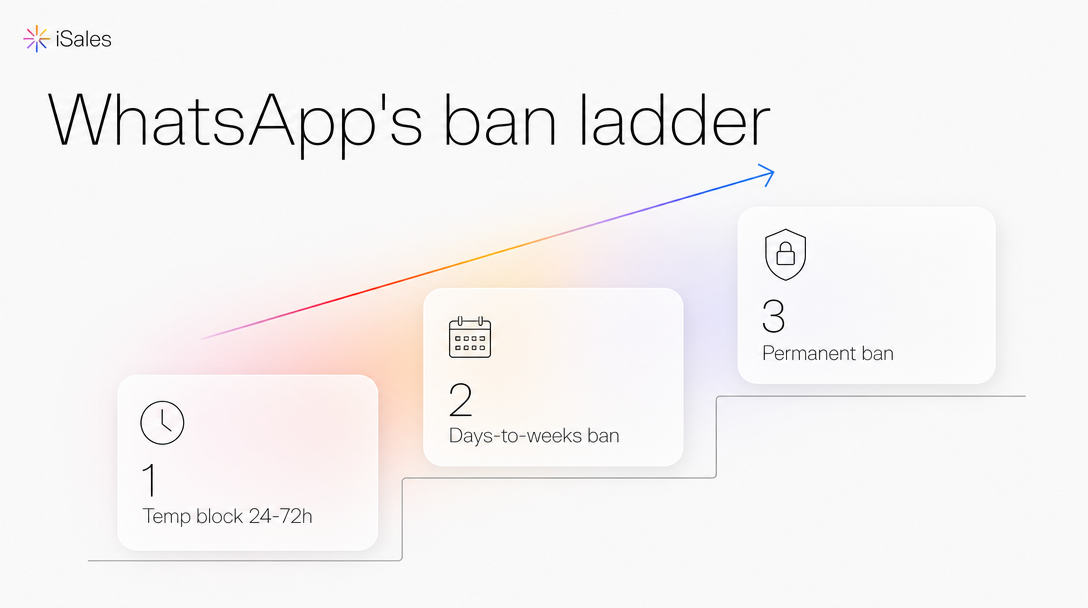 Each repeat offence climbs a rung — the block gets longer until the ban is permanent.
Two behaviours climb that ladder fastest:
- The same message to many people in a short window. Identical text fired at a list is the clearest bot signature there is.
- Messages to people who don't have you saved. Writing strangers who never opted in looks like exactly what spam is.
Above both sits the single heaviest signal: recipient complaints. A short burst of "report" taps does more damage than any proxy or number-rotation trick can undo. If people flag your messages, no anti-ban feature saves the number.
The four levers that actually move risk
Everything that genuinely lowers risk reduces to four things you can control. None is magic; together they are the difference between reading as a person and reading as a botnet.
1. A warmed number with history. A number that has been used normally and is ramped up gradually reads as an established human account. A fresh SIM that messages 200 strangers on day one reads as a bot and gets treated like one. Warmup is just the slow build of that trustworthy pattern over time; skip it and the number looks new and suspicious.
2. Hard send caps and random gaps. Volume and rhythm are signals. A safe sender holds a low daily and hourly ceiling and puts randomized gaps between messages, so the pattern looks like a person typing rather than a script firing. "Faster" is the single most expensive thing you can chase, because speed is what the filters watch.
3. A different message to every contact. This is the biggest lever of the four. Identical text to a list is the one thing every anti-spam system is built to catch. An AI that writes each contact a genuinely different message — different wording, order, framing — removes the signature that a template broadcast can't hide. It is also the one lever a cheap blaster structurally cannot pull, because it has no model writing per contact.
4. Consent and an auto-pause on complaints. Message people who know you and agreed to hear from you, and watch the complaint rate as you go. The moment complaints tick up, a careful setup stops sending on its own rather than pushing into a ban. Consent is the input that keeps the complaint rate low enough for the other three levers to matter at all.
Four things sold as "protection" that aren't
For every real lever there is a decoy the market sells harder, because it's easier to package. None of these move the odds the way the label claims:
| Sold as protection | What it actually does | Verdict |
|---|---|---|
| An "anti-ban" mode or extension | Often the exact behaviour Meta bans — the 131 flagged extensions were literally marketed this way | ❌ A name, not a mechanism |
| Virtual / burner numbers as a shield | You lose numbers faster and cheaper; no history means no trust | ❌ Trades one number for many bans |
| "Unlimited" / "no limits" sending | Removes the one lever (caps) that protects you | ❌ The tell of a burner tool |
| A proxy or VPN by itself | Hides your IP, not your behaviour; content and pace still convict you | ❌ Necessary at best, never sufficient |
If a tool's headline feature is on the right-hand list, you are buying reassurance, not risk reduction.
What "careful" actually costs
Here is where a purpose-built setup earns its place, and where its limits are worth naming out loud. iSales runs an AI agent on your own regular WhatsApp number — no Business API migration, no template approvals — and enforces the four levers by default: a 7-day warmup, then a deliberately conservative 50 messages per day and 15 per hour, each message AI-written differently per contact, with an auto-pause when complaints rise. You run the whole thing from Telegram.
That 50-per-day ceiling is slow on purpose. A 5,000-contact list will take months at that pace, and that is a real constraint you plan around. If your instinct is to blast, this will frustrate you, and that friction is the product working as intended.
A worked example makes the trade concrete. Say a coach has ~1,000 past-lead contacts and wants to announce a new cohort:
- The careful path: 7 days of warmup, then 50/day. The 1,000 messages go out over roughly three weeks (that clock is the daily cap, not the warmup), each one written differently. AI messages are usage-billed from balance at a rough $0.01–0.02 each (illustrative rate — plug in your own numbers), so the whole run costs on the order of $10–20 on top of the $49/mo agent subscription.
- The blaster path: all 1,000 identical messages fire in an afternoon, and the number is on the ban ladder by the second campaign.
Keep the two costs separate in your head: the $49 subscription and the per-message rate are the certain spend; what a torched number costs you in lost reach is a risk you're choosing to lower, not a number anyone can quote you.
When you should not use any of this
The most useful thing a guide like this can do is send some readers away:
- A small consented list you can hand-send. If you have a few hundred people who know you and you can personally message them over a couple of evenings from your phone, you need no tooling at all. A human-paced burst to people expecting it rarely trips anything.
- A cold, scraped, non-consenting list. No tool makes that safe. This is not a tooling problem you can buy your way out of; it is a consent problem, and in some markets a legal one.
- You need compliance certainty. If you want audited templates and a paper trail, the official WhatsApp Business API is the correct, boring answer. Providers like Wassenger (≈€39.90–€99.90/mo plus Meta conversation fees, research-dated), Wati or AiSensy give you template-approval determinism that a linked-device setup cannot. You trade your regular number and some flexibility for certainty. That is a fair trade for many businesses, and it is the one row where the unofficial approach loses outright.
The unofficial, AI-per-contact path — where tools like 2Chat (≈$29+/mo, research-dated) also sit — is for messaging your own base on your own number with real personalization. It is not a licence to reach strangers at scale.
Your ban-risk audit (copy it)
Before your next broadcast, score your setup. Copy this and fill it in:
WhatsApp ban-risk self-audit (copy me)
| # | Question | Lower risk | Higher risk |
|---|---|---|---|
| 1 | Is the number aged and warmed, or fresh? | Used for weeks, ramped gradually | New SIM, blasting day one |
| 2 | What's your daily / hourly cap? | Low, fixed, with random gaps | "Unlimited" / no cap |
| 3 | Is each message different? | AI-written per contact | One template to everyone |
| 4 | Did every recipient opt in? | Your own consented base | Scraped / bought list |
| 5 | Do you auto-pause on complaints? | Yes, below a threshold | You find out via the ban |
| 6 | Where's the "protection" claim? | "Reduces risk, no immunity" | "No-ban, guaranteed" |
Reading it: every answer in the right-hand column is a lever pointing the wrong way. Rows 3 and 4 carry the most weight — fix those first. If row 6 is on the right, treat everything else the vendor says with suspicion.
FAQ
Does buying a "pre-warmed" number help? Rarely. Trust comes from a consistent pattern over time on a number you use, not from a history you didn't build. A bought number with no relationship to your contacts often trips faster.
What complaint rate is safe? There is no published safe number, which is the point. Treat any uptick as a stop signal and pause before it climbs, rather than chasing a threshold Meta won't confirm.
Official API or unofficial for me? If you need audited templates, compliance certainty, or you're messaging cold audiences, go official. If you're messaging your own consented base on your own number and want real per-contact personalization, the unofficial path fits — with the discipline above.
What happens the moment a number gets flagged? Usually a temporary block first. The right move is to stop sending immediately, not to rotate to a new number and repeat the behaviour — that's how a 72-hour block becomes a permanent one.
Sources and method
- Socket / Malwarebytes, "Over 100 Chrome extensions break WhatsApp's anti-spam rules" and follow-ups, October 2025 — malwarebytes.com, thehackernews.com.
- Ban-ladder structure and top triggers: WhatsApp anti-spam enforcement, corroborated across vendor and security reporting (directional, not a published Meta figure).
- Competitor prices are research-dated (mid-2026) and drift: Wassenger ✅, 2Chat ⚠️, Wati/AiSensy ⚠️. Re-verify before acting.
- iSales pricing and enforced caps ($49/mo agent; 7-day warmup, 50/day, 15/hr) reflect current product configuration; per-message broadcast rates are illustrative and usage-billed.
If you message your own list, on your own number, and you want the four levers enforced by default instead of hoped for — connect your WhatsApp agent and start the warmup. It reduces ban risk by design. It does not sell immunity, because no one can.