TL;DR: You can automate your regular WhatsApp number and message your own list without moving to the official Business API. What you cannot buy is immunity from bans, and anyone selling "no-ban blasting" is selling a fairy tale. Three things genuinely move the odds: a warmed number, a daily cap you respect, and a different message written for each contact instead of one text sprayed at everyone. This guide maps the whole decision, and tells you the one case where you should skip all of it and use the official API.
- Who it's for: creators, coaches, agencies, and small businesses with a phone list they already own.
- What you'll get: the three-way choice (your number vs official API vs a blaster), the real limit numbers, a calculator to size any list before you send, and a clear "don't do this if…" line.
- Last updated: 2026-07-05.
The whole stack, in one map
"WhatsApp automation" is really five separate decisions stacked on top of each other. This page is the hub; each link goes to the deep dive.
- The account you run on — your regular number or a WhatsApp Business API (WABA) account. (See: official API vs unofficial automation.)
- Ban risk — what a ban actually is and why "no bans" is a myth. (See: why "no bans" is a myth.)
- Warmup — the 2–3 week ramp that earns a new number some trust. (See: the number-warmup schedule.)
- Daily limits — how many messages a day is survivable, and why faster loses. (See: WhatsApp daily limits.)
- The message itself — one text to all versus AI-written per contact. (See: AI personalization.)
Everything below is the pillar-level version of those five. If you only read one section, read the calculator near the end: it turns "how big is my list?" into "how many weeks and how many dollars."
The one promise to distrust, and the three levers that move the odds
Meta does not publish an allow-list for automation. Every tool that touches your regular number is, technically, pretending to be a WhatsApp Web session, and Meta detects and bans on spam behavior. So "guaranteed no ban" is not a feature anyone can ship. The real version is a set of levers that lower the probability:
- A warmed number. A brand-new number sending 300 messages on day one reads as a spam bot. A number that started slow and grew over weeks reads as a person.
- A daily cap you actually respect. The cap is not a suggestion. "Send everyone today" is the exact behavior detection is tuned for.
- A different message per contact. Identical text sent to hundreds of people is the single loudest spam signal there is. This is the lever most people ignore, and the one AI changes.
None of these removes risk. Together they move it from "your number dies on campaign two" to "your number behaves like a busy human." That's the whole game, and it's worth settling before any tool enters the conversation.
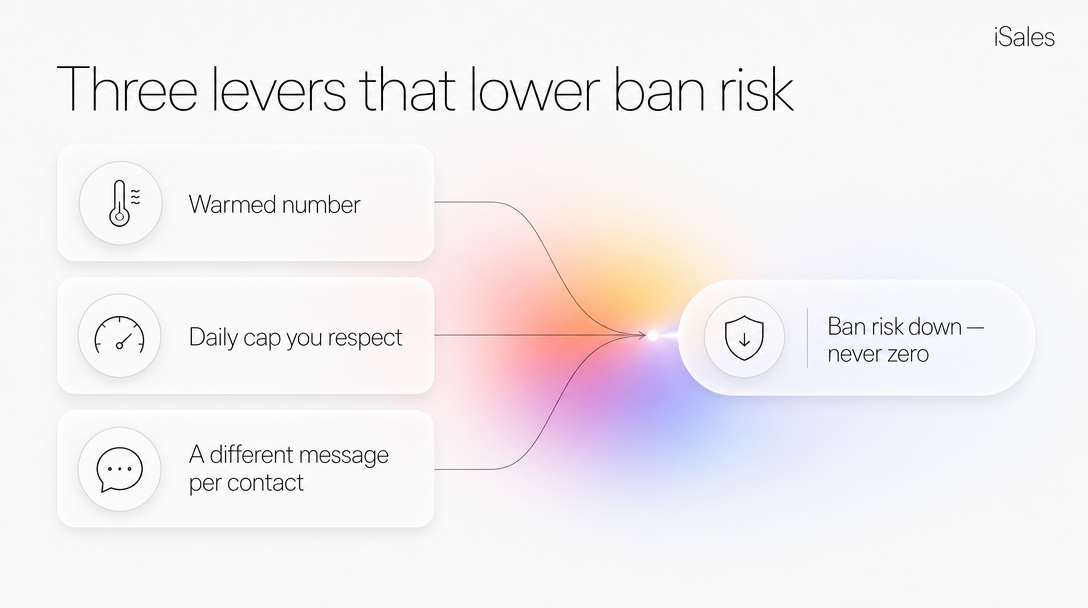 Three levers lower the odds of a ban; none of them takes the risk to zero.
Your own number vs the official API vs a blaster
Three paths, three different trades. The comparison decides most of the argument.
| Official API (Wati / AiSensy) | Blaster / Chrome extension | Your regular number, run with discipline | |
|---|---|---|---|
| Account | WABA only, not your existing number | Your number, used until it dies | Your existing number, linked device |
| Message | Pre-approved templates | One text to everyone | AI-written, different per contact |
| Ban risk | Near-zero if you follow the rules | High; "no ban" is a lie | Reduced by design, not zero |
| Cost shape | Platform sub + per-message Meta fee | Cheap upfront, number is the cost | Usage-billed + a flat agent sub |
| Cold lists at scale | Handles them (with opt-in + templates) | Torches the number | Not the right tool |
| Where you run it | Web dashboard | The flagged extension | From Telegram |
Read the two bold rows in the official-API column carefully, because they are the rows an unofficial number loses. If your job is high-volume outreach to cold, non-opted-in contacts, or you need guaranteed template delivery at scale, the official API through a Business Solution Provider is the near-zero-risk path and this guide is not for that job. The unofficial path wins for a different job: your own warm list, your real number, real conversations, no template approval queue.
For price context, a popular official-API tool like Wati lists plans around $49 / $99 / $299 a month and you still pay Meta per message on top (research-dated 2026-07, verify on their site). AiSensy lists a free platform tier with the same Meta per-message cost underneath (research-dated 2026-07, verify on source). The official path is not expensive because someone is gouging you; it's expensive because you're paying Meta for guaranteed, policed delivery.
Warmup and daily limits: the numbers that keep a number alive
Warmup is boring and it works. A defensible ramp looks like this: start at 10–20 messages a day, mostly replies to people who message you first, and grow over two to three weeks toward a steady daily cap, with randomized gaps between sends rather than a machine-gun burst. Industry integrators converge on the same shape: warm for at least ~10 days and keep steady-state volume conservative (many RU integrators recommend staying under ~200/day even on aged numbers).
A tool built for this enforces the cap for you. iSales, for example, holds a new number to 50 messages a day and 15 an hour with a 7-day warmup floor before a broadcast can ramp. That looks slow next to a blaster's "send 1,000 now." It is slow. That's the point: the slow pace is the thing keeping the number alive. The deep numbers, day by day, live in the warmup schedule and daily limits spokes.
The lever most people skip: a different message to each contact
Say a boutique fitness studio wants to re-engage ~800 past clients before a new term. The blaster way: paste one message, send it 800 times. Detection loves that; so do the recipients who see the same forwarded-looking text and report it.
The other way: the same offer, rewritten per contact. One opens with the class they used to book, one references how long it's been since their last visit, one is two lines because that person always replies short. To a human it reads like you actually typed it. To a spam filter, 800 distinct messages don't cluster into a signature. An AI agent's job here is concrete: write 800 non-identical, on-voice messages so you never send the one duplicate that gets you flagged. The mechanics are in the AI personalization spoke.
What warmup cannot fix
Here's the part the "no-ban" sellers leave out. Warmup and randomized delays change your behavior signal. They do not change the protocol signal. Any unofficial tool connects with an older Web-protocol fingerprint, and when Meta ships an update, that fingerprint is detectable regardless of how human your timing looks. Independent write-ups on unofficial automation are blunt about this: delays reduce the behavioral tell, they do not mask the fingerprint.
What that means in practice: respond-only automation on your own number carries genuinely low risk, while proactive outreach to brand-new contacts carries real risk that no warmup fully erases (vendor analyses of unofficial automation put the two profiles at very different yearly ban rates, directionally low-single-digit versus something like 15–30%). Discipline moves the number a lot. It never reaches zero. A tool that shows you the risk is more trustworthy than one that promises it away.
Size your list before you send
This is the one thing to bookmark. Copy the table, fill the middle column, and read the two bottom rows. The worked example is the studio above; the right-hand numbers are illustrative, so use your own.
| Step | Your number | Worked example (studio, own list) |
|---|---|---|
| ① Contacts on your own list | ___ | 800 |
| ② Safe steady sends per day (at a 50/day cap) | ___ | ~50 |
| A. Days to reach everyone = ① ÷ ② (plus a 7-day warmup) | ___ | ≈ 3 weeks |
| ③ Cost per AI-personalized message (usage) | ___ | ~$0.015 |
| B. Broadcast cost = ① × ③ (your numbers, not ours) | ___ | ≈ $12 |
| ④ Flat agent subscription while it runs | ___ | $49 / month |
Line A is the headline that matters: reaching your own 800 contacts is a three-week job, not a one-afternoon blast. Line B is the usage cost of writing each message with AI, billed per action from a prepaid balance rather than a flat "unlimited" tier; the per-message figure is a ballpark, not a quote. The subscription for the always-on WhatsApp agent runs $49/month (day-pass $3.30, annual $490). One number worth flagging: the $3.30 day-pass is a trial of the agent, not a way to "run a broadcast for $3.30" — warmup alone takes a week, so a day cannot clear a list. Sizing a list this way is the whole discipline: the calendar, not the price, is what protects the number.
When an unofficial number is the wrong tool
Skip everything above and go straight to the official Business API if any of these is you:
- You need to reach cold, non-opted-in contacts at hundreds a day. Warmup won't save that number; the protocol fingerprint plus the spam reports will end it.
- You need guaranteed template delivery at scale (OTPs, order updates, notifications to a big base). That is exactly what the official API is built for, and what it charges Meta to guarantee.
- You are in a regulated vertical where a compliance team requires the sanctioned channel.
The unofficial, your-own-number path is for the opposite shape: a warm list you already own, real back-and-forth conversations, and a number you'd rather use than replace. If that's not your situation, the right answer is to pay for the official rails.
Consent and your list
You are messaging your own base from your own number, which keeps you on the right side of most platform rules, but consent is still your responsibility, and the binding rule is legal, not just platform-level. In the US, promotional messaging to mobile numbers sits under the TCPA (prior express consent; regulators have increasingly read business texting to include app channels, so treat WhatsApp the same way). In the EU/UK, GDPR and PECR want a lawful basis and a clear opt-in for marketing. Give people an easy opt-out either way: a "reply STOP to unsubscribe" line tends to reduce complaints, and complaints are a primary trigger for a review. Treat "it's my list" as necessary, not sufficient, and confirm your own jurisdiction's rule.
FAQ
Can I still run ChatGPT or Copilot on WhatsApp? Not through the official Business API. Per industry reporting, Meta began restricting general-purpose third-party AI assistants (ChatGPT, Copilot, Perplexity and similar) from operating over WABA around January 15, 2026 (confirm the current terms on Meta's policy page). Running your own agent on your own regular number is a different arrangement and isn't covered by that change.
What actually happens when a number gets banned? The number loses WhatsApp access, usually without warning and often permanently. There's an appeal path with a low success rate. This is why the whole discipline exists: you're protecting an asset you can't easily replace.
Is a burner number a good idea? Only if you're prepared to lose it. Burners have no warmup history and no trust, so they're the fastest to get flagged. A real number you warm and pace lasts far longer.
Is this the same as a mass-mailer? No. A mass-mailer sends one text to everyone as fast as possible and burns the number in a campaign or two. The approach here is the opposite: paced, capped, and personalized per contact.
Next step
If your job is your own warm list on your own number, the AI Growth Starter walks you through connecting a number, turning on warmup, and drafting your first per-contact broadcast. Connect your WhatsApp agent and start warmup.
Sources & last updated
- Meta restriction on third-party AI assistants over WhatsApp Business API, effective Jan 15, 2026 — industry reporting, 2026.
- WhatsApp per-message pricing change (per-template billing), effective Jan 1, 2026 — AiSensy, 2026.
- Official vs unofficial WhatsApp API and the protocol-fingerprint detection mechanism — Kraya AI / Omnichat / Wisemelon, 2026 (vendor analyses, corroborated).
- Wati and AiSensy pricing — wati.io, aisensy.com, research-dated 2026-07 (verify on source).
- Warmup and daily-volume guidance — TextBack, GREEN-API, 2025–2026 (integrator documentation).
Competitor prices checked July 2026 — list prices, subject to change.