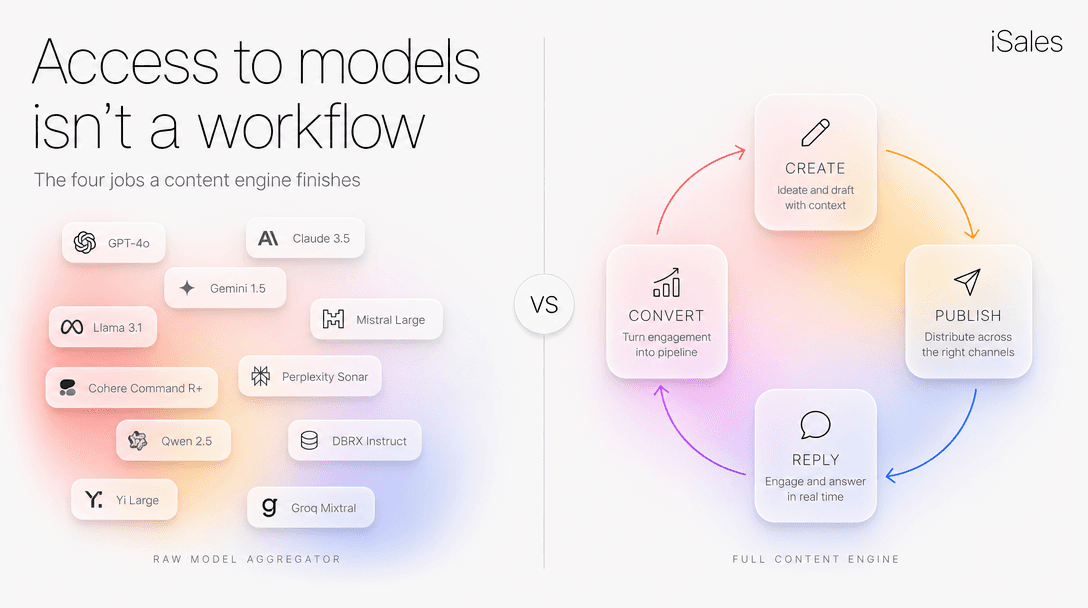
TL;DR: Buying "all the models in one place" or stacking an AI writer + scheduler + chat tool solves the generation problem. It leaves the workflow problem untouched: the asset still has to get published, the audience it earns still has to be answered, and that reply still has to become a lead. Every tool in your stack meters you in a different unit — words, channels, contacts, generated posts — and not one of them is "a finished post that got a reply." That mismatch is why you can't say what a result actually costs. This is a guide to spotting the gap, with a 30-second test you can run on your own tools.
For: marketers, creators, and small teams comparing an AI tool stack (or an all-in-one model aggregator) and wondering why "more AI" hasn't made the content job feel finished. Last updated 2026-07-05.
The one-line verdict
If your problem is "I want to try every model" or "I need a draft, fast," access to models is exactly the right purchase — and it's cheaper than a workflow. If your problem is "I publish regularly, people reply, and I keep dropping those replies," no amount of model access closes that. You need something that owns the whole line, not the first inch of it.
Most comparison articles rank these tools on model breadth and price-per-unit. That's the wrong axis. The axis that decides whether you keep paying is: how many of the four content jobs does this thing actually finish?
What "access to models" actually buys you
The pitch is seductive, and half of it is true. After five years of "more tools is better," this year's consolidation commentary keeps naming the result: bloat — overlapping subscriptions held together by API calls, with Gartner's survey work suggesting teams use maybe a third of what they pay for. So "one login instead of ten" is a real relief, and an AI writer that drafts a week of posts in a minute is genuinely useful.
But look at what you're buying: the supply of raw material. A model turns a prompt into words, an image, or a clip. That is where the work begins. The moment the asset exists, four jobs remain, and the tool that made it does none of them. This piece is about one part of that: telling access apart from a workflow.
The four jobs a content workflow finishes
A content asset only earns its keep when it completes a loop. Name the loop and the gap becomes obvious:
- On-brand. The asset sounds like you, grounded in your offer and your knowledge, not generic model-default voice.
- Published. It lands on the channels where your audience is, on schedule, without a copy-paste relay through a second tool.
- Replied-to. The DMs, comments, and questions that a good post earns get answered, in your voice, whether or not you're at your phone. This is the who-answers-the-DMs-at-night half of the job.
- Converted. That reply becomes a booked call, a qualified lead, or a paid order in the same chat, ideally without kicking the customer out to a third app.
An AI writer nails job 1 and stops. A scheduler does job 2 and stops. A chat tool can attempt job 3 but knows nothing about the post that triggered it. Aggregators sell you a shelf of engines for job 1: the widest shelf, but still only job 1. Nobody owns the seam between them, which is exactly where the customer falls through.
Picture it concretely. A coach ships a carousel at 9pm; by morning it's earned 40 DMs: "is there a payment plan?", "do you work with beginners?". The tool that made the carousel answered none of them. The coach copy-pastes replies at breakfast, loses the three who already bought elsewhere, and calls it a good post. It wasn't finished. It was generated.
The meter test (run it on your own stack)
Here's the tell, and it's fast. Ask each tool you pay for: "what did one published post that got a reply cost me?" Then look at the unit the answer comes back in:
- An AI writer answers in words or credits.
- A scheduler answers in channels or seats.
- A chat tool answers in contacts or conversations.
- A post generator answers in generated posts.
- An aggregator answers in tokens, and, tellingly, two aggregators can't agree what a token is: one sells you 260 of them for the price the next sells you twenty million. Same word, wildly different unit, and neither maps to a post that got answered.
Not one of those units is "a finished post that got a reply." That gap isn't a pricing detail; it's the proof that the tool doesn't model the outcome you actually care about. If your tool can't price the result, you're paying for access and supplying the workflow yourself.
Copy this and fill it in for your own stack; the last column is where the gap shows:
| The content job I do weekly | Which tool does it | What it's metered in | Can that tool price ONE finished, answered post? |
|---|---|---|---|
| Draft the posts | words / credits | ||
| Make the image or carousel | generated posts | ||
| Publish everywhere | channels / seats | ||
| Answer the DMs it earns | contacts | ||
| Turn a reply into a lead/sale | — (no tool) |
If the bottom rows are blank, you found your gap.
The real bill: four meters, one job unfinished
Add up a typical creator stack and the incompatible-meter problem becomes a money problem (mid-2026 list prices, verified this month, they drift):
- Jasper (writing): Pro ~$59/mo, metered in words.
- Buffer (scheduling): ~$5–10 per channel/mo, metered in channels.
- ManyChat (chat): from ~$29/mo, plus a separate ~$29/mo AI add-on, metered in contacts.
- Predis.ai (carousels/video): Lite ~$32/mo, metered in generated posts.
That's four bills, four dashboards, four meters, and the seam between "Predis made the carousel" and "ManyChat answers the DM it earned" is owned by no one. You are the integration.
A workflow prices the other way: by the action, so the outcome is legible. iSales runs on one prepaid balance — the text content pack (a plan plus three posts) is free, and a visual bills per action from that same balance: a carousel slide from $0.30, an image from $0.25, paid by card, crypto, or Stars. It isn't always cheaper per generation. But you can read the receipt: this action cost that, out of the loop, not a fourth subscription.
Where an aggregator genuinely wins
A workflow is the wrong buy for a lot of people, and a comparison that hides that is worthless.
Raw model breadth is a row the aggregators win outright. A big aggregator puts 50–90+ models on one shelf: Midjourney's latest, Sora-class video, Suno for music, and usually day-one access to whatever dropped this week. A workflow curates a smaller frontier roster tuned to publishing, not exploration. If your job is "audition every image model this month," "make a track," or "always have the newest release the day it ships," the aggregator is the better tool and it isn't close. A content engine trades that breadth for depth on the four jobs. That trade is real, and you should make it with your eyes open.
When NOT to switch
Skip the workflow, genuinely, if any of these is you:
- You post a few times a month and you're usually at your phone when replies come in. The copy-paste relay is annoying, not expensive. Stay on the single cheap tool.
- You already have publishing and customer replies handled by a setup you like, and you only need a generation source. Buy the widest, cheapest model access and bolt it on.
- You're a hobbyist or a heavy explorer who wants the model zoo. That's what aggregators are for.
The threshold is simple: a workflow only pays for itself once you're running a real content-to-customer loop, meaning you publish on a cadence, earn inbound, and want those replies handled and converted. Below that line, access to models is not just fine, it's the smarter spend. Above it, you're paying four meters to still be the glue yourself.
How to decide in 30 seconds
The 3-question buy test
- Does content you publish earn replies you have to answer? If no → you need generation (an aggregator/AI writer), not a workflow.
- Can your current tools price one finished, answered post? If no → you're buying access; the seam is on you.
- Do you want the reply and the lead handled in the same place the content is made? If yes → that's a workflow, and it's the only thing on this list that closes the loop.
Two "no"s means stay where you are. A "no" on #2 and a "yes" on #3 is the switch worth making.
FAQ
Isn't an all-in-one aggregator already "consolidation"? It consolidates the models — one login for many engines. It doesn't consolidate the workflow; you still leave to publish and answer elsewhere. Consolidating the model shelf and consolidating the job are different purchases.
Is this a Jasper alternative? For the writing job alone, Jasper (or any AI writer) is a fine tool and often a cheaper one. The reason to look past it is the other three jobs: an AI writer hands you a draft and stops, so if you also need it published and the replies handled, you're back to assembling a stack. Treat "workflow vs writer" as the real fork, not "which writer."
I already have ChatGPT. Why more? ChatGPT hands you a draft you move by hand. If it never has to be published on a schedule or answer a customer, keep ChatGPT. If it does, that's the same fork — see ChatGPT vs a sales assistant.
Will a curated roster limit my creative range? For exploration, yes; see the section above on where aggregators win. For shipping on-brand content on a cadence, the frontier models a workflow includes are the same engines the studios use. What shrinks is the model zoo; the output quality holds.
Can't I just wire my tools together with Zapier or Make? You can automate the handoffs between them, and for simple posting that helps. What automation can't do is give one system shared context: the scheduler still doesn't know which post earned the DM, and the chat tool still can't file it as a lead against the campaign that produced it. You're gluing meters together, not closing the loop.
Next step
Run the meter test on your own tools first — that's the useful part of this article whether or not you ever switch. If the bottom rows came back blank and you want to see the loop instead of just the model, answer four questions and get a free 7-day content plan plus three on-brand posts: start here →. First value is text, no card; visuals unlock when you top up.
Sources & last updated
- Aggregator/tool pricing (mid-2026 list prices, verified this month, subject to change): jasper.ai/pricing · buffer.com/pricing · manychat.com/pricing · predis.ai/pricing.
- Martech consolidation context: chiefmartec "State of Martech 2026"; martech.org, "Martech 2026: AI drives a major industry reset"; Gartner MarTech utilization survey (directional).
- Product pricing: per-action billing, published pricing page.
Competitor prices checked July 2026 — list prices, subject to change.