Short answer: at night, the lead doesn't wait for you. A message that lands at 11:47pm goes to whoever replies first, and by 9am that's often not you. You don't need a night shift to fix it. You need a setup that does four things a "we're closed, back tomorrow" autoreply never does: answers the actual question from your own information, sounds like you wrote it, captures who the person is, and moves them toward a booking. This guide shows what that takes, gives you a checklist to test your current setup, and tells you the one case where you should not automate this yet.
TL;DR
- The cost of a missed after-hours message is the booking it hands to a faster competitor by morning, not the reply you eventually type.
- A plain autoreply acknowledges; it doesn't answer and it doesn't carry the lead. Those are different jobs.
- The founder's real fear isn't "can AI reply" — it's "will it sound like me and get my facts right." That's a setup problem, not a magic one.
- Under roughly five after-hours messages a week, don't automate. A free away-message is enough. Stay there.
The message that lands at 11:47pm
Picture a real evening. You run a small studio. It's 11:47pm and a message comes in: "Hey, do you have anything for tomorrow morning? What's the price?" You're asleep. The customer is not; they're comparing three accounts they messaged in the same ten minutes.
By the time you see it at 9am, either they booked with the account that answered at 11:49pm, or they're still waiting and slightly annoyed. Naiva, one of the vendors in this space, describes it directly: "by the time you [reply], the customer has already booked somewhere else."
Most advice stops here, at "be available 24/7." That's the easy half. The hard half is what a reply at 11:49pm actually has to contain to keep that customer.
"Captured" vs "carried" — the half the autoreply pitch skips
Search this problem and you'll meet a confident number. A typical vendor guide leads with "prevents up to 70% of lost customers." You can't verify that, and neither can they — it isn't a figure anyone measured in your business. So set it aside and look at the two things you can actually reason about.
What's certain: the questions repeat, and you re-answer them by hand. Naiva's own read is that "roughly 8 out of 10 DMs to a service business are the same handful of questions: price, availability, location, 'is this for me?'" Whatever your exact split, a large share of your after-hours messages are questions you've answered a hundred times. Right now you re-type them at 9am, or a plain autoreply defers them to "we'll get back to you." Both cost the customer time they've decided not to spend.
What's a hypothesis, kept separate: some of those were real leads that cooled. You cannot know how many, so don't pretend to. On a conservative read (say one in four of your night messages was a genuine buyer, and one books elsewhere each week) that single lost booking already outweighs what an assistant costs to run. The version that survives scrutiny is two sentences, not one dramatic total: here's the time you definitely spend, and here's a bounded guess at what you might be leaking. Anyone who fuses those into one number is selling you the guess.
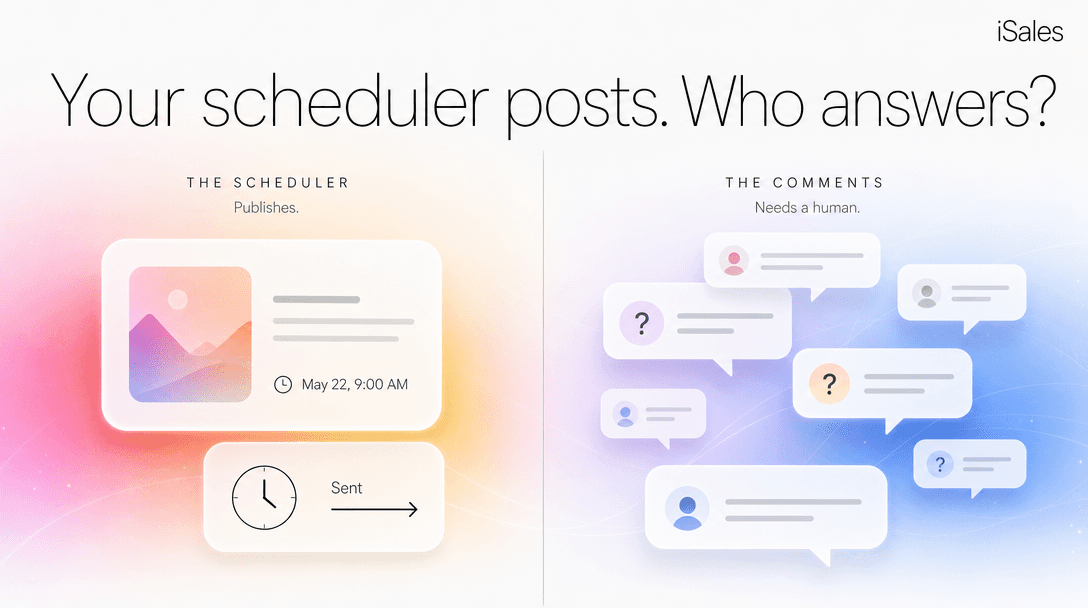
That reframing is the whole point. The job isn't to capture the message — a form does that. It's to carry it: answer, qualify, and hand you a warm lead instead of a 9am to-do.
The After-Hours Capture Checklist
Here's a test you can run on whatever you use today — an away-message, a script bot, or nothing. Copy the table, mark each row for your current setup, and count the misses.
| # | Your after-hours setup should… | Your setup? |
|---|---|---|
| 1 | Reply now, not in the morning — within a couple of minutes, not "we're back at 9am" | ☐ |
| 2 | Answer the actual question from your own prices/services, not a generic "thanks, we'll be in touch" | ☐ |
| 3 | Sound like you — your phrasing and tone, so the customer can't tell it isn't you | ☐ |
| 4 | Capture who they are — a name and a way to reach them, saved, not lost in a notifications list | ☐ |
| 5 | Move toward the booking — offer a slot, a link, or the one next step, instead of ending the thread | ☐ |
| 6 | Know when to flag you — recognize the odd or high-stakes question and hand it to a human cleanly | ☐ |
How to read your score. Miss one row and you'll survive it. Miss two or more and the lead leaks: the customer either waits, gets a canned non-answer, or talks to a bot that clearly isn't you and bounces. Rows 3 and 6 are where cheap automation fails: a keyword bot can nail rows 1, 2, 5 and still fail row 3 badly enough to lose the sale.
Three ways to cover the night — and what each actually does
There are really three options, and they're often confused because vendors blur the line between them.
| Away-message | Marketing / script bot | An assistant that answers | |
|---|---|---|---|
| What it is | Telegram Business auto-text; the built-in "we're closed" | Keyword→reply flows (e.g. ManyChat-style) | AI that reads the question and replies from your info |
| Answers the real question? | No — acknowledges only | Only if you scripted that exact path | Yes, from your prices/services |
| Sounds like you? | It's one fixed line | Robotic on anything off-script | Trained on your voice and materials |
| Carries to a booking? | No | Sometimes, on a rail | Yes — qualifies and offers the next step |
| Setup effort | ~2 minutes | Hours of flow-building | A sitting to feed it your info |
| Cost shape | Free | Flat monthly, or per-contact | Per action, from a prepaid balance |
Two caveats on that last row, because the table shouldn't only flatter one column. A flat-rate script bot can be genuinely cheaper at very high volume: if you're fielding thousands of messages a day, a fixed monthly plan beats paying per action, and you should do that math. And the assistant costs you a real setup sitting the away-message doesn't. It's only as good as the information you give it, and it will confidently get an unusual question wrong on its first nights, so you'll want to skim what it said each morning for a week. That oversight is the price of it sounding like you instead of like a script.
Where the assistant earns its place is rows 2, 3, 5 working together: it answers the actual question, in your voice, and pushes toward the booking, across every channel you use, from one setup. The same brain can answer in Telegram, WhatsApp and Instagram, so "one voice, everywhere" isn't three separate tools to wire up. That cross-channel part is exactly what the platform-siloed guides skip.
When you should not automate this yet
If you get under roughly five after-hours messages a week and you're usually near your phone anyway, don't buy anything. Set the free Telegram Business away-message so no one hears silence, and reply yourself when you surface. At that volume the setup sitting costs more than the leak, and you'll answer better by hand. The threshold that flips it: once you're re-typing the same answers past your bedtime often enough to notice, the tool is cheaper than the tax you're already paying in time.
This is also the boundary against over-trusting it. An assistant is for the repeat questions and the first-touch qualify. A genuinely sensitive or unusual message should trip row 6 and land in your lap. The setup should reduce your night work, not silently make decisions you'd want to make yourself.
What answering at night actually costs
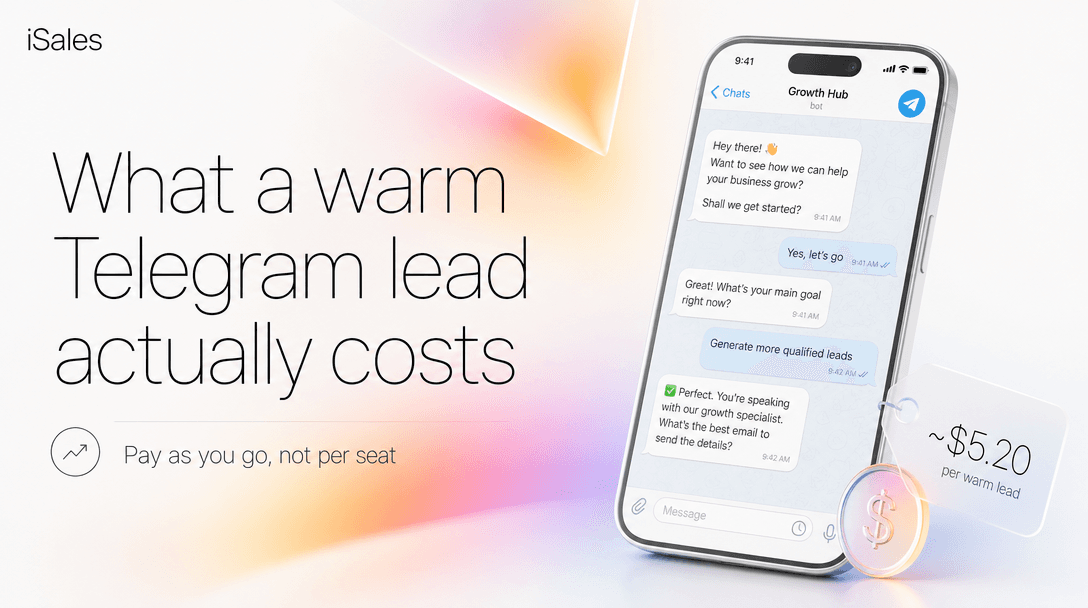
The reason a night shift never made sense is cost. You can't pay a person to sit up for the handful of messages that matter. Software changes the unit. With a usage-based assistant you pay per action from a prepaid balance: a text reply runs a few US cents, with no monthly floor to clear. Compare that to Intercom's Fin at $0.99 per resolution, billed over a 50-outcome monthly minimum (roughly $49.50 to start), with lead-qualification outcomes around $9.99 each (figures from Intercom's pricing, checked July 2026). The two meters aren't the same unit: a Fin "resolution" can span several replies and is charged only when it actually resolves, while a prepaid balance debits each reply, including the ones the assistant fumbles. Even so, for a solo studio fielding roughly 120 after-hours conversations a month, per-resolution pricing adds up to real money, while the same month on a balance stays in cents-per-reply territory. Pay for the nights that produce, not for a seat you'll never fill. Your first thirty replies cost nothing.
If you want the assistant to reply in your voice specifically, your phrasing and your sign-offs, that's the difference between an assistant and copy-pasting from ChatGPT, and it's worth reading before you decide.
The setup is four questions about your business, and it replies in a test chat the way you would, in a few minutes. If the checklist above showed two or more misses in your current night coverage, that's the gap to close.
Try it free, no card: open it in Telegram
FAQ
Will customers know it's a bot? Good practice is to let it sound like you and hand off cleanly on anything sensitive (row 6), not to hide it. The goal is a helpful first reply at midnight, not a disguise. Most price/availability questions don't need a human; the odd ones do, and it should route those to you.
Will it get my facts wrong at night? It answers from the information you give it, so accuracy tracks your setup. Feed it your real prices, services and FAQs, and skim its replies for the first week. It will miss an edge case early — that's the argument for keeping the flag-to-human step, not for staying up yourself.
Can it really reply in my voice, or is that marketing? Voice fidelity comes from training on your materials and examples, not from a "human tone" toggle. A keyword bot can't do it; an assistant grounded in your own writing can get close enough that customers don't clock it. It's the single thing to test in the free demo.
Will automating DMs get my account banned? Answering people inside your own chats and your own bot is normal use and isn't the risky part. The ban-risk conversation belongs to outbound mass messaging, a different activity with its own limits, not what after-hours answering is.
Sources (accessed 2026-07-05). Intercom Fin pricing: intercom.com/pricing, fin.ai ($0.99/resolution, ~$49.50 floor, ~$9.99 lead outcome). Tidio Lyro: tidio.com/ai-agent ("~67% of inquiries automated"). Naiva: naiva.ai ("8 of 10 DMs are the same questions"; after-hours framing). ManyChat: manychat.com/pricing (AI add-on). Our own economics (a prepaid balance charged per action, a text reply ≈ a few US cents, first thirty messages free): see the pricing page. Competitor figures are research-dated and may change. Updated 2026-07-05.