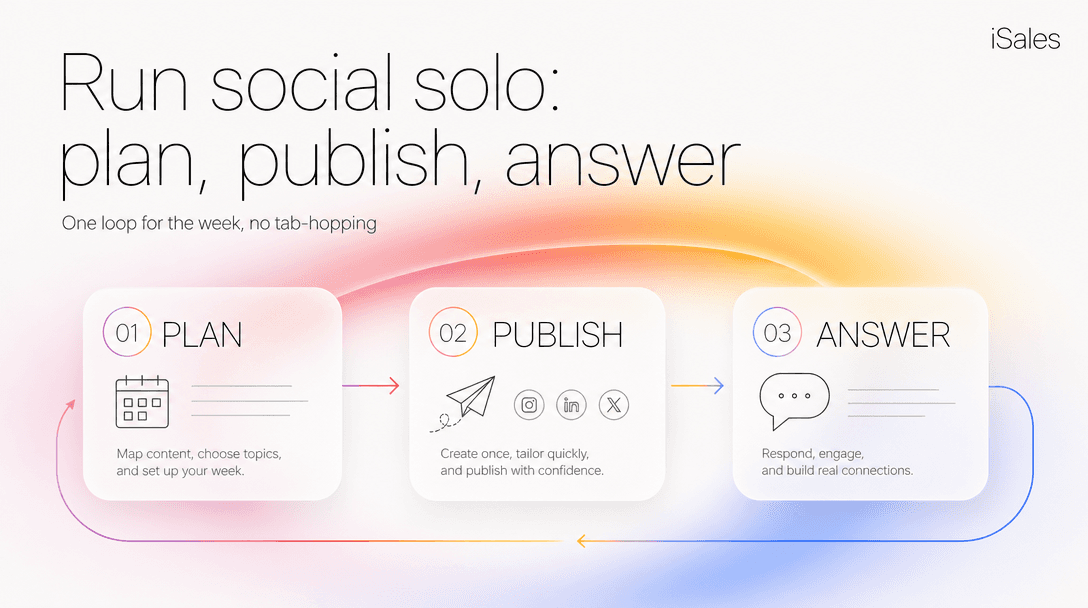
TL;DR: Most content tools automate one stage of the job. A writer drafts, a scheduler publishes, an inbox tool replies. The stage nobody automates is the handoff between them. A post that ships at 2pm and earns a buying question at midnight sits in a fourth app until morning, because the tool that published it can't see the reply it caused. This guide maps that three-stage seam, hands you a copy-paste worksheet to price your own version of it, and marks the line where closing the loop is worth it (and where it isn't).
- Who it's for: creators, SMMs, and small agencies already running two or three content tools.
- What you'll get: a function-coverage table, a fill-in "map your stack" worksheet, and a threshold for when the seam is worth closing.
- Last updated: 2026-07-05.
The stage no roundup scores
Search content workflow automation and every result is a list of tools sorted by job. Zapier's own roundup of social tools says it in one line: "No single tool spans all functions equally." An AI-content roundup this year put the same thing another way: "most teams use two or three tools across formats rather than one for everything."
Those two sentences describe a gap and call it normal. The lists rank a writer against a writer and a scheduler against a scheduler, because that is how the tools are built and sold. What no list scores is the space between the boxes: the moment a generated post becomes a published post, and the moment a published post becomes a reply you now have to answer. That space is where the work actually leaks.
Call it the seam. It has three stages and, in most stacks, three logins and three bills.
Three jobs, three tools, three bills
Here is how today's tools cover the three stages. Prices are list prices as of July 2026, taken from each vendor's own pricing page; they drift, so treat them as a snapshot.
| Tool | Generate | Publish | Reply to the audience | Where it fits |
|---|---|---|---|---|
| Jasper (from $69/seat/mo) | ✅ | ❌ | ❌ | Writes marketing copy. Doesn't post, doesn't answer. |
| Predis.ai (from $19/mo) | ✅ | ✅ | ❌ | Makes carousels/video and schedules them. No DM replies. |
| Buffer ($5–10/channel/mo) | assist | ✅ | light | Publishes; folds engagement into a bundled inbox. |
| Hootsuite ($99–399/user/mo) | assist | ✅ | inbox | Publishes + a unified inbox for moderation. |
| ManyChat ($29/mo + $29 AI add-on) | ❌ | ❌ | ✅ | Automates DM replies. Its AI is a separate line item. |
| Chatbase / Intercom Fin (from $32/mo · $0.99 per resolution) | ❌ | ❌ | ✅ | A support agent that answers. Bolted on, not born in your content. |
Two things stand out. First, the "all-in-one" managers (Buffer, Hootsuite) do treat reply as an inbox, but it's a moderation inbox: disconnected from what the content was about and who it was aimed at, and none of them generate on frontier models. Second, the reply-side tools (ManyChat, Chatbase, Intercom Fin) answer well, but they never saw the post that caused the message. Every stack still needs a human to carry the work across the gap between the boxes. That carry is the seam, and it is unpriced on every list.
Where the seam actually tears
A worked moment, illustrative but true to how the day goes.
You publish a carousel at 2pm through your scheduler. It does its job and reaches people. At 11:40pm one of them replies to the post: "is this available for delivery this weekend, and how much?" That is a buying question. In a three-tool stack, the scheduler that published the post has no idea the reply exists. The message lands in a fourth app's inbox, or a raw DM folder, and waits. You see it at 9am. By then the buyer has asked two competitors the same thing.
Nothing in that story is a tool failing at its job. Jasper wrote well. The scheduler published on time. The inbox tool would have answered politely if a human had opened it. The loss happened in the nine hours between published and answered, in the space no tool owns. Multiply it by every after-hours reply your content earns and you have the real cost of the seam. It doesn't show up as a bill. It shows up as buying questions that cooled.
Map your content stack (the worksheet)
Before you change anything, price your own seam. Copy this table and fill the blank cells. Keep two numbers strictly apart, because mixing them is how people talk themselves into (or out of) a decision on bad math.
Copy-paste worksheet:
| Stage | What it does | Your current tool | Your monthly bill | On one balance |
|---|---|---|---|---|
| Generate | text, image, carousel, video | pay per action | ||
| Publish | post to your channels | one posting sub | ||
| Reply | answer the DMs it earns | the assistant | ||
| Handoff | copy-paste, export, late replies | (hrs/week) | (see below) | one window |
Bucket 1 — the certain cost (the bill you can read off invoices). Total the tool column. Say your stack is Jasper Pro ($69/seat), Hootsuite Professional ($199), and ManyChat Pro with the AI add-on ($29 + $29). That is roughly $326/month you can verify exactly. Your tools and numbers will differ; the point is this column is knowable to the cent.
Bucket 2 — the speculative leak (keep it separate; never add it to bucket 1). What does a buying question answered at 9am instead of 11:45pm cost you? You cannot know that precisely, so don't fold it into the certain total and don't build a dramatic single number out of it. Treat it as a hypothesis you test: count your after-hours buying replies for one week, guess a conservative close rate, and see whether the leak is small or scary. If it's small, the seam isn't your problem yet. If it's scary, no cheaper generator fixes it.
That split is the whole framework. The certain column tells you what consolidation saves in subscriptions. The speculative column tells you what the handoff is quietly costing beyond the invoices. Decide on both, separately.
What one balance across the seam looks like
If the worksheet shows a seam worth closing, the alternative to three logins is one loop that carries a post from generated to published to answered without a human relay in the middle. This is the gap iSales was built to hold: the same post is written in your voice, published to your channels, and then the assistant answers the person who replied to it, working from your knowledge base. One prepaid balance, priced per action instead of per seat.
In plain numbers: a text post costs cents; an image starts at $0.25, a carousel slide at $0.30; publishing everywhere is one $20/month line; the reply is included in the assistant. The reply and the post live in the same window, so the 11:40pm buying question gets answered while it's still warm.
Where this loses. If you want the deepest video model with a full editing timeline, a dedicated tool like Runway will out-finish it: you get the same frontier models here, but the editing workspace belongs to the specialists. And if you publish across a dozen networks and live inside per-network analytics, a mature scheduler like Hootsuite has more depth there than a loop tuned for the reply. A single balance wins on the handoff, not on being the deepest box at any one stage.
When NOT to close the loop
Some readers should stay exactly where they are. If you post a few times a month, almost nobody messages you outside working hours, and you're usually at your phone anyway, the seam isn't costing you anything worth paying to remove. A free scheduler and a chat model in a browser tab will do fine. The loop starts earning its keep when replies pile up faster than you can hand-carry them, which for most solo creators is somewhere above roughly five after-hours buying questions a week. Below that line, the tools aren't your bottleneck and you shouldn't buy one to pretend they are.
Bigger teams have the opposite reason to wait: if you need multi-stage approval workflows and per-network analytics that a compliance lead signs off on, a specialist stack you already trust beats a loop you'd have to migrate to. Close the seam when the handoff is the thing slowing you down. Not before.
FAQ
What happens when the assistant answers a customer wrong? It will get an edge case confidently wrong, especially in its first days on your knowledge base. You skim what it sends early, correct it, and it stops making that mistake. It shortens the copy-paste, it doesn't remove your judgment over what goes out.
Is one balance actually cheaper at high volume? Not always. At very high, predictable volume on a single stage, a flat-rate specialist can beat per-action pricing on that stage. The loop's saving is the handoff and the subscriptions you drop, not out-pricing any one box at scale. Use the worksheet's certain column to check your own case.
Does it replace my scheduler's analytics? No. It covers the create → publish → reply loop, not deep per-network analytics or reporting. If per-network analytics is your job, keep the specialist and connect the loop for the reply.
What about my data? You can clear history and export it, and the interface runs in 12 languages. Content ships in your voice, from your knowledge base, with your approval before it goes out.
Next step
Price your seam with the worksheet first. If it shows a handoff worth closing, the fastest way to feel the loop is to answer four questions and get a week of on-brand posts back, free, no card. Get your content pack on Telegram.
Sources & last updated
- Buffer pricing and the 2020 sunset of its "Reply" product — buffer.com/pricing, buffer.com/resources/sunsetting-reply
- Jasper, Predis.ai, Hootsuite, ManyChat, Chatbase, Intercom Fin — respective vendor pricing pages; list prices, mid-2026, subject to change
- Zapier, "The best social media management tools" — zapier.com/blog/best-social-media-management-tools
- Prices above are per-action from a prepaid balance; the free tier is 30 text messages. Figures stated in plain terms.
Competitor prices checked July 2026 — list prices, subject to change.