TL;DR: The famous 30% Telegram Stars fee does not come out of your payout. It is the markup Apple and Google add when your buyer funds Stars inside the mobile app, and your buyer pays it, not you. Your per-Star payout is roughly the same whether they bought on mobile or desktop. What you actually give up on Stars is the cash-out: a Fragment conversion fee, a 21-day hold, a 1,000-Star withdrawal floor, and subscriptions that can only bill monthly. So the real question on each sale is narrower: can your own card or crypto rail recover the buyer's overpay, and can you live with the hold? This piece gives you a copyable matrix to answer that per sale.
- Who this is for: creators, experts and coaches selling digital content or paid access to a Telegram audience who've heard "Stars take 30%" and aren't sure it's worth it.
- What you'll get: what the fee actually is, the cost you really pay, and a rail-choice matrix you can screenshot.
- Last updated: 2026-07-05.
What the 30% actually is (and what it isn't)
The 30% is not deducted from your Stars payout. It is Apple's and Google's standard in-app-purchase cut, charged to your buyer at the moment they top up Stars inside the iOS or Android app. It inflates what the buyer spends; it never touches your balance. Telegram credits a creator roughly the same amount per Star — about $0.013 at recent rates — regardless of how the buyer funded them.
That single fact rewrites the question. You are not "losing 30% of your revenue to Stars." Your mobile buyer is spending 30% more than the thing costs, and none of that extra reaches you. On a cheap sale, that overpay is a couple of dollars and nobody notices. On a real ticket, it is money your customer burns to reach you that you could have kept by routing them somewhere cheaper. And it disappears entirely if the buyer happens to top up Stars on Telegram Desktop or web, where there is no app-store cut.
So the 30% is real, but it is a tax on your buyer's convenience, not a skim off your income. The cost that is genuinely yours sits at the other end of the sale.
The part you actually pay: cash-out
Getting Stars back to money is where your own costs live, and there are four of them.
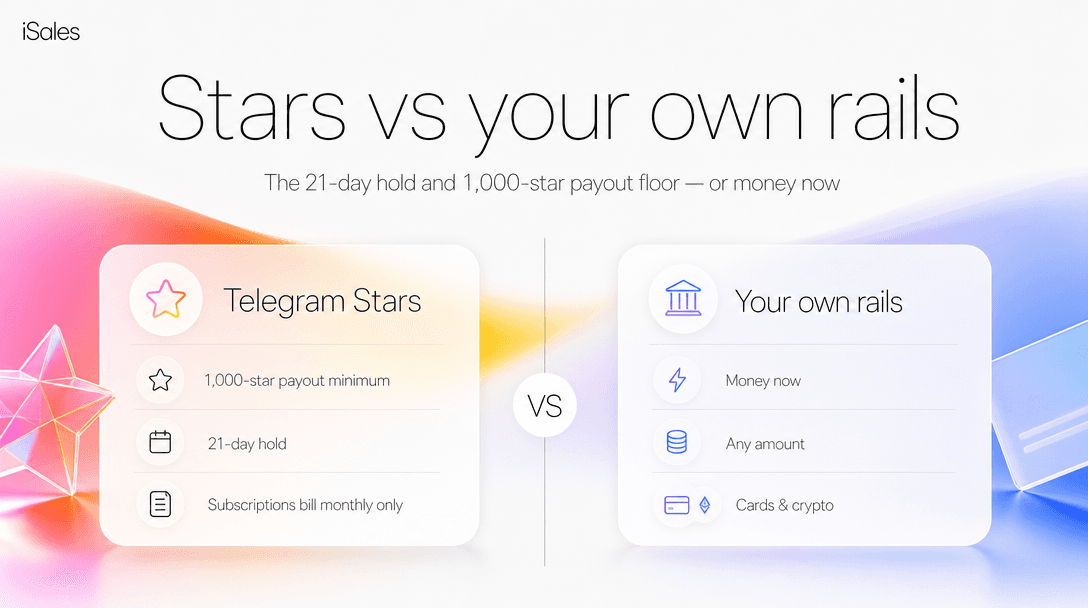
- A Fragment conversion fee, around 5% plus a small market spread, when you convert Stars to TON on Fragment, Telegram's official cash-out route. Add the exchange step to USDT and it lands near 6–8% all-in on a normal day.
- A 1,000-Star minimum. You can't withdraw a smaller balance, so early sales sit until they clear the floor (about $13 of payout value at recent rates).
- A 21-day hold. Each Star is locked for 21 days from when you received it, so this week's sales are not this week's cash.
- Monthly-only subscriptions. Telegram's native Star subscriptions can bill on one cadence only: monthly. There is no built-in annual or quarterly plan, and each mobile renewal re-pays the store markup.
None of this is a secret rate anyone escapes. It applies to every creator on every Stars-based tool. The sibling guide walks the full sell-and-withdraw steps and a fill-in net-take calculator if you want the arithmetic; here we use it to decide, not to compute. If you want that math, see sell content for Stars and cash out in USDT.
Your own card or crypto rail carries none of the four. Card acquiring runs around 2.8% (rising a little in 2026 as VAT applies to the commission), crypto stablecoin transfers cost cents on the right network, funds settle without a three-week lock, and you can bill any cadence you like. What it lacks is the one-tap, no-card checkout that makes Stars convert impulse buyers. That trade is the whole decision.
The rail-choice matrix
Copy this and match your situation. It flips on three things: the ticket size, whether your buyers are mostly on mobile or desktop, and whether the sale is one-off or recurring. The percentages behind it are 2026 market ranges (your numbers, and rates drift), so re-check before you price.
| Your sale | Buyers mostly on… | One-off or recurring | Use | Why |
|---|---|---|---|---|
| Cheap impulse content, under ~$15 (a preset, one video, a paid answer) | mobile | one-off | Stars | one tap, no card; convenience wins more buyers than the cash-out fee costs |
| Cheap impulse content, under ~$15 | desktop-heavy | one-off | Stars | desktop funding skips the buyer's overpay; on a sub-$15 ticket the one-tap checkout still beats the cash-out fee |
| Mid ticket, ~$15–50 (a bundle, a module, a paid consult) | mobile | one-off | Own rail | recovers most of the buyer's ~30% overpay, and no 21-day hold |
| Mid ticket, ~$15–50 | desktop-heavy | one-off | Either — thin gap | desktop Stars (~8% at cash-out) vs own-rail (~3%); decide by whether buyers hold cards |
| Large ticket, over ~$50 (high-value files, a full program, a retainer) | any | one-off | Own rail | the overpay plus cash-out on a big number is real money, and cash-flow matters |
| Membership / subscription | mobile | recurring | Depends | Star subs are one-tap but monthly-only and re-pay the markup each renewal; use your own rail for annual, quarterly or higher tiers |
| You need the money this week | any | any | Own rail | Stars lock for 21 days and need a 1,000-Star floor before you can withdraw |
| International or card-averse buyers | mobile | one-off | Stars | many people can pay Stars in a tap who won't or can't enter a card |
The matrix is the reusable thing here. Two rows deep it already tells most creators something the "Stars take 30%" headline never does: on cheap impulse content, Stars is often the right call even after fees, and the switch to your own rail is a big-ticket, mobile-audience, or cash-flow move.
The break-even line, with real numbers
Here is the flip that the matrix compresses, worked on a held-constant buyer dollar. Say a customer is willing to spend $20.
- Through Stars, mobile: they pay $20, Apple takes about $7 at the top-up step, Fragment takes about $1 at cash-out, and roughly $12 lands in your USDT wallet.
- Through your own card rail: they pay $20, acquiring takes under a dollar, and roughly $19.20 lands in your account.
- Through Stars, desktop: the same 1,000 Stars costs the buyer only ~$13 to fund (no app-store cut), you still net ~$12, and the own-rail alternative on that $13 nets ~$12.60 — a gap of well under a dollar.
Same $20 out of the customer's pocket, and on a mobile buyer your own rail keeps about $7 more; on a desktop buyer it keeps almost nothing extra. That is why device is a real axis, not a footnote. The line that falls out: once a single sale clears roughly $15–20 and your audience skews mobile, your own rail recovers enough of the markup to be worth the extra tap. Below that, or with a desktop-heavy or card-averse audience, Stars' one-tap checkout earns its fee.
One thing the numbers leave out on purpose: Stars can lift conversion. A no-card, one-tap payment closes more impulse buys than a redirect to a checkout, and on cheap content that lift can outweigh the fee. Keep that upside separate from the fee math — it is a real reason to pick Stars, but it is a guess, and folding a guess into a cost figure is how creators talk themselves into the wrong rail.
Where each rail honestly wins
A fair way to hold this is that neither rail is "better" — they win different rows.
| What you're optimizing for | Stars wins | Your own rail wins |
|---|---|---|
| Cheapest checkout for a $5 impulse item | ✅ one tap, no card | |
| Reaching card-averse / international buyers | ✅ | |
| Keeping the most on a $200 sale | ✅ recovers the mobile markup | |
| Getting paid this week | ✅ no 21-day hold | |
| Annual or quarterly billing | ✅ any cadence | |
| Native, familiar in-app subscription UX | ✅ monthly channel gating |
If you sell across that whole table, you don't want to pick one rail — you want to route each sale to the right one without running two tools. That is the narrow thing an assistant does here: it sells your content for Stars and invoices on the payment systems you already connected, in the same chat, so the matrix above becomes a setting rather than a spreadsheet. It is not the cheapest way to do any single row — a native Stars shop is simpler for one impulse item, and a non-custodial direct-USDT tool captures crypto at a lower flat fee with no hold. It earns its place only when you're doing several rows at once.
When not to bother switching
If you sell one cheap file now and then to a mostly-mobile audience and never invoice for services, don't move anything. Native Telegram Stars, or a focused Stars shop, already does that job, and the 30% your buyer overpays on a $5 item is not worth restructuring your checkout to save. The switch to your own rail — and the assistant that automates the choice — pays off when you're doing two things at once: selling impulse content and charging real money for consults or high-value files, and you're tired of watching the big tickets fund an app-store cut.
FAQ
Do I lose 30% of every Stars sale? No. The 30% is Apple's or Google's cut on your buyer's in-app top-up. Your payout per Star is roughly the same whether they bought on mobile or desktop. What you pay is the cash-out: a Fragment fee (~5% plus spread), a 21-day hold, and a 1,000-Star withdrawal floor.
Can my buyers avoid the 30% themselves? Partly. Topping up Stars on Telegram Desktop or web isn't subject to the app-store fee, so the same purchase costs them roughly a third less to fund. You can't force it, but for a desktop-heavy audience it quietly narrows the gap between Stars and your own rail.
Is a Stars subscription cheaper than my own recurring billing? It's simpler to set up and one-tap for the buyer, but it bills monthly only and each mobile renewal pays the store markup again. For annual plans, higher tiers, or a currency Stars can't reach, your own rail keeps more and gives you the cadence you want.
What's the smallest ticket where my own rail is clearly worth it? As a rule of thumb, once a single sale clears ~$15–20 and your buyers are mostly on mobile, the recovered markup beats the extra checkout friction. Under that, Stars usually wins on convenience.
Do I have to choose one rail for everything? No, and you probably shouldn't. Route cheap impulse content to Stars and real tickets to your own rail. The point of the matrix is that it's a per-sale decision, not a platform you marry.
Next step
If you want one setup that sells your content for Stars and invoices on your own payment rails from the same chat — so the matrix above is just a setting — you can try it on your first 30 messages free: open the assistant in Telegram. The pricing page shows the rails and per-action costs.
Sources & last updated
- Telegram Stars mechanics, Fragment cash-out, 1,000-Star minimum, 21-day hold, ~$0.013/Star payout — Telegram Stars documentation (Tier-1) plus creator guides (GramBase, StarsEarn, Telestars), research-dated 2026-07-05. ⚠️ Rates and rules drift; re-verify before pricing.
- Star subscriptions bill on a monthly period only — Telegram Star subscriptions documentation (Tier-1).
- App-store ~30% fee on in-app Stars purchases and the desktop/web exemption — Telegram Stars documentation and Apple/Google in-app-purchase policy, 2026.
- Card acquiring (~2.8%, plus VAT on the commission from 2026) and crypto/USDT transfer costs — payment-provider fee pages and network fee explainers, research-dated 2026-07-05.
- Product mechanics (sells content for Stars, invoices on your own connected rails, both in one chat).