Short answer: the number you compare when shopping for an AI assistant ($0.99 a resolution, $29 a month, $14 a plan) is almost never the number you pay. What you pay is decided by the unit your bill is pegged to, and three are on the market: per resolution (your bill grows as your customers do), per contact/seat package (you pay for capacity whether you use it or not), and per action (you pay for work actually done). Same "cheap" sticker, three very different monthly bills. Below: the two traps hiding inside the cheap stickers, a fill-in calculator for your own volume, and when each model — including a plain flat plan, or none of them — is the right answer.
- Who this is for: anyone comparing an AI assistant / support chatbot and trying to predict the real monthly cost.
- What's inside: the "what does your bill track?" framework, Intercom Fin's per-resolution math, ManyChat's contact-tier trap, a copy-and-fill calculator at 500 / 2,000 / 5,000 conversations, and a "don't buy this yet" section.
- Competitor prices are quoted from public pages on 2026-07-05 and drift — re-check before you decide.
The price you compare isn't the price you pay
Pricing pages are built to be scanned, and a scan rewards the smallest visible number: "$0.99 per resolution" beats "$49 a month," and "Free" beats both. But those numbers answer different questions. The one that actually predicts your bill is duller: when my business grows, which way does this line move? A per-resolution price climbs with every customer you help. A packaged plan steps up as you cross contact or seat tiers, and keeps charging when you're quiet. A per-action balance moves with the work done, not the people served or the seats reserved.
You can't feel the difference at ten conversations. You feel all of it at five thousand.
Three units, three curves
Strip the branding off and every AI-assistant price is one of three units. This is what actually decides your bill:
| What your bill tracks | You pay for… | The bill grows when… | Feels cheapest when… |
|---|---|---|---|
| Per resolution (e.g. Intercom Fin) | each conversation the AI successfully resolves | you get more customers | volume is tiny or spiky |
| Per contact / seat package (e.g. ManyChat, most SaaS tiers) | reserved capacity (contacts, seats, message caps) — used or not | you cross a tier line | you fill a tier exactly |
| Per action (usage from one balance) | the actual work done — a reply, an image, a transcription | you do more work | volume is steady and mid-to-high |
None of these is a scam. Each is genuinely cheapest in one column and quietly expensive in another. The mistake isn't picking the "wrong" one. It's comparing three stickers without noticing they're pegged to three different things. Pick the unit whose curve matches how your volume behaves, then compare stickers within that unit.
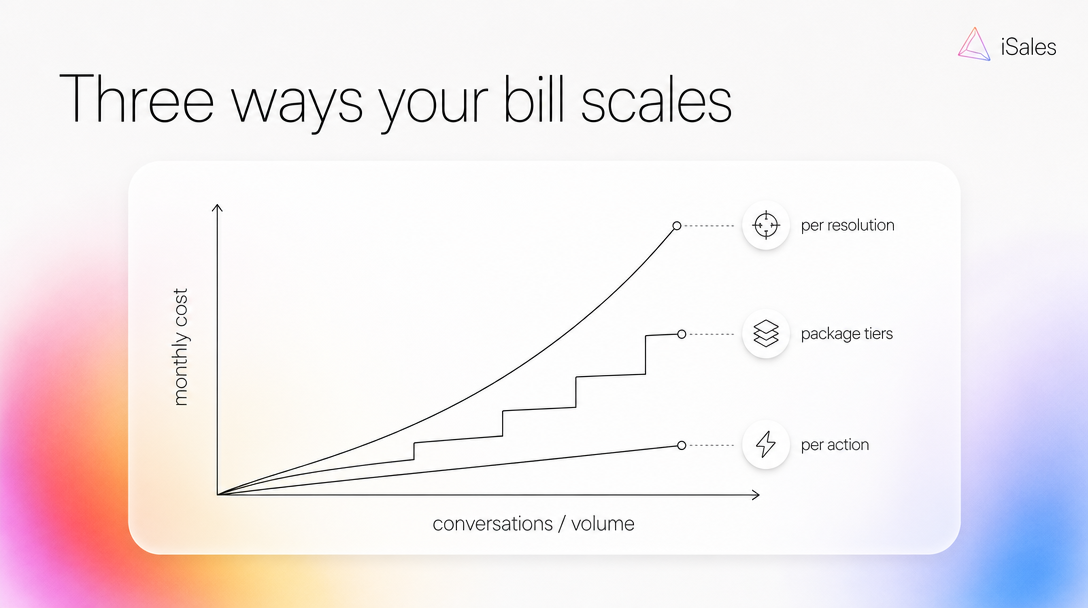 Three units, three shapes: per resolution climbs with every customer, package tiers step up, per action rises with the work you actually do.
The per-resolution trap: why $0.99 stops being cheap
Intercom's Fin is the cleanest example because its price is genuinely simple: $0.99 per resolution (Intercom calls it an "outcome"), on a base plan of $49/month that includes 50 resolutions, with extras at $0.99 each (fin.ai, checked 2026-07-05). A lead-qualification outcome is $9.99. Seats are separate, roughly $29–$132 each depending on plan. Fin only charges on a successful resolution, once per conversation, so you don't pay for failed attempts. Worth knowing exactly what triggers the charge: Intercom counts a resolution when the customer confirms Fin solved it, or simply doesn't come back to ask for more after Fin answers (fin.ai). So not every conversation bills — but you can't know your resolution rate until you're live.
Ninety-nine cents to close a support ticket is a fair price. The problem is the arithmetic of scale. Here's the line at four volumes:
| Resolutions / month | At $0.99 each | vs the $49 sticker |
|---|---|---|
| 50 | included in base | $49 |
| 500 | ~$495 | +10× |
| 2,000 | ~$1,980 | +40× |
| 5,000 | ~$4,950 | +100× |
That $4,950 is a ceiling, not a bill: it's 5,000 × $0.99 assuming every conversation resolves. In practice only a share resolve, so split the number into two buckets:
- Certain: the rate is $0.99 per resolution. That won't move.
- Unknown: what fraction of conversations Fin actually resolves. If two-thirds resolve, 5,000 conversations bill ~3,300 resolutions ≈ $3,300; if half, ~$2,475. Your real bill is resolution-rate × conversations × $0.99 — a range you should estimate before signing, not a single scary figure.
Either way, the shape is the point: the line goes up and to the right with your own success. The month your marketing works and inbound doubles is the month your support bill doubles too. That's the anxiety per-resolution buyers describe: the bill spikes exactly when customers need you most.
The other trap: ManyChat's tiers, the $29 AI line, and a gutted free plan
ManyChat is a different animal that people file under the same "cheap chatbot" heading, and it hides its cost somewhere else. Its billing tracks active contacts, not resolutions — and in a March 2026 restructure the shape changed (manychat.com, via 2026 pricing roundups, checked 2026-07-05):
- The free plan dropped from 1,000 contacts to 25 — a sandbox now, not a usable tier.
- Paid tiers by contacts: Essential $14 (250 contacts), Pro $29 (2,500), Business $69 (7,500).
- The actual AI — real conversational answering — is not in any plan. It's the "AI Step" add-on at +$29/month on top.
So ManyChat's curve doesn't spike with resolutions; it step-jumps every time your audience crosses a contact line, and it carries a flat $29 AI tax the sticker doesn't show. "$29 Pro" is really "$29 + $29 = $58 before your contacts outgrow the tier." Same lesson, different mechanism: the number on the pricing page is not the unit doing the billing.
Two traps, two directions — one pegs your bill to your customers, the other to your reserved capacity plus a fixed AI surcharge. Neither is visible on the front of the box.
Run the numbers on your own volume
Here's the artifact worth keeping. Pick your realistic monthly customer conversations, then convert it into each model's own unit, because the conversion is where the real cost hides. The cells below use stated assumptions so they're actually computable; swap in your own. (The per-resolution row here applies a ~60% resolve rate, which is why 5,000 conversations reads ~$2,970, not the $4,950 ceiling from the last section.)
| Your monthly conversations → | 500 | 2,000 | 5,000 | Your #: ____ |
|---|---|---|---|---|
| Per resolution (Fin) — the $4,950 ceiling × a ~60% resolve rate × $0.99 | ~$300 | ~$1,190 | ~$2,970 | ____ × 0.6 × 0.99 |
| Contact package (ManyChat) — driven by contacts, not conversations¹ | ~$43 (≤250) | ~$58 (≤2,500) | ~$98 (≤7,500) | your tier + 29 |
| Per action (one balance) — illustrative ~$0.01–0.03 / text reply² | ~$5–15 | ~$20–60 | ~$50–150 | replies × your rate + media |
¹ ManyChat bills by active contacts, so map your audience size to a tier, not your conversation count; the $29 AI Step is on top of every tier ($43 = Essential $14 + $29; $58 = Pro $29 + $29; $98 = Business $69 + $29). ² We can't print a single "$X per reply" — a reply is priced by tokens × model × the intelligence tier you pick — so this row assumes one ~1–3¢ text reply per conversation, plus any images or video at their shown price. Treat it as your numbers, not ours; the real per-reply median is a figure to pull before you decide.
What matters is the shape of each row, not which is cheapest today. The per-resolution row is a rocket: it multiplies with volume. The contact row is a staircase: flat, then a jump, then flat, plus a fixed AI line. The per-action row tracks the work itself; it doesn't spike because you got popular, and it doesn't bill you for a half-empty tier. Where the rows cross depends on your volume, your resolve rate, and how heavy your conversations are — a crossing point you only see with your own numbers in the cells.
When per-resolution — or a flat plan — is the right call
A metered per-resolution price isn't a con, and it beats everything else in one real case: spiky or very low volume. A flurry of tickets in December, near-silence in February, and per-resolution means the quiet month costs almost nothing — you're not reserving capacity you don't use. If that's your shape, Fin's model works for you.
And a plain flat plan wins its own row: predictability at stable low volume. A prepaid, pay-per-action balance is a variable line: it moves month to month, and if you budget in fixed rows, that's friction. If you handle a steady trickle of conversations, want exactly one number on the invoice, and don't need the assistant to also write content or take payments, a cheap flat plan ($14 Essential, $49 Fin base) is simpler and easier to forecast than any balance. That's the row usage-based loses: one fixed, boring, predictable number.
Per-action can also lose on raw money, in one case: if your conversations are long or media-heavy — lots of generated images, video, multi-step actions — a metered balance can run past a flat plan. Usage-based rewards lean interactions and charges you for sprawling ones. If most of your "conversations" are really content-generation sessions, price that separately before you assume per-action is cheaper.
And the real "don't buy anything yet" line: if you get under ~5 inbound customer messages a day and you're usually at your phone, none of this pays for itself. Copy-pasting from ChatGPT when a message comes in is free and fine. The math only turns in favor of a dedicated assistant when the volume — or the after-hours gap — is big enough that the copy-paste is costing you real time or real leads.
Pay-per-action fits the middle and up: steady volume past a casual trickle, where a per-resolution bill has started to rocket and a reserved package wastes seats. That's the case for running your volume through a pay-per-action model — one balance, priced by the work rather than by your customer count or a reserved tier.
FAQ
Is Intercom Fin's $0.99 per resolution good value? For low or spiky ticket volume, yes — you pay near-nothing in quiet months. At scale it's the most expensive shape in this comparison, because the bill multiplies with every resolution. Estimate resolution-rate × conversations × $0.99 before committing, not the raw ceiling.
What exactly counts as a Fin "resolution"? Per fin.ai (checked 2026-07-05): the customer confirms Fin solved their issue, or doesn't come back for more help after Fin answers. A configured hand-off to a human can also count. You're charged once per conversation and only on success — not for failed attempts or escalations. That definition is why your resolution rate (and therefore your bill) is impossible to pin down before you go live.
Do I pay for Fin and a seat? On Intercom, generally yes: Fin's $0.99-per-resolution sits on top of a base plan, and human seats are billed separately (roughly $29–$132/seat/mo, ⚠️ 2026 roundups). So the per-resolution line isn't your whole bill — it's the line that grows fastest.
What's the catch with a "cheap" ManyChat plan? Two catches: the real conversational AI is a separate $29/month add-on, and billing tracks active contacts, so the plan step-jumps as your audience grows. The 2026 free tier is 25 contacts — a demo, not a workable plan.
Isn't pay-per-action unpredictable too? It's variable, yes. That's the trade against a flat sticker. But it's variable with work done, not with your customer count, and heavy actions show their price before they run. If you need one fixed number and have stable low volume, a flat plan is the calmer choice; that's a real reason to not pick usage-based.
Do these prices change? Constantly. Everything here is dated 2026-07-05; ManyChat restructured in March 2026 and Intercom is mid-acquisition. Treat every figure as a checkpoint, re-verify on the vendor's page, and compare the unit, which changes far less often than the sticker.
Next step
Want the crossing point on your own numbers instead of an average? Take your realistic monthly conversations and run them through a pay-per-action model — the first 30 messages are free, no card. For what an assistant like this actually does day to day (and where you still want a human), start with the guide to an AI assistant for business.
Sources & updated
- Intercom Fin — $0.99 per resolution, $49 base plan (50 resolutions included), $9.99 lead-qualification, charged once per conversation on a successful outcome; a resolution = customer confirms or doesn't return after Fin answers: fin.ai pricing pages + intercom.com/pricing (research-dated 2026-07-05, ⚠️ verify current). Human seats ~$29–$132/seat/mo (2026 pricing roundups, ⚠️ directional).
- ManyChat — March 2026 restructure; Free 25 contacts, Essential $14 / Pro $29 / Business $69 by contacts, AI Step add-on +$29/mo: manychat.com/pricing + 2026 pricing roundups (research-dated 2026-07-05, ⚠️).
- Per-resolution market range (~$1–$6; Zendesk ~$1.50, Freshchat Freddy ~$0.49): 2026 chatbot-pricing roundups (directional, ⚠️).
- Our model — prepaid USD balance, pay per action, free 30 messages, no per-resolution fee, no seat lock-in; a text reply is priced by tokens × model × intelligence tier (illustrative, not a fixed per-reply figure): see pricing.
- Updated: 2026-07-05.