TL;DR: Most "how to monetize a bot" guides answer a different question than the one you're asking. They tell you how to monetize the audience around the bot — run ads in it, sell a subscription, drop affiliate links — or they wire it to Stripe/Shopify and send buyers off to a checkout. All real. The move most 2026 guides skip is the fourth one: making the assistant itself take the money — invoicing on payment rails you already control, and selling digital content inside the conversation. This guide maps all four so you pick the one that fits.
Who this is for: creators, experts, and small operators who already answer people in DMs and want the same chat to get paid. Last updated: 5 July 2026.
"Monetize a bot" means two different things
When people search "make money with a chatbot," they get two answers stitched together and rarely told apart:
- Monetize the audience around the bot. The bot is a distribution channel. You sell ad slots inside it, gate a subscription behind it, or route affiliate links through it. The money comes from attention: you need reach.
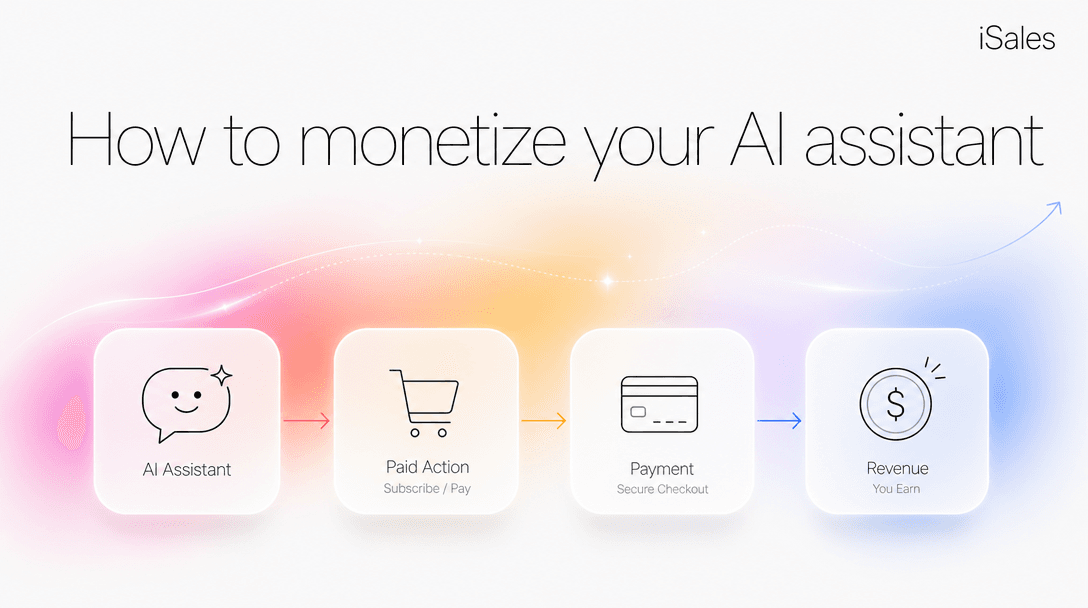
- Monetize the assistant itself. The bot is the seller. It consults, then charges for the consult; it holds your paid content and sells it in the thread. The money comes from the work the assistant does: you need demand, not necessarily a huge following.
Almost every ranking guide is about the first one, because that's the older, easier-to-explain model. This guide spends most of its time on the second, because it's where the 2026 shift is and where most write-ups stop. But it's worth saying up front: for a lot of people, the first model is the right answer.
The four models — and which one is actually yours
Here are the four working models, what you keep from each, and the catch. Read the last column carefully: three of these might be a better fit than the fourth.
| Model | Best when | What you keep | The catch |
|---|---|---|---|
| Ads / sponsorship in the bot | You have real reach (tens of thousands of active users) | The whole sponsor fee | Needs scale; irrelevant if you have a few hundred engaged people |
| Paid access / subscription | You have recurring, gated value (a club, signals, a course) | Sale minus payment fees | Churn is real; one-off buyers won't subscribe |
| Affiliate in-chat | You recommend other people's products naturally | A commission slice | You don't own the product or the customer; low margin |
| The assistant takes payment | You sell your own time, answers, or content in the conversation | Sale minus rail fees (you set the rails) | You have to actually converse and close; overkill for a single static link |
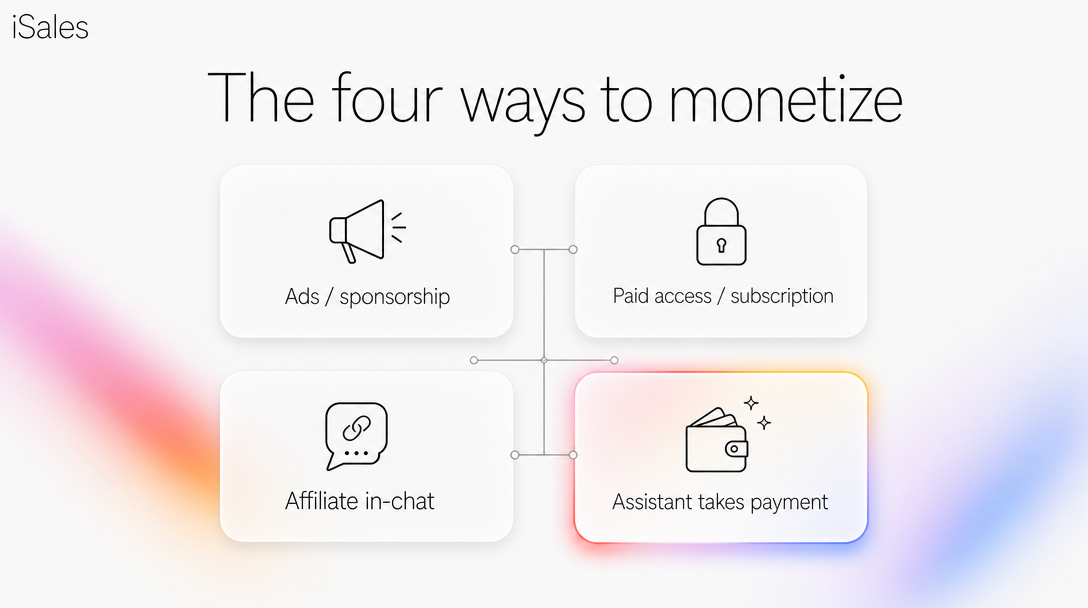 The four models at a glance — three monetize the audience around the bot, one lets the assistant itself take the money.
So which is yours? If you run a 50k-subscriber media channel, your money is in ad slots and affiliate — the fourth model is not your priority, and you can stop reading here. If you have a catalog people browse and you want a public, SEO-able storefront, a storefront + subscription is your lane (more on that below). The fourth model — the assistant taking the payment — is for the person who is already answering paid-intent questions by hand: the expert doing free consults in DMs, the creator whose "how do I buy this?" replies happen at midnight, the coach whose method is worth money one answer at a time.
"The assistant takes the money" — the two modes that work today
If the fourth model is yours, it runs in two concrete modes. Neither is exotic; both work in Telegram right now.
Mode 1 — invoice on your own rails. The assistant consults, and at the right moment it issues an invoice through the payment systems you connected — your cards, your crypto, your own account. The buyer pays inside the chat; the money lands on your rails, not the platform's. This is the mode for bigger tickets and services: a paid consult, a diagnosis, a done-for-you quote.
Mode 2 — sell content for Stars. The assistant holds your photos, videos, or files and sells them for Telegram Stars, delivers the purchase in the thread, and pays you out in USDT. This is the impulse rail: a paid guide, a premium post, a locked video — bought and delivered without leaving the conversation.
This is where the tools diverge, and the differences are specific, not sweeping. A content bot like Telestars sells for Stars — but only Stars, with no way to invoice on your own card rail, running in a "secretary" mode on your account. A chatbot builder like ManyChat converses well — but hands the actual sale to Shopify or Stripe, so the payment leaves the chat. A platform like Salebot does take payment in-chat — but you assemble the funnel by hand, with the AI acting as support, not as the thing you're monetizing. The narrow slice that nobody else bundles into one conversational assistant is the union: iSales is the only assistant that sells your content AND invoices on your own payment systems AND does it in one chat. (Each of those pieces exists separately elsewhere — it's the combination in a single assistant that's the wedge.)
What Stars actually costs — and when to invoice instead
The most common objection is "Stars takes a big cut," and it's true — but the number depends on where the buyer taps, and it's never a clean handoff. Here's the real fee stack (⚠️ figures are 2026-dated; verify current rates):
- Stars bought in the iOS/Android app carry the ~30% Apple/Google store fee before anything else.
- Stars bought on desktop/web are far cheaper — roughly 3–4%.
- Cashing Stars out to USDT isn't one hop: it typically routes Stars → TON via Fragment (~5%), then TON → USDT on an exchange.
- Your own card rail (invoice mode) runs about ~3% at any ticket size.
So the fee math doesn't have a "Stars wins below $X" break-even — on pure fees, your own rail is cheaper at every ticket. What Stars buys you is convenience and impulse: a buyer taps once, no card form, no invoice. The real decision is when the fee delta is worth the extra friction of invoicing, and that grows with ticket size. Fill in your own numbers (model both where the buyer taps — mobile Stars is the expensive case, desktop Stars is close to your own rail):
| Your sale | Stars, mobile (~30% + payout path) | Stars, desktop (~3–4%) | Your own rail (~3%) | Fee delta (mobile Stars → own rail) |
|---|---|---|---|---|
| $ ____ (impulse content) | ≈ $ ____ kept | ≈ $ ____ kept | ≈ $ ____ kept | $ ____ |
| $ ____ (a consult / service) | ≈ $ ____ kept | ≈ $ ____ kept | ≈ $ ____ kept | $ ____ |
Rule of thumb: for small impulse content, Stars' one-tap convenience can be worth more than the few percent you'd save by invoicing — that's a friction call, not a fee one (your own rail still keeps more of every sale). For anything service-shaped or a bigger ticket, the mobile-Stars fee delta gets large enough that the invoice pays for itself. Route each sale by where it's bought and how big it is, not by dogma.
Storefront vs conversational assistant: where each one wins
A conversational assistant is not strictly better than a storefront — they win different rows. Work out which one you actually need:
| Storefront (Whop / Stan / Tribute) | Conversational assistant | |
|---|---|---|
| Public, browsable, SEO-able catalog page | ✅ Yes | ❌ No — it's a chat, not a shop window |
| Discovery / affiliate marketplace | ✅ Some (Whop) | ❌ Not the model |
| Flat-fee, 0% platform-cut option | ✅ Yes (Stan ⚠️ ~$29/mo, 0% txn) | ❌ Stars carries the store fee |
| Consults, qualifies, and closes in dialogue | ❌ It's a checkout | ✅ Yes |
| Invoices on your own payment rails, in-chat | ⚠️ Partial | ✅ Yes |
| Sells content and invoices in one place | ❌ Split | ✅ Yes |
⚠️ Competitor fees are 2026-dated and change: Whop runs a ~3% platform fee on top of ~2.7% + $0.30 processing (≈5.7%+ in practice); Stan is a flat monthly with 0% transaction fee; Tribute and Boosty sit around ~10–11.7%. Check current rates before you decide.
When a conversational assistant is the wrong tool. If all you want is to drop one paid link in your bio and never talk to the buyer, a Stan or Tribute link is simpler — you don't need an assistant to sell a static PDF. If you have fewer than a handful of paid interactions a week and you're happy pasting a payment link yourself, don't automate it yet; the copy-paste is cheaper than the setup. The assistant earns its place the moment the conversation is the thing that closes the sale.
How to start without overbuilding
If the fit is real, the setup is three steps — with a gotcha at each that quick-start instructions gloss over:
- Add a paid item — a piece of content, or a paid service/consult. Gotcha: start with one, not a catalog. The first paid object is what tells you whether people will actually pay in the chat.
- Set a price. Gotcha: pick the rail per item — Stars for impulse content, your own invoice for anything service-shaped. Don't put a $200 consult on Stars and hand ~30% to the store.
- Connect a wallet for payout. Gotcha: USDT withdrawal has its own path and timing (the Fragment/TON hop above) — set it up and test a small withdrawal before you promote anything, so your first real sale doesn't strand its payout.
The rest of the picture
This is the hub; each of these deserves its own deep-dive, and they're on the way: Stars → USDT step-by-step, when the Stars fee means you should invoice instead, a straight Telestars / Salebot / ManyChat breakdown, storefront-vs-assistant for creators, pay-per-answer premium bots, and turning a methodology into a paid AI mentor. Start with the model that's yours from the table above, then follow the mode you'll actually run.
FAQ
Does the platform take a cut of my sales? Depends on the tool. Storefronts take a transaction percentage; Stars carries the store fee; an own-rails invoice is just your payment processor's fee. Ask any tool the plain question: does the money land on rails I control, or on the platform's?
How do I actually get paid out? For own-rails invoicing, straight to your connected payment account. For Stars, payout is in USDT via the Stars → TON → USDT path — factor the hops and the timing, and test a small withdrawal first.
I already use Tribute / Whop — do I switch? Not necessarily. Those are storefronts and they're good at being storefronts. Add a conversational assistant when the selling happens in a dialogue — consults, qualification, "which one is right for me?" — that a checkout page can't hold.
Is this only for adult / "AI companion" content? No. That niche is loud on Stars, but the same two modes serve experts invoicing consults, coaches gating premium answers, and diagnosis bots charging per breakdown.
Do I need coding or a separate dashboard? No — both modes run inside the Telegram assistant and its Mini App. The point of the model is that there's no second storefront to manage.
Next step
If you already answer paid-intent questions by hand, the fastest test is to let one assistant charge for one of them. You can try it free — the first 30 messages are on the house. Turn on monetization →
Sources & last updated
- Telegram Stars terms & fee structure — telegram.org/tos/stars (rel="nofollow"), cross-checked against 2026 creator-payout write-ups. ⚠️ Rates are 2026-dated.
- Storefront/creator-platform fees (Whop, Stan, Tribute, Boosty) — public pricing/fee pages, 2026. ⚠️ Verify current rates before deciding.
- Competitor capabilities (Telestars, Salebot, ManyChat) — vendor docs/positioning as of 2026; point comparisons only, no outcome claims.
Competitor prices checked July 2026 — list prices, subject to change.