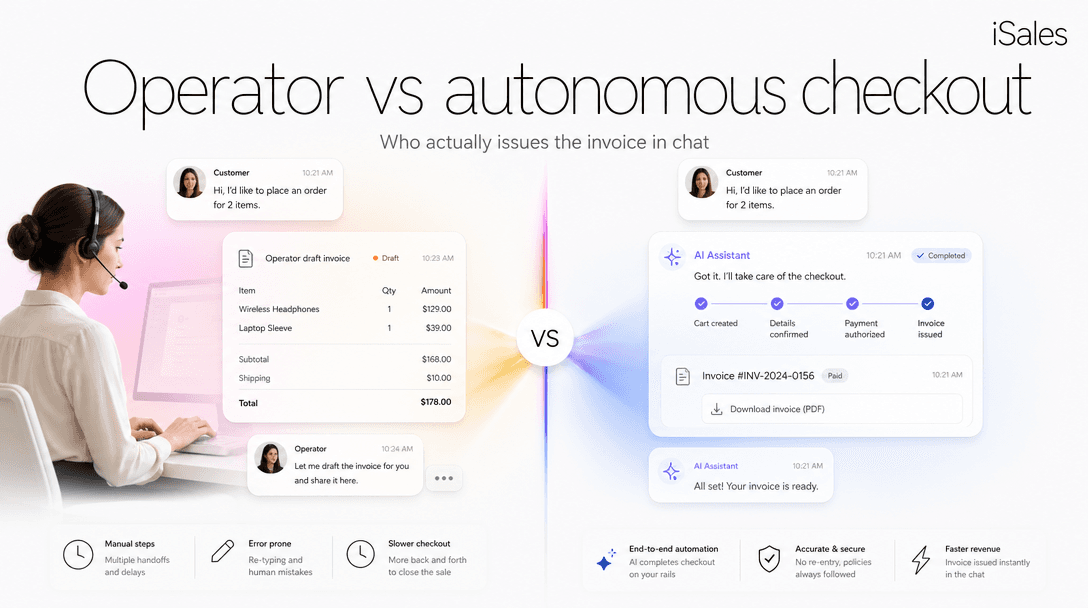
TL;DR: Plenty of chat tools say a customer can pay "right in the chat." Look at the mechanics and almost all of them mean one of three different things. A human operator composes the invoice and sends a pay link. Or the chat redirects the buyer to a store checkout. Or a buyer's shopping agent completes the order on a third-party surface like ChatGPT. Each is real; none is your AI issuing and completing the payment inside the conversation, unattended, on your own rails. That fourth shape, a seller-side autonomous checkout, is the one worth building toward. The axis that sorts all four is boring but decisive: who clicks "issue invoice."
For: ecommerce, SaaS, and service owners comparing chat tools that promise in-chat payment. What you'll get: the mechanics behind each "payment in chat" claim, a fair comparison, who should pick which, and a reusable Invoice-Issuer Test. Last updated: 2026-07-05.
The question a payment demo never answers
Watch any "takes payment in the chat" demo and it looks solved. A message comes in, a price appears, the customer pays, everyone smiles. The demo never shows you the one thing that decides whether it works at 2am: who composed that invoice. In most tools, a person did, just off-screen. In others, the "chat" quietly punted the buyer to a store checkout. In the shiniest 2026 version, the thing doing the buying wasn't the merchant's agent at all. It was the shopper's agent, on someone else's platform.
Those are not variations on one feature. They are four different machines wearing the same screenshot, and they fail in different places. Sort them by a single question, "does the merchant's own AI compose and complete the payment, or does a human, a store, or a third-party surface step in?", and the marketing collapses into something you can actually evaluate.
Shape 1 — Buyer-side agent (the agentic-commerce headline)
The loudest 2026 story is agentic commerce. OpenAI's Instant Checkout, built on the Agentic Commerce Protocol co-developed with Stripe, lets a shopper tap "Buy," confirm order and payment, and finish without leaving ChatGPT (OpenAI, Stripe, 2025). It genuinely completes payment in-conversation. So if your mental model is "AI checkout in chat is now solved," you're half right.
The half that matters: in ACP, ChatGPT acts as the customer's agent. It collects the buyer's details, the buyer confirms, and the merchant then accepts on its own systems (OpenAI Developers, 2026). This is a buyer-side agent shopping on a third-party surface. It has nothing to do with the chat on your website. It puts your catalog in front of ChatGPT's shoppers; it does not put a seller on your own highest-intent traffic. (The space is moving fast, so re-verify ACP's shape before you build on it.)
Shape 2 — Store-redirect (the payment leaves the chat)
Shopify-native assistants like Zipchat are excellent at conversation and objection-handling, and they sit directly on Shopify's cart and checkout APIs. But the "checkout" they drive is the store's checkout. The agent recommends and pushes the shopper toward Shopify's flow, where the payment actually completes (Zipchat, 2026). The conversation is a funnel into checkout, not the place checkout happens. For a large physical catalog that native cart depth is a real advantage. Hold that thought; it returns in the comparison below.
Shape 3 — Operator-issued and deflect-then-handoff
The most common shape is the oldest one: a human composes the invoice. Support-first AI agents (Intercom Fin at ~$0.99 per outcome, Gorgias at ~$1 per resolution, HubSpot's Breeze Customer Agent at ~$0.50 per resolved conversation, down from $1 as of Apr 2026; all research-dated 2026, ⚠️ verify current) are tuned to deflect a ticket and hand a genuine sale to a person or a CRM. When money needs to move, a live agent builds the request. Take the human offline and the 11pm buyer gets a captured email and a "we'll get back to you," not a paid order.
Shape 4 — Seller-side autonomous (the unfilled slot)
The slot none of the above fills is a narrow one. The merchant's own AI composes the invoice and completes the payment inside the conversation, on the merchant's own rails, without an operator building it and without leaving for a store. This is where iSales sits: a selling assistant that qualifies, recommends, handles the objection, then issues and completes payment on your connected payment providers (or sells digital content for Stars), and escalates hard cases to you rather than to a queue. The autonomy is seller-side. No human on your side has to compose the order. The buyer still taps "pay," because that part is human everywhere, ACP included, but nobody on your payroll has to be awake for it.
A fair comparison (it loses two rows)
Research-dated 2026; competitor capabilities and prices change, so treat this as a snapshot, not a guarantee.
| Capability | Operator-issued (Intercom/Gorgias/HubSpot) | Store-redirect (Zipchat/Shopify) | Buyer-side agent (ChatGPT/ACP) | Seller-side autonomous |
|---|---|---|---|---|
| Composes the invoice with no seller-side operator | ❌ human composes | n/a (store cart) | ✅ (buyer's agent) | ✅ |
| Payment completes inside this conversation | after a human | ❌ leaves to store | ✅ (on ChatGPT) | ✅ (on your rails) |
| Runs as your agent on your site | ✅ | ✅ | ❌ (buyer's, on ChatGPT) | ✅ |
| Reach into ChatGPT's shopper base | ❌ | partial (Shopify feed) | ✅ | ❌ |
| Deep physical-cart / checkout hooks | varies | ✅ native | ✅ | ⚠️ invoicing, not native cart |
| Pricing basis | per resolution / seat | per resolution / MAU | platform | usage / closed sales |
Two rows go the other way on purpose. ChatGPT reach belongs to ACP; a seller-side agent on your site does nothing to get you listed inside ChatGPT's shopping results. And deep physical-cart hooks belong to a Shopify-native tool, because for a big SKU catalog, sitting on the store's cart APIs beats a general invoicing agent. If either row is your growth bet, the honest answer points away from a site agent.
Who should pick which
- Digital content, services, consults, or anything decided in the conversation and sold on your own rails, across your site and Telegram or WhatsApp: a seller-side autonomous agent removes the operator bottleneck exactly where it hurts, after hours and at peak intent.
- A large physical catalog whose growth bet is appearing inside ChatGPT's shopping results: that's ACP / Instant Checkout plus a Shopify-native nudge. Don't buy a seller-side site agent for a job it doesn't do.
- You only want ticket deflection and never intend to sell in chat: a support deflector is cheaper and correct. Skip all of this.
The Invoice-Issuer Test (steal this)
Next time a vendor says "takes payment in the chat," don't argue capability. Classify it. Four questions, about a minute, and the shape falls out:
| # | Ask | If the answer is… | …it's |
|---|---|---|---|
| 1 | Who composes the order/invoice? | a human agent | operator-issued |
| 2 | Where does payment complete? | a store or hosted page you're redirected to | store-redirect |
| 3 | Whose agent is doing the buying? | the shopper's, on a third-party surface | buyer-side agent |
| 4 | At 2am with no operator online, does a real sale close? | it captures a ticket instead | not autonomous |
Only a tool where the merchant's own AI composes the invoice, completes payment in the conversation, on your rails, with no operator required, answers all four the hard way. Everything else captures a ticket for you to work tomorrow; only that one collects the money tonight.
FAQ
The buyer still clicks "pay," so how is this autonomous? It is, and it should be. A buyer authorizing their own purchase is normal, ACP included. "Autonomous" here means seller-side: no one on your team composes the invoice or has to be online. That's the gate an operator-issued tool can't remove.
How do chargebacks and disputes work on an autonomously issued invoice? Exactly as they do today. The charge lands on your connected processor (Stripe, Polar, or your PSP), so its dispute flow, refund tooling, and fraud controls (Radar-style rules) apply unchanged. The agent triggers the charge; your processor owns the money and the risk tooling.
Do I need Shopify or a store for this? No. Seller-side autonomous checkout invoices on your own rails for digital goods, services, and consults, the cases a Shopify cart wasn't built for. If your catalog is physical SKUs that live in Shopify, a store-redirect or ACP is the better fit (see the comparison above).
Is card data safe if an AI composes the invoice? The agent never touches raw card (PAN) data. Payment executes on your processor, which keeps the PCI scope and tokenization it already has; the agent only assembles the order and fires the request. Same rails a human operator would use, minus the human.
Where this fits
This is the deep-dive under our pillar on a website chat that sells and takes payment. Start there for the full loop, or read why a chat should sell, not deflect. If you want a seller-side agent on your own traffic, one that issues and completes payment in the conversation and keeps selling in the same voice across Telegram and WhatsApp, you can put an AI salesperson on your site. Usage-based, closed-sales pricing, free to try, no operator required.
Sources (research-dated 2026-07-05; capabilities and prices change, so verify current before relying on them): OpenAI — Instant Checkout & the Agentic Commerce Protocol; OpenAI Developers — Agentic Commerce key concepts; Stripe — powering Instant Checkout + ACP; Zipchat on the Shopify App Store; HubSpot Breeze pricing (CMSWire/SiliconANGLE, Apr 2026). Our pricing: usage / closed-sales, free to try.