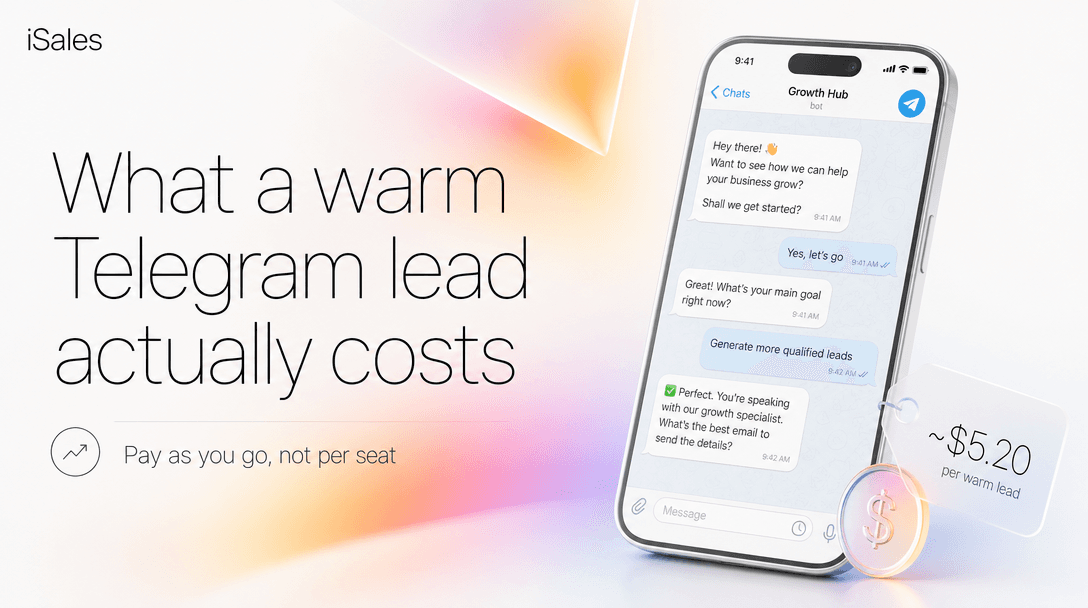
Short answer: there is no single "price of a lead," and a pay-as-you-go Telegram agent doesn't invent one. What it has is a marginal cost you can read to the cent: a goal budget you cap, a proxy you rent by use, and LLM spend drawn from a balance. No per-seat license, no annual contract, no "leads per hour" headline. The number worth watching is cost per warm conversation, and then cost per opportunity once you know your own close rate. Below is the arithmetic, what seat-priced AI SDRs actually bill after the included credits run out, and a fill-in table so you can price your own funnel instead of trusting somebody's blended average.
- Who this is for: founders and RevOps pricing Telegram outreach against seat-based AI SDR tools.
- What's inside: the CPL trap, real competitor prices (research-dated), the pay-as-you-go anatomy, and a calculator you can copy.
- The rule you'll leave with: a warm conversation is an earlier, cheaper unit than a booked lead. Don't put them side by side and call one a bargain.
- Updated: 2026-07-05.
Start with the unit, not the price
Cost per lead is simple to write down: total spend divided by leads. Spend $9,000, get 30 leads, your CPL is $300. The trap is hidden inside the word "lead."
A lead and an opportunity are different things. A lead is a contact who showed some interest: replied, clicked, filled a form. An opportunity is a qualified prospect already in the sales cycle, with a real need, a timeline, and some budget signal. Between them sits a filter, and plenty of leads never cross it. So "CPL $300" and "cost per opportunity $300" are two different numbers, and quoting one when you mean the other wrecks a budget. Ask what unit a price refers to before you compare anything.
Two more things distort CPL in public benchmarks. First, most numbers leave out people cost and data cost: the enrichment, the list, the hours behind a campaign. Fold those back in and CPL commonly rises 30–50% (research-dated, cross-vendor B2B benchmarks, 2026). Second, the "good" number is not universal. A marketing-qualified lead runs roughly $50–150 in most B2B sectors; a sales-qualified lead runs $200–500+; blended CPL lands around $200–700 depending on channel and cycle (research-dated ⚠️, directional, verify in your niche). The metric that actually matters is effective CPL: the cost of the lead that becomes an opportunity, not the cheap one that stalls at first reply.
What a seat-based AI SDR actually bills
Now the alternative you're pricing against. Most AI SDR tools charge for a seat, a data subscription, or a lead quota, and the sticker on the pricing page is rarely the bill that lands. Here is the current public picture:
| Tool | Model | Sticker (research-dated ⚠️, 2026) | What the sticker usually excludes |
|---|---|---|---|
| Apollo.io | Per seat + credits | $49–149 / user / mo | Credit overages, mobile-number reveals; real-world ~$150–400 / user / mo |
| Artisan (Ava 2.0) | Credit-based | $280–660 / mo | ~20 credits per prospect; enrichment eats the quota fast |
| 11x (Alice) | Per digital worker, annual | ~$3,750+ / mo, min ~$50–60K / yr | No public pricing; enterprise commit, not month-to-month |
| AiSDR | Flat, unlimited seats | from $900 / mo | Message volume caps; add-ons above the tier |
Two patterns fall out of that table. One, the effective cost tends to run 1.5–2× the sticker once you add the data, enrichment, and warmup the plan doesn't include (a repeated finding across 2026 pricing write-ups, not a measured figure of ours). Two, and this is the structural gap: every tool above works email and LinkedIn. None of them work Telegram groups. If your buyers actually live on Telegram, a $900/mo seat can't reach them at any price.
The pay-as-you-go anatomy of a Telegram agent
A managed Telegram agent is priced differently on purpose: no Basic/Pro packages, no seat. Its marginal cost is three readable lines.
- Goal budget. You set a ceiling per goal: $10, $20, or $50 (default $20). That caps what the agent may spend on LLM work while it pursues the task.
- Proxy per account. A dedicated mobile proxy, billed by use. The price is dynamic; the fallback rates are about $10/day, $30/week, $100/month per account.
- LLM from balance. Every action (classifying a group signal, scoring a lead, drafting a DM, planning the next step) debits the balance as it happens. Cents per action, no fixed pack. The exact figure is tokens × model price, not a flat "$X per message."
Add those three over a month, divide by warm conversations, and you get a cost per conversation visible to the cent. Here is the fill-in version. Copy it, drop in your own numbers; the example below is illustrative and its close rate is deliberately conservative.
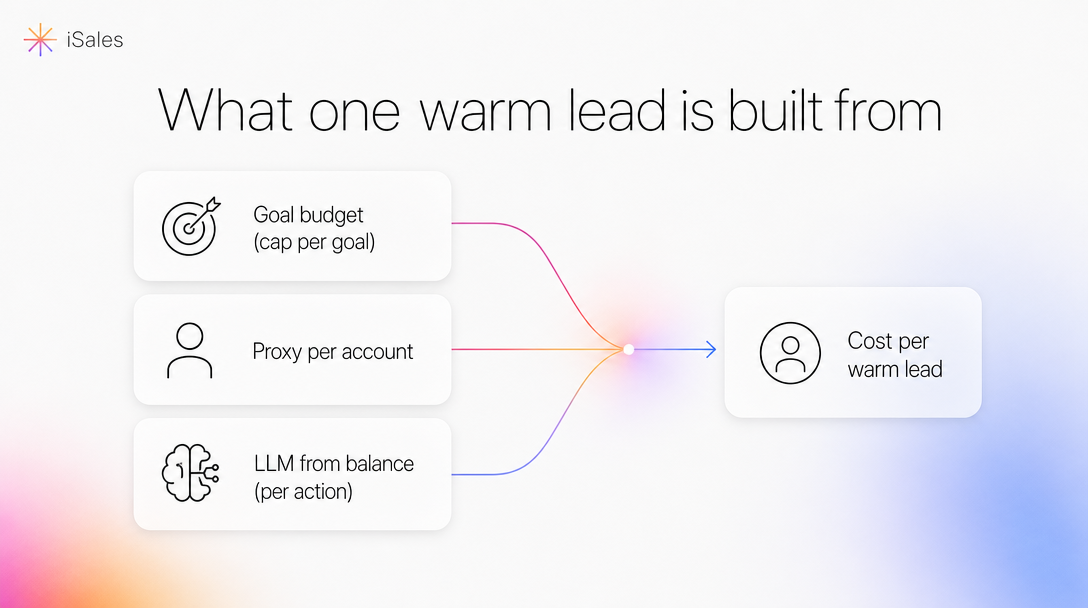 The three pay-as-you-go cost lines — goal budget, proxy per account, and LLM from balance — add up to a cost per warm conversation you can read to the cent.
| Line | Your number | Example (1 account / month) |
|---|---|---|
| Proxy per account | ___ | ~$100 |
| LLM from balance (across your goals) | ___ | ~$20–50 |
| Definite monthly cost | ___ | ~$120–150 |
| Warm conversations in the month | ___ | 60 |
| Cost per warm conversation | ___ | ~$2.00–2.50 |
Keep the certain and the uncertain in separate buckets, because mixing them is how cost math misleads. The block above is the certain cost: what you spend, divided by conversations that actually happened. Cost per opportunity is a separate, hypothetical line, because it depends on a close rate you don't control. If only 1 warm conversation in 5 becomes a qualified opportunity, ~$120–150 buys ~12 opportunities, so ~$10–13 each. At 1 in 3, closer to ~$6–8. Use the low conversion, not the flattering one, when you plan.
The comparison, and the row it loses
Put the two models next to each other and a fair table doesn't let the Telegram agent win everywhere:
| Criterion | Seat-based AI SDR | Pay-as-you-go Telegram agent |
|---|---|---|
| Channel reach | Email + LinkedIn, wide | Telegram groups only |
| Built-in contact database | Yes (large B2B directory) | No — it works live signals, you bring the niche |
| Cost predictability | Flat monthly, easy to forecast | Variable; depends on volume and proxy days |
| Cost at very low volume | Fixed seat, fine if barely used | Poor — fixed proxy dominates per-conversation cost |
| Cost at real volume | Rises with seats and credits | Proxy amortizes toward tens of cents per conversation at high volume |
| Ban-risk posture | Platform-native sending | Warmup + daily caps + per-contact AI: ban-safe by design, not a no-ban promise |
The agent gives up two real things. It ships no contact database, so it's useless without a niche where your buyers already gather. And its cost is less predictable than a flat seat, because a slow month still pays for the proxy. That fixed proxy is also the reason it loses at low volume: at ~$100/month, five conversations means ~$20 each before a single LLM token, dearer than buying a finished lead outright.
So don't buy this if you run a handful of conversations a month, or your market lives on email and LinkedIn rather than Telegram. At that volume a $49 Apollo seat, or plain cold email, is cheaper and a better fit. The agent only earns its proxy above roughly a few dozen warm conversations a month, in a channel your buyers actually use. Above that line the fixed cost spreads thin and the per-conversation number gets genuinely small; below it, stay where you are.
FAQ
How do I calculate cost per lead? Total spend for a period divided by leads from that period. Include people, tools, and data cost, not just ad spend, or you'll understate it by a third or more. And fix what "lead" means before you divide.
Is a Telegram agent cheaper than Apollo or 11x? Wrong question, because they sell different units. A seat tool books leads across email and LinkedIn; the agent produces warm conversations on Telegram, an earlier funnel stage. Compute your own cost per opportunity for each before you compare, and only then in a channel you'd actually use.
What's a good cost per lead for B2B? It depends on deal size and cycle. A $500 SQL that closes at 20% can be excellent for a high-ticket service and ruinous for a cheap product. Judge it against unit economics, not an absolute number.
What happens to the price at low volume? The proxy is a fixed cost, so few conversations means a high cost per conversation. Below a few dozen a month, buying leads is usually cheaper than running an agent.
Are there seat fees or an annual contract? No. You cap a goal budget, rent a proxy by use, and spend LLM from a balance. Nothing is billed per seat, and there's no yearly lock.
Next step
If you'd rather see the cost per conversation on your own funnel than on an average, set a goal budget of $10, $20, or $50 and run the agent on your niche; the first 30 messages are free. Open @personal_business_bot. For how the agent gets from a group signal to a booked opportunity, see the warm Telegram lead-gen walkthrough; for what actually moves ban risk, read the ban-safe outreach breakdown.
Sources & updated
- AI SDR pricing (Apollo $49–149/user/mo + overages; Artisan Ava $280–660/mo; 11x/Alice ~$3,750+/mo, ~$50–60K/yr min; AiSDR from $900/mo) — vendor pricing pages and 2026 third-party pricing reviews, accessed 2026-07-05, ⚠️ research-dated, verify on live pages (they drift).
- B2B CPL benchmarks (MQL ~$50–150, SQL ~$200–500+, blended ~$200–700; omitted labor/data understates CPL 30–50%) — 2026 cross-vendor benchmark write-ups, accessed 2026-07-05, ⚠️ directional, verify in your niche.
- "Sticker to real cost ≈ 1.5–2×" — recurring observation across 2026 AI SDR pricing analyses, not a measured figure of ours.
- Telegram agent marginal cost (goal budget $10/$20/$50 default $20; proxy dynamic, fallback ≈$10/day·$30/week·$100/month per account; LLM from balance, tokens × model) — from the product; per-conversation and per-opportunity totals are examples, not measured results.
- Updated: 2026-07-05.