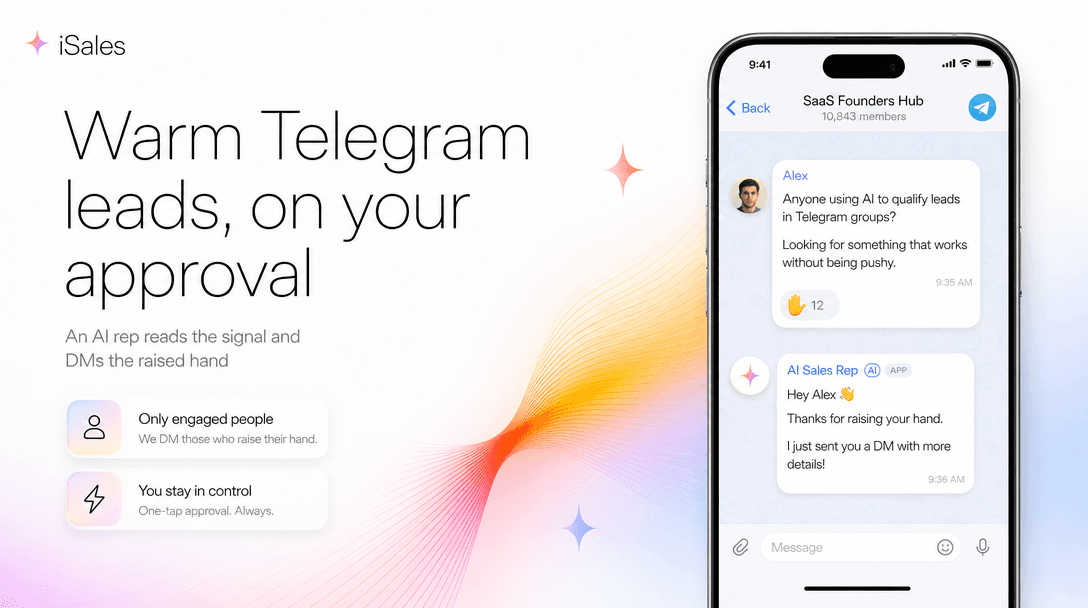
Short answer: the reliable way to get leads out of Telegram groups is to reverse the usual order. Instead of scraping a member list and messaging everyone, you wait for someone to show intent (a question, a complaint about their current vendor, a "who does X?"), then warm the account like a human and reach out only to the person who raised their hand. An AI sales rep can run that loop for you: it watches themed groups for demand signals, warms up over about a week inside normal daily limits, drafts a short first message tied to what the person actually said, and (until you trust it) waits for your one-tap approval before sending. When they reply, it hands you the live conversation and stops. This guide walks the whole funnel, gives you a decision map you can screenshot, and is clear-eyed about where this approach is the wrong one.
- Who it's for: B2B, agencies, and independent operators whose buyers discuss their problem in Telegram groups.
- What's inside: why scrape-and-blast fails, what a demand signal is, the full signal-to-lead funnel, a warm-vs-cold decision map, real costs, and a "don't use this" section.
- Updated: 2026-07-05.
Why "scrape and blast" is the wrong default
The old playbook was one step: pull the member list of a niche group, message all of them the same offer. It breaks in two places at once, and neither is fixable with a bigger proxy.
The first is bans. Telegram flags accounts that go from zero to a wall of identical cold DMs — that behavior pattern is the signal it bans for. Industry write-ups on Telegram outreach converge on the same guardrails (stay under ~40–50 new DMs a day when starting, warm the account over 10–14 days), which is a polite way of saying the naive version gets your account killed. The mechanics are worth their own read; we break them down in why scrape-and-blast outreach gets accounts banned.
The second is temperature. A person who never showed interest reads even a well-crafted cold message as spam. Third-party outreach analyses report warm, group-sourced contacts replying several times more often than cold-list DMs and getting reported far less (directional numbers, not ours). Relevance beats volume, and relevance comes from when and why you reached out.
A warm-signal agent changes the order of operations, not the messaging tool. Find the person who already showed intent, then warm up, then write.
The warm-vs-cold decision map
Before the mechanics, here's the whole decision on one screen. Two questions decide almost everything: how you pick who to contact, and what you're optimizing for.
| Optimize for warm & relevant | Optimize for raw volume & reach | |
|---|---|---|
| Contact on a signal (they raised a hand) | ✅ Warm-signal agent (this guide): join groups → read intent → warm 7 days → DM on approval. Built for a higher reply rate and lower report rate than list blasting. Slowest to scale. | Rare and awkward — genuine buying signals are naturally scarce, so you can't crank "reach" on them. If you're here, you're really doing the row below. |
| Contact from a list (scraped or bought) | A human SDR hand-personalizing a cold list. It works, but it doesn't scale your time, and it's still a cold open. | ❌ Scrape-and-blast. Fastest raw reach for a day or two — then rising report rates, flagged accounts, and a burned number. |
The trade-off is not hidden: the warm-signal quadrant wins on reply quality and account longevity, and it loses on speed and raw reach. If your only goal is to touch the largest number of usernames this week and you don't care what happens to the account, the bottom-right cell is genuinely faster in the short term. Everything below assumes you'd rather have ten warm conversations than a thousand cold sends and a dead account.
What a "demand signal" actually is
A demand signal is a message in a group where someone reveals intent or a problem you solve. The agent reads the meaning of the message through a language model, so "can anyone recommend someone who does X?" and "we're fed up with our current X provider" register as the same signal, even though neither contains the word "looking." Keywords are secondary; recognized intent is the point.
That distinction is useful even if you never touch an agent, so here's the classifier you can apply by hand:
| Demand signal | Noise |
|---|---|
| Direct ask: "looking for a contractor for…", "who can help with…" | General chatter, memes, off-topic |
| Pain with the current solution: "our X keeps breaking", "tired of…" | Idle curiosity with no intent to act |
| "How do I choose / what does it cost" about your topic | Already bought, sharing a result |
| A stated plan: "this quarter we're rolling out…" | Debating the topic in the abstract, no personal need |
The agent tracks these across the groups it watches (there's a cap on how many it monitors), filters them, and stores each qualifying one as a reason to make contact. That's a fundamentally different entry point from "take every member": a message only goes to someone who already raised their hand.
The whole funnel: signal to warm lead
Here's the path a signal takes. To keep it concrete, picture a small studio that does B2B bookkeeping and looks for clients in founder chats. The niche and numbers are illustrative; yours will differ.
- Signal. In a founders' group, someone posts "who handles bookkeeping for a services business?" The agent recognizes the intent — not the keyword.
- Warm-up. For the first ~7 days the connected account behaves like a real person (a 10-step warm-up), well under daily limits, instead of DMing on day one.
- Scoring. The agent scores the author against your criteria — say, a solid fit to your ideal client, a genuine signal rather than idle chatter, and an open DM — and only files a lead if it clears your threshold.
- DM on approval. It drafts a short message tied to the signal and, at the supervised autonomy level, drops it into a queue for your one-tap approve, edit, or skip.
- Hand-off. The person replies; the agent passes you the whole conversation inside your bot and writes nothing further. You take the warm thread and close.
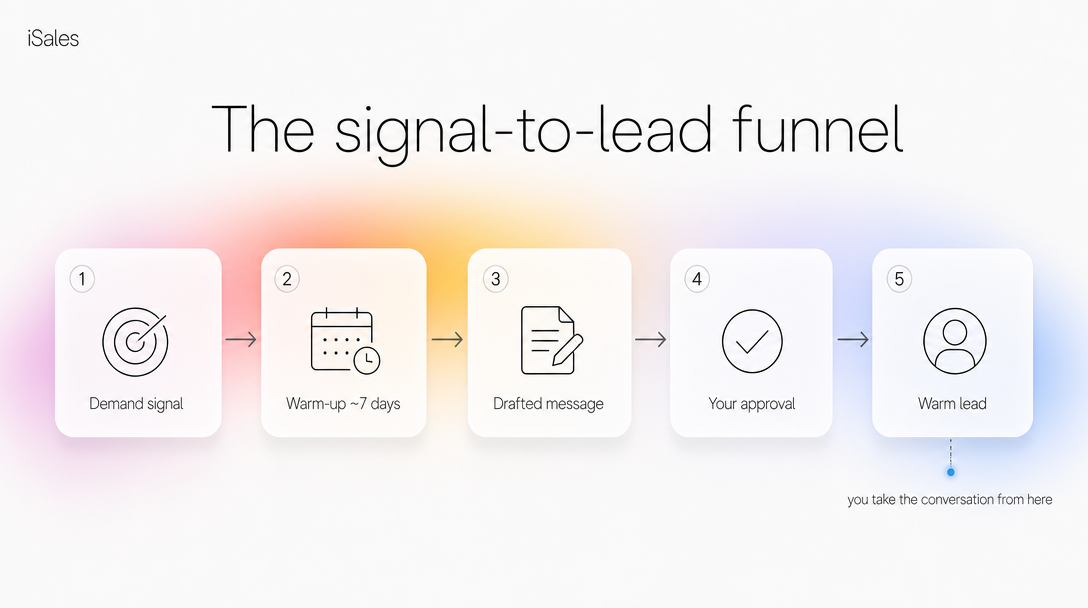 The signal-to-lead funnel: a group signal moves through warm-up, scoring, and an approved DM to a warm lead handed off to you.
The message in step 4 isn't "Hello, we offer services in…". It's a short reference to what the person said: "Saw you asked who handles bookkeeping for a services business — that's exactly our focus, happy to show how we'd approach yours. Useful?" Short (the agent has a hard length cap), specific, anchored to something the person wrote themselves. That anchoring is the whole difference between a warm first touch and a blast. And step 5 is the one people miss: the agent doesn't try to "close" anyone. It gets to a warm reply, hands you the full history, and stops. It sets the table; you make the sale.
Governed, not a black box
This is where the approach separates from its two neighbors. A scripted chatbot follows a decision tree and breaks on the first off-script question. A full-autopilot blaster acts on its own and brings you bans and complaints. A governed agent sits between them: autonomous on the routine, but its autonomy is a dial, not a switch.
There are three levels: one-prompt, supervised, and expert. At the supervised level, every outbound move passes through an approvals queue, so you see who it wants to contact and exactly what it plans to send, and you approve or edit. You raise the dial only as trust builds; you don't turn it all the way up on day one. The deeper version of this, including why "approve everything forever" is its own failure mode, is in managed autonomy: your AI rep on probation.
One real limitation: scoring and message drafting will get an edge case wrong now and then. The first days are exactly when you keep the dial low and skim the queue, rather than granting full autonomy and hoping.
For context on where this is running today: as of July 2026 that's 35 real agent launches on our side. Our data, not an industry benchmark, and not a conversion promise — which is why this guide sells you the mechanism and the controls, not a "leads per session" number.
Where this sits against the tools you know
If you already run outbound, you've priced the Western SDR stack. It's centered on email and LinkedIn, and those tools don't reach Telegram-group signals:
| Tool | Primary channel | Price (research-dated 2026-07-05) |
|---|---|---|
| Apollo | Email + LinkedIn data | ~$49–119 per seat/mo; ~$150–400 with credits & overages |
| 11x (Alice) | Email + LinkedIn | ~$36–60K/yr, annual contract |
| Artisan (Ava) | ~$280–660/mo | |
| AiSDR | Email + LinkedIn | from ~$900/mo |
These are sticker rates that tend to run higher in practice. The comparison isn't about who's cheaper. Telegram groups are a channel these tools skip, and a buying signal inside one is a warmer input than a scraped email list. Public reviews over the past year have also criticized the autonomous-SDR category for hallucinated prospect details and flagged accounts (third-party reviews, not the vendors) — which is why approvals sit inside this workflow rather than bolted on.
What it actually costs
Pricing here is pay-as-you-go, not a seat you rent. You set a goal budget ($10 / $20 / $50 presets, $20 by default), pay for the per-account proxy as used (a fallback of about $10/day when the live rate isn't available), and the agent's LLM work (reading signals, scoring, drafting) draws from your balance as it runs. New accounts start with 30 free messages.
Keep two buckets separate when you estimate. The certain cost is the proxy plus LLM spend for a month of running — a figure you can bound. What you should not do is multiply a hopeful close rate into a single dramatic total; that's a projection, not a cost. The clean way to think about it is cost-per-warm-lead = what you spent ÷ the qualified leads that reached your approvals queue. We break the full math down, with real seat-tool comparisons, in what a warm Telegram lead actually costs. Plug in your own numbers there — the total is yours, not ours.
When this is the wrong tool
A signal-based group agent is not universal. Skip it, genuinely, if any of these is you:
- Leads already come inbound (referrals, your site, existing demand). Group outreach is an extra layer you don't need yet; work the pipeline you have first.
- Your niche is impulse B2C (food delivery, small purchases). There are no week-long "demand signals" in chats worth warming for.
- You need volume this week. Warm-up and approvals make the agent deliberately slow at the start. That patience is the price of a living account and a warm lead; if you can't pay it right now, this isn't your tool yet.
Here's the one-line rule. Run a warm Telegram agent if your buyers discuss their problem in themed groups (B2B or a considered purchase), a warm first touch is worth more to you than raw reach, and you can spare a few minutes a day to clear a queue in week one. If two of those three are false, stay manual — copy-pasting a few personalized DMs a week is fine until the volume hurts.
FAQ
How is an AI agent different from a chatbot? A chatbot reacts, on a script, to people who came to it. An agent goes out, finds a reason to make contact (a signal in a group), holds an open conversation, and hands a warm lead to a human. Different jobs: the bot answers; the agent finds and warms.
Can AI actually qualify leads? Within criteria you set. It scores the author of a signal — fit to your ideal client, whether their DMs are reachable — and drops the ones that don't clear your threshold. It's transparent scoring you configure, not a magic BANT verdict.
Is contacting people this way spam or non-compliant? Contact goes to someone who posted a demand signal, not to a bought cold list, and a human approves each move at the supervised level. The accounts are yours and you accept the platform risk knowingly. Any lead screenshots we publish are anonymized. It's a different risk profile from mass cold DMs — lower, not zero.
Will it replace a salesperson? No, and it doesn't try. It removes the grind of finding prospects and making a warm first touch; a human closes. On a reply, the lead is handed to you with the full history.
Does it run 24/7? It watches for signals continuously but acts inside human limits (warm-up, a daily message cap). It keeps watching around the clock; it just doesn't blast around the clock — it writes like a person, within limits.
The cluster, and your next step
This is the hub. The deeper pieces:
- Why scrape-and-blast gets accounts banned — the ban mechanics and what reduces the risk.
- Managed autonomy: an AI rep on probation — the autonomy dial and the approvals queue in depth.
- What a warm Telegram lead actually costs — the full pay-as-you-go breakdown against seat-tool prices.
Want to see what signals the agent would catch in your niche? You can set a goal and watch a demo on the first 30 messages free. Launch the Telegram agent, pay-as-you-go, via @personal_business_bot.
Sources & updates
- Funnel mechanism (signal detection, 10-step warm-up, scoring, approval-gated DM, hand-off, autonomy levels 1/2/3): from the product — signal pipeline, ≤40 warm DMs/day, up to 200 monitored groups, approvals queue.
- Pricing: pay-as-you-go — goal budget $10/$20/$50 (default $20), per-account proxy (~$10/day fallback), LLM from balance; 30 free messages to start. Competitor prices (Apollo, 11x, Artisan, AiSDR) research-dated 2026-07-05, sticker rates.
- Directional third-party figures (warm/group vs cold reply and report rates; ~40–50 DM/day and 10–14-day warm-up guardrails) from published Telegram-outreach analyses, not our measurements.
- Our data: 35 real agent launches (our receipt, not a benchmark), as of 2026-07-05.
- Updated: 2026-07-05.