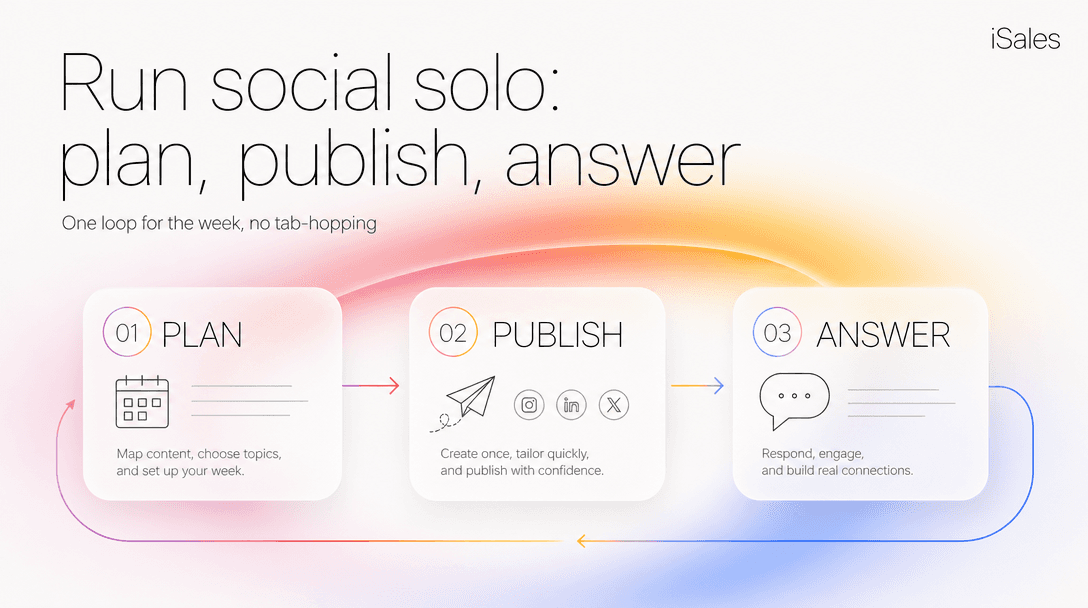
TL;DR: Running social solo doesn't fail at the posting step. Schedulers batch a week of posts in one sitting and reply to comments now (Buffer, Metricool and Later all ship an inbox). It fails at the seam: nearly every workflow guide bolts "engage" on as a separate fourth phase in a separate tool, disconnected from the post that earned the reply. This guide gives you a copyable one-evening setup and a light weekly cadence that keeps planning, auto-publishing and answering in one loop, plus a straight read on when a standalone scheduler is still the better buy.
- Who this is for: a solo expert, creator or one-person SMM running 2–4 platforms without a team.
- What you'll get: a one-evening setup checklist, a weekly cadence table you can copy, and real 2026 tool prices.
- Last updated: 2026-07-05. Competitor prices are mid-2026 list values; re-check before you buy.
The real bottleneck isn't posting. It's Wednesday.
Say you run social for your own studio. Sunday night you batch a week of posts, and Monday they auto-publish on schedule. By Wednesday a warm comment is sitting under Monday's post ("do you have a slot this weekend?"), and you see it Thursday, because the reply landed in a different app than the one you scheduled from and you weren't in that tab. The post did its job. The workflow dropped the catch.
That gap has a cost you can feel. For many solo operators social eats 6+ hours a week (that's 43% of small-business owners, per Glow/VerticalResponse 2026 — directional, not a hard benchmark), and a lot of that time goes to context-switching between tools rather than making anything.
The five-phase workflow every guide gives you, and the seam it leaves
Open any 2026 workflow guide (Metricool, Loomly, Buffer) and you get the same spine:
Plan → Create (batch) → Schedule → Engage → Analyze
Four of those five are genuinely solved for a solo operator. Batching is real: sit down once, write a week. Auto-scheduling is a commodity. Per-platform analytics in one window exists on the free tiers.
The seam is phase four. "Engage" gets described as a separate block you do later ("20 minutes morning, 20 minutes evening") inside a separate inbox that didn't make the post and doesn't know which post the reply belongs to. So a warm comment becomes a fresh chore instead of the loop closing. That single handoff is what the templates skip, and it's the part that actually eats a solo week.
The one-evening setup (do this once)
The whole idea is to spend one focused evening wiring the loop, then run a light daily rhythm off it. A checklist you can copy:
- List your 2–4 real platforms (the ones your buyers actually use, not all of them).
- Connect them once via OAuth so publishing is a single action, not one login per network.
- Draft the week from a small set of rubrics (say: one teaching post, one proof/result, one offer, two light/behind-the-scenes) so you're filling slots, not inventing from a blank page.
- Batch the week's posts in one sitting (captions plus visuals) and queue them.
- Set one daily reply window of 15 minutes where you answer from the same place the posts live, so a comment shows you which post earned it.
- Pick the one metric you'll actually act on (usually saves, replies or profile taps, not raw likes).
That's the setup. Everything below is maintenance.
The weekly cadence you can copy
Paste this into your notes. It's built for 2–4 platforms at ~3–5 posts/week, the realistic solo volume rather than a daily-posting treadmill that burns you out by March.
| Day | ~Time | What you do | Runs on its own |
|---|---|---|---|
| Sunday eve | 60–90 min | Plan and batch next week's posts from your rubrics; queue them | — |
| Mon–Fri | auto | Posts publish on schedule across every connected platform | ✅ |
| Daily | 15 min | One reply window: answer comments and DMs where the posts live, with the post's context attached | — |
| Friday | 15 min | Check what landed (per platform); keep the format that worked, drop what didn't | — |
Two rules make it hold: batch once, don't drip, and answer where you posted, so replying never means opening a fourth app.
What changes when it's actually one loop
Here is what the cadence quietly buys you. When the same tool plans, publishes and holds the replies, a comment arrives with its context attached: which post, which caption, which offer pulled it. So answering picks up a conversation the post already started, instead of guessing at a name you don't recognise. One thread runs from the post to the reply, in one place, and that continuity is why collapsing the phases beats bolting on a separate inbox. (For the deeper "who owns the comment after you post" argument, and where schedulers' own inboxes fit, see the scheduler-vs-reply breakdown.)
On money it nets out to one balance instead of three logins and three bills. iSales runs the publishing loop as a $20/mo add-on with no per-post fee, next to the tool that drafted the posts and the assistant that answers them; the full picture lives in the publish-everywhere guide.
When a standalone scheduler is the better call
This loop is not the right buy for everyone. Where it loses:
- You're deep on one platform and want depth. If you live on Instagram and need best-time-to-post, link-in-bio and a polished content calendar, a specialist (Metricool from ~$18/mo, Buffer from ~$6/channel) goes deeper on the calendar than this does. The loop trades calendar depth for one-thread continuity; name your priority.
- You post rarely and you're always on your phone. If you publish once a week and catch comments live, Buffer's free plan (3 channels) already covers you. Don't pay for a loop you're closing by hand anyway.
- You need team workflows. Approval chains, multi-seat inboxes, collision detection: Agorapulse and NapoleonCat are built for that, and a one-person loop isn't trying to be.
A rough threshold: the loop earns its place once you run two or more platforms and the replies are meant to turn into customers, not just lift an engagement rate. Below that, a good scheduler (or nothing) wins.
FAQ
How many posts a week does a solo operator actually need? Around 3–5 quality posts across 2–4 platforms beats daily posting you can't sustain. Consistency you can hold for a year outperforms a two-week sprint.
Does auto-publishing hurt reach versus posting manually? There's no widely reported native-API penalty in 2026 for standard scheduled posts, and the platforms don't advertise one. Reach tracks the content and your replies far more than the publish method. The thing that reliably lifts engagement is answering fast, which is the loop's whole point.
Can I keep my current scheduler and add only the reply loop? Yes. Plenty of solo operators keep a favorite calendar and move only the "answer where you posted" step. The loop is worth more the more phases live inside it, but it isn't all-or-nothing.
What if the assistant answers a comment wrong? It will occasionally get an edge case confidently wrong. Skim its first few days and correct the voice; treat early replies as drafts you glance at, not fire-and-forget.
Start the loop
Pick your 2–4 platforms, connect them once, and let the week run. Connect your socials → One evening of setup, then a week that answers for itself.
Sources
- Buffer Community inbox (free on all plans, launched Nov 2025) — buffer.com/community, accessed 2026-07-05.
- Metricool 2026 social-media workflow template and Inbox — metricool.com/social-media-workflow, metricool.com/social-media-inbox, accessed 2026-07-05.
- Tool pricing (list, mid-2026, ✅ re-verified 2026-07-05): Buffer Essentials $5/channel annual ($6 monthly), free plan = 3 channels; Metricool Starter ~$18/mo annual; Later from ~$25/mo; Hootsuite Standard $99/mo annual.
- Time-on-social (directional, single-source ⚠️): Glow/Picmim 2026 analysis; VerticalResponse SMB survey — accessed 2026-07-05.
- iSales publishing add-on $20/mo ($200/yr), publications not metered — product pricing, accessed 2026-07-05.